
UNITED STATES
SECURITIES AND EXCHANGE COMMISSION
WASHINGTON, D.C. 20549
FORM 10-K
(Mark One)
| ANNUAL REPORT PURSUANT TO SECTION 13 OR 15(d) OF THE SECURITIES EXCHANGE ACT OF 1934 | |||||
For the fiscal year ended December 31 , 2025
or
| TRANSITION REPORT PURSUANT TO SECTION 13 OR 15(d) OF THE SECURITIES EXCHANGE ACT OF 1934 | |||||
For the transition period from ___________________ to ___________________
Commission File Number: 001-39100
(Exact name of registrant as specified in its charter)
(State or other jurisdiction of incorporation or organization) | (I.R.S. Employer Identification No.) | ||||
| (Address of principal executive offices) | (Zip Code) | ||||
(212 ) 888-3124
(Registrant’s telephone number, including area code)
Securities registered pursuant to Section 12(b) of the Act:
| Title of each class | Trading Symbol(s) | Name of each exchange on which registered | ||||||
Common Stock, $0.0001 par value per share | ||||||||
Securities registered pursuant to Section 12(g) of the Act: None
Indicate by check mark if the registrant is a well-known seasoned issuer, as defined in Rule 405 of the Securities Act. Yes ☒ No ☐
Indicate by check mark if the registrant is not required to file reports pursuant to Section 13 or Section 15(d) of the Act. Yes ☐ No ☒
Indicate by check mark whether the registrant: (1) has filed all reports required to be filed by Section 13 or 15(d) of the Securities Exchange Act of 1934 during the preceding 12 months (or for such shorter period that the registrant was required to file such reports), and (2) has been subject to such filing requirements for the past 90 days. Yes ☒ No ☐
Indicate by check mark whether the registrant has submitted electronically every Interactive Data File required to be submitted pursuant to Rule 405 of Regulation S-T (§ 232.405 of this chapter) during the preceding 12 months (or for such shorter period that the registrant was required to submit such files). Yes ☒ No ☐
Indicate by check mark whether the registrant is a large accelerated filer, an accelerated filer, a non-accelerated filer, a smaller reporting company, or an emerging growth company. See the definitions of “large accelerated filer,” “accelerated filer,” “smaller reporting company,” and “emerging growth company” in Rule 12b-2 of the Exchange Act.
| ☒ | Accelerated filer | ☐ | ||||||||||||||||||
| Non-accelerated filer | ☐ | Smaller reporting company | ||||||||||||||||||
| Emerging growth company | ||||||||||||||||||||
If an emerging growth company, indicate by check mark if the registrant has elected not to use the extended transition period for complying with any new or revised financial accounting standards provided pursuant to Section 13(a) of the Exchange Act. ☐
Indicate by check mark whether the registrant has filed a report on and attestation to its management’s assessment of the effectiveness of its internal control over financial reporting under Section 404(b) of the Sarbanes-Oxley Act (15 U.S.C. 7262(b)) by the registered public accounting firm that prepared or issued its audit report. Yes ☒ No ☐
If securities are registered pursuant to Section 12(b) of the Act, indicate by check mark whether the financial statements of the registrant included in the filing reflect the correction of an error to previously issued financial statements. ☐
Indicate by check mark whether any of those error corrections are restatements that required a recovery analysis of incentive-based compensation received by any of the registrant’s executive officers during the relevant recovery period pursuant to §240.10D-1(b). ☐
Indicate by check mark whether the registrant is a shell company (as defined in Rule 12b-2 of the Act). Yes ☐ No ☒
The aggregate market value of the voting and non-voting common equity held by non-affiliates of the registrant, based on the closing price of the registrant’s shares of common stock as reported by The Nasdaq Global Select Market on June 30, 2025 (the last business day of the registrant’s second fiscal quarter), was approximately $1.9 billion.
As of January 31, 2026, the registrant had 81,902,232 shares of common stock, $0.0001 par value per share, outstanding.
DOCUMENTS INCORPORATED BY REFERENCE
Portions of the registrant’s Definitive Proxy Statement relating to its 2026 Annual Meeting of Stockholders to be filed within 120 days after the end of the fiscal year ended December 31, 2025 are incorporated by reference into Part III of this Annual Report on Form 10-K.
PROGYNY, INC.
TABLE OF CONTENTS
2
CAUTIONARY NOTE REGARDING FORWARD-LOOKING STATEMENTS
This Annual Report on Form 10-K contains forward-looking statements within the meaning of the Private Securities Litigation Reform Act of 1995. We intend such forward-looking statements to be covered by the safe harbor provisions for forward-looking statements contained in Section 27A of the Securities Act of 1933, as amended, or the Securities Act, and Section 21E of the Securities Exchange Act of 1934, as amended, or the Exchange Act. All statements other than statements of historical fact contained in this Annual Report on Form 10-K are forward-looking statements, including, without limitation, statements regarding our future results of operations and financial position; our ability to acquire or invest in complementary businesses, products, and technologies; our ability to achieve profitability on an annual basis and sustain such profitability; the sufficiency of our cash and cash equivalents and anticipated sources and uses of cash; our business strategies, plans, objectives and goals; our ability to acquire new clients and successfully engage new and existing clients; our ability to effectively manage our growth; our ability to compete effectively with existing competitors and new market entrants; the impact of recently adopted accounting pronouncements; our ability to attract and retain qualified employees and key personnel; the plans and objectives of management for future operations and capital expenditures; general economic and market trends; the impact of public health emergencies on our business, operations, and the markets and communities in which we and our clients, members and providers operate; and the potential impact of evolving laws and regulations, including any laws and regulations restricting reproductive rights. These statements are neither promises nor guarantees, but involve known and unknown risks, uncertainties and other important factors that may cause our actual results, performance or achievements to be materially different from any future results, performance or achievements expressed or implied by the forward-looking statements.
In some cases, you can identify forward-looking statements by terms such as “may,” “will,” “should,” “expect,” “plan,” “anticipate,” “could,” “intend,” “target,” “project,” “contemplate,” “believe,” “estimate,” “predict,” “potential,” “seek,” “assume,” “future,” “continue” or “aim” or the negative of these terms or other similar expressions. The forward-looking statements in this Annual Report on Form 10-K are only predictions. We have based these forward-looking statements largely on our current expectations and projections about future events and financial trends that we believe may affect our business, financial condition and results of operations. These forward-looking statements speak only as of the date of this Annual Report on Form 10-K and are subject to a number of important factors that could cause actual results to differ materially from those in the forward-looking statements, including the factors described under Part I, Item 1A. “Risk Factors” and Part II, Item 7. “Management’s Discussion and Analysis of Financial Condition and Results of Operations” of this Annual Report on Form 10-K.
In addition, statements such as “we believe” and similar statements reflect our beliefs and opinions on the relevant subject. These statements are based upon information available to us as of the filing date of this Annual Report on Form 10-K, and while we believe such information forms a reasonable basis for such statements, such information may be limited or incomplete, and our statements should not be read to indicate that we have conducted an exhaustive inquiry into, or review of, all potentially available relevant information. These statements are inherently uncertain, and investors are cautioned not to unduly rely upon these statements.
You should read this Annual Report on Form 10-K and the documents that we reference in this Annual Report on Form 10-K completely and with the understanding that our actual future results may be materially different from what we expect. We qualify all of our forward-looking statements by these cautionary statements. Except as required by applicable law, we do not plan to publicly update or revise any forward-looking statements contained herein, whether as a result of any new information, future events, changed circumstances or otherwise.
3
SUMMARY OF RISKS AFFECTING OUR BUSINESS
Below is a summary of the principal factors that make an investment in our common stock speculative or risky. This summary does not address all of the risks and uncertainties that we face. Additional discussion of the risks summarized in this risk factor summary, and other risks and uncertainties that we face, can be found under the heading “Risk Factors” in Part I, Item 1A. of this Annual Report on Form 10-K and should be carefully considered, together with other information in this Annual Report on Form 10-K and our other filings with the U.S. Securities and Exchange Commission, or the SEC, before making an investment decision regarding our common stock.
•We may fail to meet our publicly announced guidance or other expectations about our business and future results of operations, which would cause our stock price to decline.
•The market in which we operate is highly competitive, and, if we do not continue to compete effectively, our business, financial condition and results of operations could be harmed.
•Unfavorable conditions in the global economy or our industry could limit our ability to grow our business and negatively affect our results of operations.
•Our business depends on our ability to retain our existing clients and increase the adoption of our services within our client base. Any failure to do so would harm our business, financial condition and results of operations.
•Our largest clients account for a significant portion of our revenue, and a significant number of our clients are in the technology industry. The loss of one or more of these clients, changes to pricing terms with these clients or changes within the technology industry could negatively impact our business, financial condition and results of operations.
•If we are unable to attract new clients, our business, financial condition and results of operations would be adversely affected.
•A significant change in the utilization of our solutions, including the consumption rate or the mix of utilization, could have an adverse effect on our business, financial condition and results of operations.
•We operate in a highly regulated industry and must comply with a significant number of new and evolving legal and regulatory requirements, as well as complex judicial mandates, which could have an adverse impact on our business.
•Acquisitions, strategic investments, or partnerships could be difficult to identify, pose integration challenges, divert the attention of management, disrupt our business, dilute stockholder value, and adversely affect our business, financial condition and results of operations.
•We have a limited operating history with our current platform of solutions, which makes it difficult to predict our future results of operations.
•The health benefits industry may be subject to negative publicity, which could adversely affect our business, financial condition and results of operations.
•If our information technology systems, or those of the third parties with whom we do business, including our provider clinics, specialty pharmacies or other vendors, lag, fail or suffer cybersecurity breaches, we may experience a material disruption of our services or suffer a loss or inappropriate disclosure of confidential information, which could materially impact our business and results of operations.
•Our use of artificial intelligence may subject us to new or heightened legal, regulatory, ethical, operational or other challenges.
•Our business depends on our ability to maintain our Center of Excellence network of high-quality fertility specialists and other healthcare providers. If we are unable to do so, our future growth would be limited and our business, financial condition and results of operations would be harmed.
•Our growth depends in part on the success of our strategic relationships with, and monitoring of, third parties, including channel partners and vendors as well as insurance carriers.
4
•If we fail to maintain an efficient pharmacy distribution network or if there is a disruption to our network of specialty pharmacies or their supply chains or business economics, our business, financial condition and results of operations could suffer.
•We are part of the broader healthcare industry and subject to increasing scrutiny, business requirements and regulation within our business, including with respect to Progyny Rx’s PBM operations, which may adversely affect our business, financial condition and results of operations.
GENERAL
Unless the context otherwise indicates, references in this Annual Report on Form 10-K to the terms “Progyny,” “the Company,” “we,” “our” and “us” refer to Progyny, Inc. and its wholly owned subsidiaries.
“Progyny®” and our other registered and common law trade names, trademarks and service marks are the property of Progyny, Inc. Other trade names, trademarks and service marks used in this Annual Report on Form 10-K are the property of their respective owners. Solely for convenience, the trademarks and trade names in this Annual Report on Form 10-K may be referred to without the ® and ™ symbols, but such references should not be construed as any indicator that their respective owners will not assert their rights thereto.
MARKET, INDUSTRY AND OTHER DATA
This Annual Report on Form 10-K contains statistical data, estimates and forecasts that are based on independent industry publications and other publicly available information, as well as other information based on our internal sources. This information involves many assumptions and limitations, and you are cautioned not to give undue weight to these estimates. We have not independently verified the accuracy or completeness of the data contained in these industry publications and other publicly available information. Further, while we believe our internal research is reliable, such research has not been verified by any third party. The industry in which we operate is subject to a high degree of uncertainty and risk due to a variety of factors, including those described under Part I, Item 1A. “Risk Factors” of this Annual Report on Form 10-K, that could cause results to differ materially from those expressed in these publications and other publicly available information.
5
PART I
ITEM 1. BUSINESS
Overview
Progyny is a global leader in women’s health and family building solutions. We envision a world where everyone can realize their dreams of family and ideal health. Our mission is to empower healthier, supported journeys through transformative fertility, family building and women’s health benefits. Through our differentiated approach to benefits plan design, member education and support and active network management, our clients’ employees are able to pursue the most effective treatment across life’s milestones from the best providers and specialists and achieve optimal outcomes.
We launched our fertility benefits solution in 2016 with five employer clients and have since expanded our platform to include solutions in pregnancy and postpartum, menopause and midlife, benefit and leave navigation and parent and child wellbeing in order to address the continuum of women’s health. Today, we have grown our current base of clients to more than 590 employers, each with at least 1,000 covered lives. Our clients include many of the nation’s most prominent employers across a broad array of industries. We currently have contracts to provide coverage to approximately 7.2 million employees and their covered dependents (known in our industry as covered lives, and to whom we refer to as our members). We have achieved this growth by demonstrating that our purpose-built, data-driven and disruptive platform consistently delivers superior clinical outcomes in a cost-efficient manner, while driving exceptional client and member satisfaction. We have retained substantially all of our clients since we launched our fertility benefits solution, and our member satisfaction is evidenced by our most recent industry-leading Net Promoter Score, or NPS, of +81 for our fertility benefits solution and +79 for Progyny Rx, our integrated pharmacy benefits solution, as of December 31, 2025.
We are transforming women’s health benefits, proving that comprehensive, inclusive, and intentionally designed solutions can simultaneously benefit employers, members and providers. We believe the value proposition we deliver to all of these constituents is key to our success and growth. Our solutions empower members with concierge support, coaching, education, and digital tools; provide access to a premier network of fertility and women’s health specialists who use the latest science and technologies; drive optimal clinical outcomes; and reduce healthcare costs.
Market Opportunity
We believe we have a significant opportunity to provide employers with a superior comprehensive solution that addresses the unique challenges and complexities of women’s health and family building benefits. We estimate that the market for women’s health and family building benefits in the United States will continue to grow, especially as current estimates of the market exclude those individuals who do not have access to a comprehensive family building benefit and, as a result, do not seek treatment for infertility.
We contract with employers to provide women's health and family building benefits to their employees and covered dependents. We believe our addressable market primarily consists of large self-insured employers as well as labor populations under the Labor Management Relations Act of 1947 (also known as the Taft-Hartley Act) and federal government populations. There are approximately 9,000 employers in the United States who have a minimum of 1,000 employees, who together with the Taft-Hartley populations and federal government populations, represent approximately 106 million potential covered lives in total. As such, we estimate that our current member base of 7.2 million covered lives under contract represents a mid-single digit percent of our total market opportunity.
As part of our growth strategy, we anticipate expanding our addressable market to include large group fully insured employers. Overall, we believe our market opportunity is substantial and is continuing to grow as a result of the rising demand for women’s health and family building benefits solutions, the lack of adequate offerings in the market today and the increased awareness of the challenges of women’s health that we are helping to drive.
Solutions
We are redefining women's health and family building benefits through our purpose-built, data-driven and disruptive platform through which we offer our benefits solutions. Our innovative and comprehensive solutions have proven to be simultaneously beneficial for our clients, our members and our network of providers and specialists. Through our differentiated approach to benefits plan design, member education and support and active network management, our clients’ employees are able to pursue the most effective treatment from the best providers and specialists and achieve optimal outcomes in a cost-efficient manner, while our clients and members achieve savings in upfront treatment costs as well as reduced maternity and neonatal intensive care unit, or NICU, expenses.
6
Fertility Benefits Solution
Differentiated Benefits Plan Design
In order to simplify the process for our members, we offer our proprietary Smart Cycle approach. The innovative Smart Cycle is our proprietary, easy-to-understand fertility benefits design. It provides members with equitable access to the treatment they need and is designed to drive superior outcomes and reduce both upfront treatment expenses and subsequent costs. Everything needed for a comprehensive fertility treatment is contained within a Smart Cycle treatment bundle, including all necessary diagnostic testing and access to the latest technology (e.g., in the case of IVF treatment, preimplantation genetic testing). We currently offer 20 different Smart Cycle treatment bundles, which may be used independently or in combination depending on a member’s need. Each Smart Cycle has a separate unit value (i.e., some have fractional values and some have whole values). Our clients contract to purchase a cumulative Smart Cycle unit value per eligible member. These can range from one to unlimited cumulative Smart Cycle units. Members have access to our selective network of high-quality fertility specialists and can choose their preferred provider clinics within our network and utilize their Smart Cycles for whichever treatments they and their fertility specialists determine to be necessary throughout their fertility journey, providing our members with tailored treatments that result in optimal clinical outcomes. Our superior clinical outcomes driven by our Smart Cycle plan design include higher rates of pregnancy and live births, as well as lower miscarriage rates and fewer multiple births. In addition, these clinical outcomes are further reinforced through our pregnancy and postpartum program, which provides support throughout from pregnancy through postpartum.
Personalized Concierge-Style Member Support Services
We provide our members with access to high-touch, end-to-end concierge support, including logistical assistance, clinical guidance and emotional support through our Progyny Care Advocates, or PCAs, and our in-house clinical staff, as well as access to digital tools. Our PCAs have deep fertility expertise and provide extensive clinical education, guidance and emotional support to our members. Additionally, we have an in-house clinical staff, comprised of professionals with substantial expertise in reproductive endocrinology, fertility nursing, clinical psychology and social work who design our PCA training curriculum and direct our comprehensive member experience. Our comprehensive member portal further supports the member experience by providing key educational resources and easy-to-access benefits information to our members. We believe our platform provides our members with best-in-class support services to help them navigate their fertility and family building journeys.
Selective Network of High-Quality Fertility Specialists
We have utilized our deep industry knowledge and the insights derived from our data analytics platform to establish and actively manage a national network of leading fertility specialists in the United States. Our members have access to our selective Center of Excellence network of high-quality providers that includes over 1,100 fertility specialists who practice at over 690 provider clinic locations throughout the United States and over 1,190 specialists in total when including reproductive urologists. Our network includes 45 of the top 50 fertility practice groups by volume in the United States according to 2022 CDC data, which was published in 2024 and is the most recent data available. Fertility specialists who are invited to join our network must meet and maintain rigorous credentialing standards and quality thresholds that we set for inclusion in our network to ensure that our members receive the highest quality care. Our national network serves members in virtually every state, providing extensive geographic coverage to our national employers.
Progyny Rx, an Integrated Pharmacy Benefits Solution
Progyny Rx is our integrated pharmacy benefits solution that can be added by clients that utilize our fertility benefits solution. This solution provides our members with access to the medications needed during their treatment. As part of this solution, we provide care management services, which include our formulary plan design, simplified authorization, assistance with prescription fulfillment and timely delivery of the medications by our network of specialty pharmacies, as well as medication administration training, pharmacy support services and continuing PCA support. Our single treatment and medication authorization process reduces the administrative burden, creating an efficient pharmacy solution for our members and their fertility specialists. Progyny Rx reduces dispensing and delivery time to eliminate the risk of missed treatment cycles. Given the importance of the timely use of medication to the success of fertility treatments, and the complexity involved in administering the medications, we believe Progyny Rx provides a differentiated and effective pharmacy solution for our clients and their employees.
7
Pregnancy and Postpartum Solution
Our pregnancy and postpartum solution offers comprehensive support from pregnancy through postpartum and return-to-work, improving outcomes, reducing complications, and supporting a healthier workforce. Progyny’s integrated care model provides personalized clinical guidance and coaching, emotional support, access to digital tools and logistical expertise.
Menopause and Midlife Solution
Our menopause and midlife solution offers access to programmatic clinical coaching, personalized digital tools, and a curated network of menopause and midlife providers. Our comprehensive approach removes barriers to treatment and improves health outcomes through a specialized clinical network, proactive, personalized guidance, and early intervention and treatment options.
Benefit and Leave Navigation Solution
Our benefit and leave navigation solution provides expecting parents with a concierge-level service model that delivers expert guidance, navigation and support for parental leave planning. It offers access to benefit and leave navigation tools, educational resources, and return-to-work support.
Parent and Child Wellbeing Solution
Our parent and child wellbeing solution provides comprehensive, personalized support, expert guidance and benefit navigation, and interactive education and community to address the unique challenges parents face. It offers access to a continuum of support to help members with children ages 0-12 navigate parenthood, including tailored 1:1 coaching from licensed clinical social workers, proactive stress-reduction strategies, and guidance on navigating workplace policies and benefits.
Assistance Service Reimbursement Programs
We also offer an assistance services program where certain services can be offered through a reimbursement program, including adoption, surrogacy, doula, and travel reimbursement when travel is required to receive medical services. We manage the reimbursement of these expenses for those clients who offer such reimbursement benefits. For these programs, employers designate a specific lifetime dollar amount toward the elected assistance service for their employees. We then administer the expense reimbursement to employees up to this dollar amount. We work with our clients to determine what expenses related to adoption or surrogacy or any other elected benefit will be covered under their plan, thereby alleviating their administrative burden.
Global Solution
Progyny Global offers expertise, a high-touch partnership model and a compliant framework to deliver on country-specific needs across the fertility, family building and women’s health benefits space. Progyny Global offers inclusive, personalized support for every stage of life and simplifies women’s health journeys by helping members find quality care and providing crucial support and advocacy.
Robust Data Collection Process
We believe that we are the only fertility and family building benefits company to collect data in a timely manner directly from fertility providers on adherence to treatment protocols and clinical outcomes, including single embryo transfer rates, pregnancy rates, miscarriage rates, live birth rates, multiple birth rates, practice patterns, treatment timelines and costs per birth. This data is used to understand the utilization of our benefits, our provider clinics’ adherence to best practices and the outcomes produced by each clinic and across our network. This data also informs decisions across our platform, from services covered to our fertility network standards and enables us to actively manage our fertility specialist network and ensure that our fertility specialists are utilizing best practices and optimizing outcomes. The data collection process also includes extensive member surveys, which allow us to understand and improve our member experience and satisfaction. Finally, this data allows us to provide our clients with unique and detailed reports in order to provide full transparency into the utilization of their benefit program, their expenditures and the outcomes delivered and value created. We believe that we effectively utilize our thorough data collection and analysis process and our unique and robust data set to continuously improve the client and member experience across our platform.
8
Prestigious Medical Advisory Board
Our Medical Advisory Board is comprised of nationally recognized fertility specialists who are advancing fertility science and research. They are responsible for oversight of key clinical issues, including evaluating new fertility treatment diagnostics and procedures to ensure that our benefits design and overall program is comprehensive and designed to drive the best outcomes. This review ensures that we are evaluating and covering the latest and most effective fertility treatments and identifying opportunities to improve our plan design, member experience and fertility specialists network standards.
Full Service Client Success
We provide a dedicated client success team to help ensure that we are delivering superior service to our clients and members. Our client success managers support our clients’ day-to-day needs and resolve issues that arise, including benefit awareness and client reporting. We believe our client success services, including our detailed client reporting, play an important role in helping us maintain and strengthen our client relationships.
Value Proposition
We believe that our competitive success is a function of our ability to concurrently: (1) provide tangible financial value to our clients through total cost management; (2) deliver better and more supported journeys to our members; and (3) provide value to, and work collaboratively with, the nation’s leading providers and specialists.
We Provide Measurable Value to Our Employer Clients
•Substantial and Measurable Financial Value. Our superior clinical outcomes drive savings and total cost management in both upfront fertility treatment costs (due to our higher live birth rates) as well as subsequent maternity and NICU expenses for our clients (due to our lower multiple birth rates).
•Progyny Rx Savings. Progyny Rx delivers unit cost savings to our clients based on a reduction in unnecessary quantities of medication dispensed.
•Employee Productivity and Retention. Our solutions address employee absenteeism, poor productivity, and the lack of employee retention as well as the return-to-work issues.
•Appeal to Existing and Prospective Employees. Better fertility benefits programs can be a key component to enhancing a company’s overall benefits program and an important tool in its recruiting efforts and in helping retain key talent. An appealing feature of the Progyny benefit from an employee retention perspective is that the benefit is both comprehensive and is accessible by all groups across an employee population. The level of employee satisfaction we provide is important for any employer focused on employee retention.
We Provide Meaningful Value to Our Members
•Superior Clinical Outcomes. Our members experience healthier pregnancies (with significantly increased utilization of single embryo transfer) and superior rates of pregnancy and live births, as well as reduced rates of miscarriages and multiple births, saving valuable time and money and limiting personal and professional disruption.
| Outcome | National Averages for All Provider Clinics | Progyny In-Network Provider Clinic Averages for All Patients | Progyny In-Network Provider Clinic Averages for Progyny Members Only(3) | |||||||||||||||||
Live birth rate per attempted retrieval(2) | 34.9 | % | 36.8 | % | 46.7 | % | ||||||||||||||
Single embryo transfer rate(1) | 78.9 | % | 80.8 | % | 96.6 | % | ||||||||||||||
Pregnancy rate per IVF transfer(1) | 54.3 | % | 55.6 | % | 60.8 | % | ||||||||||||||
Miscarriage rate(1) | 18.2 | % | 17.9 | % | 14.4 | % | ||||||||||||||
Live birth rate per transfer(2) | 42.2 | % | 43.2 | % | 52.1 | % | ||||||||||||||
IVF multiples rate(2) | 5.8 | % | 5.4 | % | 2.1 | % | ||||||||||||||
9
(1)Calculated based on the Society for Assisted Reproductive Technology, or SART, 2021 National Summary Report, finalized in 2024.
(2)Calculated based on CDC, 2022 National Summary and Clinic Data Sets, published in 2024.
(3)Calculated based on the 12-month period ended December 31, 2023.
•Comprehensive Coverage. We provide all individuals with access to comprehensive coverage. Our Smart Cycle design ensures that members always have coverage for a full treatment cycle as their access to treatment is not limited by a dollar maximum that could be exhausted mid-treatment.
•Access for All Employees and Dependents. Our solutions are available to be utilized across all employee groups, including populations not typically covered.
•Equitable Access to Care. Our benefit plan design ensures members receive fair and balanced access to care that is not dependent on where members live, how expensive a provider is or which specific treatments are required.
•High-Touch Concierge Member Experience. We provide our members with high-touch, end-to-end concierge support, including logistical assistance, clinical guidance and emotional support through our PCAs and our in-house clinical staff.
•Access to Selective, Premier Fertility Specialist Network. Our solution provides members with access to the nation’s leading fertility specialists.
•Integrated Pharmacy Benefits Solution. Progyny Rx provides members with a simplified authorization process, timely medication delivery and member support from pharmacy clinicians seven days a week.
We Provide Meaningful Value to Our Providers and Specialists
•Members Supported with a Comprehensive Benefit. Our solutions provide our members with access to a comprehensive benefit and the flexibility to utilize the latest approved technologies and best practices. Members are supported by PCAs throughout their journeys.
•Superior Clinical Outcomes. Outcomes for Progyny members across our fertility specialist network are superior to the average outcomes that the same provider clinics report to the CDC for all of their patients. Specifically, as shown in the table above, the in-network average live birth rate per attempted retrieval for Progyny members is 46.7%, as compared to the 36.8% average live birth rate per attempted retrieval for all patients at those same clinics. This results in the typical Progyny member undergoing 2.1 retrievals for a live birth as compared to the national average of 3.6 retrievals. This difference of more than one retrieval represents substantial cost avoidance for our clients, as well as significantly less physical and emotional stress on the member.
•Eliminating Financial Risk Associated with Collections. We assume full responsibility for the collection of all members’ deductibles and coinsurance, thereby eliminating the burden and cost of collection (and bad debt expense) for member payments that our provider clinics otherwise would experience.
•Data Sharing and Reporting. We produce clinic scorecards quarterly with key performance indicators that allow fertility specialists to compare their results with peer averages.
•Higher Volumes and Improved Financial Performance. Fertility specialists in our network often experience an increase in patient volume, and because of our comprehensive benefits design, an increase in the number of patients who progress from consultation to treatment.
10
Growth Strategy
Expand Our Client Base
We intend to continue expanding our client base of self-insured employers in the United States by leveraging our experienced sales team and strong relationships with benefits consultants. As we have grown, we have meaningfully diversified our client base across an array of different industries. We believe that our employer clients are thought leaders in their respective industries and are creating a network effect that is helping to drive more widespread adoption of women’s health and family building benefits in their specific industries. We are expanding our client base within each industry that we serve, and have developed industry-specific strategies, which enable us to most effectively target our addressable market. Additionally, we believe that our expanding presence has resulted in a heightened awareness of women’s health and family building benefits and has informed the market of the value we provide to our employer clients and our members, which we believe also helps facilitate growth.
Capitalize on Embedded Growth Potential within Our Existing Client Base
Because of how our revenue model is structured, we believe we are positioned to realize organic revenue growth as our clients and their respective employee bases grow and utilize more of our services as a result. A meaningful portion of our clients have grown, and we believe many of them will continue to grow. In addition, we have historically realized similar utilization trends of fertility services for new members compared with existing members on a same client basis. We believe the combination of these factors results in meaningful and sustainable embedded growth potential well into the future.
Expansion of Progyny Benefits Solutions within Our Existing Client Base
We expect to see further growth from existing clients that add incremental services to their fertility benefits program. For example, a client can expand the fertility benefits they offer to their employees by increasing the number of Smart Cycles they contract for, and they can expand the solutions they offer by adding our new solutions in pregnancy and postpartum, menopause and midlife, benefit and leave navigation and parent and child wellbeing. More than 2.7 million members will have access to one or more of our newer solutions. In addition, our fertility benefits solution clients can purchase our add-on Progyny Rx solution. Currently, 92% of our clients under contract are utilizing our Progyny Rx solution, including 97% of the clients we signed in fiscal year 2025. We believe our sales and marketing capabilities play an important role in informing and educating clients about the additional value and impact we can provide to them and their members by enhancing their benefits program.
New Services and Addressable Markets to Enhance the Depth and Breadth of Our Comprehensive Offerings
As we continue to grow and expand our client base, we continually evaluate the latest evolving trends to identify ways we can better serve the needs of existing and potential clients and their employees. We believe we are uniquely positioned to do this for several reasons. We believe the combination of our Medical Advisory Board and our selective network of high-quality fertility specialists, as well as the data we collect and analyze, provides us with differentiated insights into fertility care delivery and support. In addition, we believe we have positive and collaborative relationships with our clients that offer us additional insights into their needs. We believe the combination of these factors, coupled with our demonstrated track record of adding more services to our benefits design, highlights that we are well positioned to continue to do so in the future. To date, we have identified several ways we believe we can expand our comprehensive benefit offerings, our addressable market, and our client base in the future, including through acquisitions and the addition of new solutions, such as pregnancy and postpartum, menopause and midlife, benefit and leave navigation, and parent and child wellbeing. In addition, as part of our growth strategy, we anticipate expanding our addressable market to include large group fully insured employers. We will continue to evaluate opportunities as our platform continues to expand.
Clients
We currently have contracts to serve over 590 employers in the United States across more than 40 industries, including technology, consumer retail, e-commerce, industrial, healthcare, media, insurance, legal, food and beverage, financial services, life sciences, professional services, government services, union, energy, manufacturing, logistics, transportation, aerospace, real estate, nonprofit and hospitality sectors. Our current clients, who are leaders across both high-growth and mature industries and range in size from at least 1,000 to 300,000 employees, represent approximately 7.2 million lives under contract.
11
Substantially all of our clients have renewed their benefits management contracts since our fertility benefit offering launched in 2016. The majority of our clients have signed multi-year contracts or contracts that renew automatically on an annual basis.
Given that the majority of our clients contract with us for a January 1st benefits plan start date, our sales cycle follows the conventional healthcare benefits cycle, which largely concludes by the end of October of the prior year to allow for benefits education and annual open enrollment to occur. In the 2025 sales cycle, substantially all of our new clients with benefits going live in 2026 opted for comprehensive coverage, electing Progyny Rx, multiple Smart Cycles and/or egg-freezing.
Competitive Landscape
We believe we are the leader in the market for employer-sponsored women’s health and family building solutions. We believe we compete favorably based on the following factors: the value and comprehensiveness of our benefit solutions and superior outcomes for members; benefits plan design; access for all employees and their covered dependents; equitable access to care across geographic areas; treatment plans that maximize effectiveness and achieve desired outcomes; member experience, including unlimited dedicated patient education, clinical guidance and emotional support; access to a network of high-quality providers and specialists; data reporting and sharing; and access to an integrated pharmacy solution.
While we do not believe any single competitor offers a similarly robust, integrated fertility and family building benefits solution, there are alternative solutions in the market such as the health insurance companies who are able to provide fertility benefits management services as part of their overall administration of a company’s health plan and who are our primary competitors. In addition, other competitors include specialty fertility-focused solutions owned or sponsored by health insurance companies to provide more comprehensive support to fertility patients than their general medical coverage provides, such as case management or educational support, and venture capital or private equity-backed companies who focus on maternity and reproductive health services more broadly, or who provide fertility-specific benefits solutions.
Sales and Marketing
We sell our solutions through our sales organization and, in many cases, we leverage our relationships with top benefits consultants, channel partners and health plan partners to establish relationships with potential clients. Our sales team has broad experience in health benefits management and extensive long-term relationships with industry participants and benefits executives at large employers. Our sales team is organized principally by geography and account size and is responsible for identifying potential clients and managing the overall sales process. The success and effectiveness of our sales team is evidenced by the addition of over 70 new clients in 2025, and the fact that a majority of our current clients terminated their prior fertility benefit to switch to Progyny.
We generate client leads, accelerate sales opportunities and build brand awareness through our marketing programs. Our marketing programs target human resource, benefits and finance executives in addition to healthcare professionals and senior business leaders. Our principal marketing programs include learning opportunities for potential members, demand generation, field marketing events, integrated marketing campaigns (including direct email and online advertising) and participation in industry events, trade shows and conferences. We also benefit from strong referrals as several of our prominent clients have publicly endorsed Progyny and discussed the value they and their members receive.
Government Regulation
The healthcare industry is subject to significant and evolving federal and state regulation and judicial interpretation. We are regulated, directly or indirectly through our client relationships, by various federal agencies, including, but not limited to, the Department of Health and Human Services, or HHS, the Department of Labor, or DOL, and the Federal Trade Commission, or FTC, as well as by various state governments and agencies. Although many regulatory and governmental requirements do not directly apply to us or our business, our clients may be directly subject to such regulations and requirements, and, in turn, we may be required to comply as a result of our contractual obligations with our clients. We have structured our operations to comply with all laws, regulations and other requirements applicable to us directly and to our clients, members, fertility specialists and specialty pharmacies. However, it is uncertain how our operations may be impacted by changing political, legislative, and regulatory landscapes and priorities, as well as other factors impacting the healthcare industry.
12
Licensing Requirements
Many states have licensure or registration requirements for entities acting as a third-party administrator, or TPA, or pharmacy benefit manager, or PBM. Given the nature and scope of the solutions and services that we provide, we are required to maintain TPA and/or PBM licenses and registrations in certain jurisdictions and to ensure that such licenses and registrations are in good standing on an annual basis. These licenses require us to comply with the rules and regulations of the governmental bodies that issued such licenses, including maintaining certain solvency or bond requirements. In addition, certain states impose licensing requirements on entities that provide utilization review services. We are licensed, are exempt from licensure or registration, or believe that we are otherwise authorized in the states where we provide utilization review services.
ERISA Regulation
The Employee Retirement Income Security Act of 1974, or ERISA, regulates certain aspects of employee health plans, including both insured and self-funded health plans sponsored by our clients, with whom we have agreements to provide TPA services and, in most cases, PBM services through Progyny Rx. In our capacity as a TPA and/or PBM for our clients, we may be subject to certain provisions of ERISA.
Under ERISA, health plan fiduciaries are subject to certain fiduciary obligations. However, we believe that the conduct of our business vis-à-vis our clients’ plans is not of a fiduciary nature, and, therefore, we are not subject in general to the fiduciary obligations imposed by ERISA with respect to such plans. In addition, ERISA plans are subject to certain rules, published by the DOL, including reporting requirements for direct and indirect compensation received by health plan service providers. ERISA's prohibitions on certain forms of remuneration made to, or received by, health plan service providers or other persons are broadly written, and their application to particular cases is uncertain.
Although ERISA has historically been interpreted to have a broad preemptive effect with respect to certain state laws that “relate” to benefit plans, it does not preempt all state laws imposing transparency or other requirements on PBMs. If the interpretation of ERISA preemption is further narrowed in the future, our contractual obligations with our self-insured clients would likely require us to comply more broadly with state laws applicable to health insurance that do not currently apply to us.
PBM Regulation
Recently, there have been a number of reform efforts focused on PBM regulation, program pricing, and transparency, from both federal and state legislatures and agencies, including, but not limited to, the disclosure, receipt and retention of rebates and other payments received from pharmaceutical manufacturers or pharmacy program partners, rules governing contractual provisions between PBMs and their contracted payers and/or pharmacies, registration or licensing of PBMs, transparency reporting requirements, and audits of PBM operations.
In addition, certain quasi-regulatory organizations, including the National Association of Boards of Pharmacy and the National Association of Insurance Commissioners, have issued model regulations or may propose future model regulations related to PBM operations. PBM credentialing organizations may also establish voluntary standards regarding PBM activities. While the model regulations and standards of these quasi-regulatory or credentialing organizations are not legal requirements, federal and state lawmakers may be influenced to adopt similar legislation, and such model regulations and standards may also impact client expectations or requirements for PBM services.
HIPAA Privacy and Security Requirements
Regulations promulgated pursuant to the Health Insurance Portability and Accountability Act of 1996, as amended, or HIPAA, establish privacy and security standards that limit the use and disclosure of certain individually identifiable health information (known as “protected health information”), including reproductive health information, and require the implementation of administrative, physical and technical safeguards to protect the privacy of protected health information and ensure the confidentiality, integrity and availability of electronic protected health information. The privacy regulations established under HIPAA provide individuals with rights related to understanding and controlling how their protected health information is used and disclosed. As a provider of services to entities subject to HIPAA, we are directly subject to certain provisions of HIPAA in our capacity as a “Business Associate.” When acting as a Business Associate under HIPAA, to the extent permitted by applicable privacy regulations and contractual arrangements with our clients, we are permitted to use and disclose protected health information to perform our services and for other limited purposes, but other uses and disclosures, such as marketing communications, require written authorization from the member or must meet an exception specified under HIPAA. We also have downstream Business Associates that perform services for us and are also subject to HIPAA.
13
Other Data Privacy and Cybersecurity Requirements
In addition to HIPAA, numerous other federal and state laws, rules, regulations and standards govern the collection, dissemination, use, handling, transfer, processing, access to and confidentiality of personal information, some of which may be applicable to our business. Certain federal and state laws protect types of personal information that may be viewed as particularly sensitive. For example, New York’s Public Health Law, Article 27-F protects information that could reveal confidential HIV-related information about an individual. In many cases, state laws are more restrictive than, and not preempted by, HIPAA, and may allow personal rights of action with respect to data privacy or cybersecurity breaches, as well as fines. State laws are contributing to increased enforcement activity and may also be subject to interpretation by various courts and other governmental authorities. Further, the California Consumer Privacy Act, as amended by the California Privacy Rights Act (collectively, CCPA), gives California residents certain rights to access and delete their personal information, opt out of certain personal information sharing, including certain sensitive personal information, and receive detailed information about how their personal information is used. The CCPA provides for civil penalties for violations, as well as a private right of action for data breaches, which has increased the likelihood and risks associated with data breach litigation. Additional compliance investment and potential business process changes may be required. Similar laws have passed in other states and are continuing to be proposed at the state and federal level, reflecting a trend toward more stringent privacy legislation in the United States. The enactment of such laws could have potentially conflicting requirements that would make compliance more challenging and could lead to additional liability risks.
Consumer Protection Laws
Federal and state consumer protection laws are being applied increasingly by the FTC, Federal Communications Commission, or FCC, and state attorneys general to regulate the collection, use, handling, transfer, storage, processing and disclosure of personal or health information, through websites or otherwise, and to regulate the presentation of website content. Consumer protection laws require us to publish statements to users of our services that describe how we handle personal information and choices consumers may have about the way we handle personal information.
State Corporate Practice and Fee-Splitting Prohibitions
These laws generally prohibit non-physician entities from practicing medicine, exercising control over physicians or engaging in certain practices such as fee-splitting with physicians. We have structured our operations and contracts with our providers to comply with these laws. However, regulatory authorities, state medical boards, state attorneys general and other parties, including our network physicians, may assert that we are engaged in the prohibited corporate practice of medicine, and/or that our arrangement with our network providers constitutes unlawful fee-splitting.
Intellectual Property
As of December 31, 2025, we had a number of registered trademarks, including Progyny (and design), Smart Cycle and UnPack It, none of which are subject to any known rights of any third parties, including any impairments, assignments or pledges. Other than these registered trademarks, we do not believe our business is dependent to a material degree on trademarks, patents, copyrights or trade secrets.
Seasonality
Our business experiences moderate seasonality in revenue with a slightly higher proportion of revenue during the second half of the year as compared with the first half. Given that the majority of our clients contract with us for a January 1st benefits plan start date and that the average cost of treatments earlier in the overall treatment process is somewhat lower than the average cost as treatment progresses, our revenue from treatment services tends to grow as the year continues, particularly for new clients. In addition, as with most medical benefits plans, members will typically seek to maximize the use of their benefits once they have reached their annual deductible and/or annual out-of-pocket maximums, thereby increasing treatments in the latter part of the year. For additional information, see Part I, Item 1A. “Risk Factors—Risks Related to Our Business and Industry—Our business experiences seasonality, which may cause fluctuations in our sales and results of operations” of this Annual Report on Form 10-K.
14
Employees and Human Capital
As of December 31, 2025, we had 856 employees, of which 835 were full-time. Our employees are our most important asset, and our culture is key to our success. We are united around our mission and committed to our shared values of curiosity, respect, excellence, accountability, tenacity, and empathy.
Our people strategy is primarily focused on culture and engagement, competitive compensation and development, and community outreach and support.
•Culture and Engagement. We believe that our culture is a key contributor to our ability to execute our strategy, attract and retain talent, and deliver value to our clients and members. Our mission-driven focus on improving access to personalized fertility and family building care fosters a shared sense of purpose and accountability among our employees. As we grow, we continue to invest time and resources in creating a culture that emphasizes curiosity, respect, empathy, accountability, and excellence, while maintaining operational discipline and clarity of execution. We regularly measure employee engagement through company-wide engagement surveys, targeted pulse surveys, and ongoing feedback mechanisms. These tools are designed to assess employee sentiment across areas such as communication, collaboration, leadership effectiveness, workload sustainability, recognition, and alignment with our business objectives. Survey participation and results are reviewed by senior leadership and functional leaders to identify strengths, emerging risks, and areas for improvement. Engagement survey results are used to inform the development and refinement of targeted action plans at the enterprise, functional, and team levels. We also leverage manager-level commitments and leadership development efforts to reinforce consistent communication, accountability, and inclusive decision-making practices across the organization. We continue to monitor engagement trends through follow-up pulse surveys, retention metrics, and qualitative feedback to evaluate the effectiveness of these initiatives and to adjust programs and practices as needed. While we believe our culture remains a foundational strength, particularly in connection with our mission and peer collaboration, we recognize that maintaining employee engagement and organizational alignment is increasingly important as we operate in a complex, fast-growing environment.
•Competitive Compensation and Development. We invest in our workforce by offering competitive salaries, attractive incentives and innovative benefits. Our benefits are designed to help employees and their families stay healthy, meet their financial goals, protect their income and balance their work and personal lives. These benefits include access to mental health services, life and financial planning workshops, wellness initiatives, employee assistance programs, and new parent and return-to-work benefits. We also include Progyny benefits as part of our offerings, allowing our employees to access comprehensive women’s and family health support. We offer paid parental leave for new parents, with an extension of leave for those with an infant in the NICU, as well as a pregnancy loss leave benefit as an enhancement to our bereavement leave policy, explicitly recognizing the physical, emotional, and mental health impact of a pregnancy loss or failed fertility procedure, adoption process or surrogacy arrangement. We also offer additional paid leave to all employees to support other family health and care challenges. In addition, we focus on creating opportunities for employee growth, development and training, including opportunities to cultivate talent and identify internal candidates for new roles at the Company, management and leadership development programs, technical skill building initiatives and mentoring programs.
•Community Outreach and Support. We believe it is important to give back and promote community outreach and support through corporate giving, charitable matching, and employee volunteerism in the communities in which we live and work. We allow flexible work hours to accommodate employee volunteer opportunities and attendance at company-sponsored charitable events. We also continue to develop partnerships with community organizations that align with our priorities in women's health and healthcare equity.
Our Corporate Information
We were incorporated in Delaware in 2008 under the name Auxogen Bioscience, Inc. In 2010, we changed our name to Auxogen, Inc. and in 2015 we changed our name to Progyny, Inc. Our principal executive offices are located at 1359 Broadway, New York, New York 10018, and our telephone number is (212) 888-3124. Our website address is www.progyny.com. Information contained on, or that can be accessed through, our website is not incorporated by reference into this Annual Report on Form 10-K.
15
Available Information
We file electronically with the SEC our annual reports on Form 10-K, quarterly reports on Form 10-Q, current reports on Form 8-K (including amendments to those reports), proxy statements and other information. Our SEC filings are available to the public on the Internet at the SEC’s website at http://www.sec.gov. We also make available on our website at investors.progyny.com, under “Financials—SEC Filings,” free of charge, copies of these reports as soon as reasonably practicable after filing or furnishing these reports with the SEC. The information contained on the websites referenced in this Annual Report on Form 10-K is not incorporated by reference into this Annual Report on Form 10-K. Further, our references to website URLs are intended to be inactive textual references only.
We announce material information to the public through filings with the SEC, our investor relations website at investors.progyny.com, press releases, public conference calls, and webcasts to achieve broad, non-exclusionary distribution of information. We therefore encourage investors and others interested in Progyny to review the information disclosed through such channels. Any updates to the list of disclosure channels through which we will announce information will be posted on the investor relations page of our website.
16
ITEM 1A. RISK FACTORS
Investing in our common stock involves a high degree of risk. You should carefully consider all of the information contained in this Annual Report on Form 10-K, including the sections titled “Cautionary Note Regarding Forward-Looking Statements,” Part II, Item 7 “Management’s Discussion and Analysis of Financial Condition and Results of Operations” and our consolidated financial statements and the accompanying notes included elsewhere in this Annual Report on Form 10-K. The risks and uncertainties described below are not the only ones we face. Any of the following risks could materially and adversely affect our business, financial condition and results of operations, the actual outcome of matters as to which forward-looking statements are made in this Annual Report on Form 10-K and could cause the trading price of our common stock to decline, which would cause you to lose all or part of your investment. Our business, financial condition and results of operations could also be harmed by risks and uncertainties not currently known to us or that we currently do not believe are material.
Risks Related to Our Business and Industry
We may fail to meet our publicly announced guidance or other expectations about our business and future results of operations, which would cause our stock price to decline.
We have provided, and may continue to provide, guidance about our business and future results of operations. On February 26, 2026, we issued guidance for the first quarter of 2026 and full year 2026. Our guidance, which consists of forward-looking statements, is qualified by, and subject to, such assumptions, estimates and expectations as of the date such guidance is given and may be revised at a later time, solely in our discretion, as we learn more information. Such forward-looking statements involve known and unknown risks, uncertainties, and other important factors that may cause our actual results, performance or achievements to be materially different from any future results, performance, or achievements expressed or implied by the forward-looking statements. In developing guidance, our management must make certain assumptions and judgments about, among other things, our business strategy, plans, and goals; expectations concerning our market position and future operations; and other financial and operating information, as well as the impact of events beyond our control, such as macroeconomic conditions, shortages of fertility medications or trends in utilization or consumption, that are inherently difficult to predict. While the guidance may be presented with numerical specificity, it is necessarily speculative in nature. Accordingly, our guidance is only an estimate of what management believes is realizable as of the date of release of such guidance. Furthermore, analysts and investors may develop and publish their own projections of our business, which may form a consensus about our future performance. Our actual business results may vary significantly from such guidance or consensus due to a number of factors, many of which are outside of our control and which could adversely affect our business and future results of operations. In addition, if we make downward revisions of our previously announced guidance, or if our publicly announced guidance of our future results of operations fails to meet expectations of securities analysts, investors or other interested parties, the price of our common stock would decline.
The market in which we operate is highly competitive, and, if we do not continue to compete effectively, our business, financial condition and results of operations could be harmed.
We operate in a highly competitive market and compete on the basis of several factors, including: the value and comprehensiveness of our solutions and the Smart Cycle (our unique approach to benefits plan design that ensures that members always have coverage for a full treatment cycle as their access to treatment is not limited by a dollar maximum that could be exhausted mid-treatment), superior outcomes, access for all employee groups and covered dependents, equitable access to care across geographic areas, quality of the member experience and comprehensive member support, access to our selective Center of Excellence network of high-quality fertility specialists, data reporting and analysis and access to an integrated pharmacy solution. While we do not believe any single competitor offers similarly robust and integrated fertility and family building benefits solutions, there are alternative solutions in the market offered by health insurance companies, entities owned or sponsored by health insurance companies, and venture capital or private equity-backed companies that focus on maternity and reproductive health services more broadly or that provide fertility-specific benefits solutions.
As we market our solutions to potential clients that currently utilize other fertility benefits vendors, we may fail to convince their internal stakeholders that our offerings and our model are superior to their current solutions. Some of our competitors are more established, benefit from greater brand recognition and have substantially greater financial, technical and marketing resources. Our competitors may develop or integrate solutions and services that may be more efficient or appealing to our existing and potential clients. For example, fertility-focused PBMs could emerge that would compete with Progyny Rx. In addition, we believe one of our key competitive advantages is our purpose-built, data-driven platform. While we do not believe any competitors have developed a similarly robust data collection, sharing and reporting process at this time, current or future competitors may be successful in doing so in the future.
17
As the market in which we operate matures and more competitors enter the market and introduce differentiated solutions or services that compete with our solutions, our success depends on our ability to: compete effectively in our market, identify and effectively respond to changes in market dynamics and client and member preferences, maintain or increase our market share, and differentiate our offerings by innovating and delivering products and services that provide enhanced value to our clients and members. As we market our solutions to existing and potential clients, we must convince them that our solutions and our model are superior to our competitors. As a result of these and other factors, we may be unable to continue to compete successfully, which would have an adverse effect on our business, financial condition and results of operations. We also could be adversely affected if we fail to identify or effectively respond to changes in market dynamics. As a result of any of these factors, we may not be able to continue to compete successfully against our current or future competitors, and this competition could result in declining market share, which would harm our business, financial condition and results of operations.
In addition, many healthcare industry participants are consolidating to create larger and more integrated healthcare delivery systems with greater market power, and we expect regulatory and economic conditions to result in additional consolidation in the healthcare industry. Financial investors are acquiring fertility practices, and this may accelerate consolidation within the fertility industry. Although comprehensive, our solution is a standalone fertility benefit, and clients may prefer a single healthcare solution, which could adversely affect our ability to retain existing clients or grow our client base. We work with partner organizations to market our benefit to potential clients. As consolidation accelerates, the economies of scale of our partner organizations may grow. If a partner experiences sizable growth following consolidation, it may determine that it no longer needs to rely on us and may reduce demand for our services. Furthermore, as healthcare providers consolidate to create larger and more integrated healthcare delivery systems with greater market power, these providers may try to use their market power to negotiate fee increases for their services. Finally, consolidation may also result in the acquisition of our partners by competitors or development by our partners of products and services that compete with our products and services. Any of these potential results of consolidation could also have a material adverse effect on our business, financial condition and results of operations.
Unfavorable conditions in the global economy or our industry could limit our ability to grow our business and negatively affect our results of operations.
Market volatility and uncertainty related to general economic conditions remain widespread, making it very difficult for our clients and us to accurately forecast and plan future business activities. Negative conditions in the general economy in the United States and elsewhere, including conditions resulting from changes in gross domestic product growth, financial and credit market fluctuations, inflation, consumer confidence, international trade relations, tariffs, export controls and other trade barriers, global trade wars or domestic preferences, geopolitical conflict, political turmoil, natural catastrophes, epidemics, pandemics or outbreaks of contagious diseases, warfare and terrorist attacks, could cause a decrease in business investments, including spending on employee benefits, and negatively affect the growth of our business. In addition, economic conditions, including inflation, interest rate fluctuations, changes in capital market conditions, disruptions in the banking industry and other parts of the financial services sector, and regulatory changes, such as the taxability of medical benefits like ours, may affect our ability to obtain necessary financing on acceptable terms.
Unfavorable changes in our industry, including reductions in general healthcare spending, or in the United States and global economy could have a negative effect on our and our existing clients’ and potential clients’ results of operations. This could result in the delay or cancellation by certain clients, including if adoption of our solutions are perceived by existing clients and potential clients to be discretionary, if they experience a reduction in their employee headcount, whether due to reductions in force or turnover, or are unable to grow employee headcount or there are material defaults by members on past amounts due. An increase in the cost of obtaining fertility medication or general medical cost inflation could also negatively impact our results of operations. In addition, the increased pace of consolidation in the healthcare industry may result in competitors with greater market power, which may adversely affect our ability to retain existing clients and attract new clients. Many economists believe the global economy will likely experience a recessionary environment in the near future. The Federal Reserve’s efforts to tame inflation have led to, and may continue to lead to, increased interest rates. A significant escalation or expansion of economic disruption could have a material adverse effect on our results of operations. We cannot predict the timing, strength, or duration of any economic slowdown, instability, or recovery, generally or within any particular industry, nor its impact on us or our clients.
18
The global economy has also been impacted by geopolitical tensions. There is currently significant uncertainty about future trade relationships between the United States and various other countries. Further escalation of specific trade tensions, or more broadly in global trade conflicts, could materially and adversely affect the Company’s business and operations. The U.S. government and other governments may impose tariffs on certain pharmaceutical drugs and their components that may impact pharmaceutical imports into the United States, and we, our customers, suppliers, and our pharmacy program partners may then become subject to additional tariffs and adverse business impacts. If we are not successful in mitigating the impact of tariffs, trade barriers, and other geopolitical disruptions, our business, financial condition and results of operations may be adversely affected.
Our business depends on our ability to retain our existing clients and increase the adoption of our services within our client base. Any failure to do so would harm our business, financial condition and results of operations.
As part of our growth strategy, we are focused on retaining and expanding our services within our existing client base. Our clients can expand the benefits they offer their employees in a number of ways, including by adding egg freezing, increasing the number of Smart Cycle units, and adding our Progyny Rx solution or any of our other solutions and services. We went live with Progyny Rx in 2018, and 92% of our current clients have now launched this solution, including approximately 97% of the clients we signed in 2025.
Factors that may affect our ability to retain our existing clients and sell additional solutions to them include, but are not limited to, the following:
•the price, timeliness and outcomes of our solutions;
•the availability, price, timeliness, outcomes, performance and functionality of competing solutions;
•our ability to maintain and appropriately expand our Center of Excellence network of high-quality fertility specialists;
•our ability to continue to offer complementary solutions and services that will enhance our comprehensive fertility and family building offering;
•changes in healthcare laws and regulations, the enforcement of such laws and regulations, or healthcare trends;
•global economic conditions, including any material increase in unemployment rates, and the business environment of our clients and, in particular, slowing growth or reduction in our clients’ headcount or spending on employee benefits; and
•consolidation of our clients, resulting in a change to their benefits program or a shift to one of our competitors.
Any of the above factors, alone or together, could negatively affect our ability to retain existing clients and sell additional solutions to them, which would have an adverse effect on our business, revenue growth and results of operations.
Our largest clients account for a significant portion of our revenue, and a significant number of our clients are in the technology industry. The loss of one or more of these clients, changes to pricing terms with these clients or changes within the technology industry could negatively impact our business, financial condition and results of operations.
We currently have contracts to serve over 590 employers with at least 1,000 covered lives in the United States across more than 40 industries. For the year ended December 31, 2025, none of our clients accounted for more than 10% of our total revenue. For the year ended December 31, 2024, one client accounted for 12% of our total revenue (the "Client"). The Client terminated its services agreement effective January 1, 2025.
19
Engagement with these clients is generally covered through contracts that are multi-year in duration. These clients may terminate early or decline to renew their existing contracts with us upon expiration, and any such termination or failure to renew could have a negative impact on our revenue and impact our long-term growth. Our clients could also renegotiate pricing terms at the time of renewal, which could have a negative impact on our revenue. In addition, we generate a significant portion of our revenue from clients in the technology industry. Any of a variety of changes in that industry, including reductions in workforce or heightened employee attrition, changes in economic conditions, mergers or consolidations, reduced spending on benefits programs and other factors, could adversely affect our business, financial condition and results of operations.
If we are unable to attract new clients, our business, financial condition and results of operations would be adversely affected.
To increase our revenue, we must continue to attract new clients. Our ability to do so depends in large part on the success of our sales and marketing efforts and our ability to attract industry leaders in diversified sectors, which could prompt others in the same sectors to follow suit in order to remain competitive. Potential clients may seek out other options; therefore, we must demonstrate that our solutions are valuable and superior to alternatives. If we fail to provide high-quality solutions and convince clients of the benefits of our model and value proposition, we may not be able to attract new clients. The market for our solutions could decline or grow more slowly than we expect, including due to general economic conditions, high unemployment rates, reductions in workforce or employee attrition, impacts related to epidemics, pandemics, and outbreaks of contagious diseases, a decrease in business investments, including spending on employee benefits, and other factors. If the market for our solutions declines or grows more slowly than we expect, or if the number of clients that contract with us for our solutions declines or fails to increase as we expect, our financial results could be adversely impacted. As the markets in which we participate mature, fertility solutions and services evolve and competitors begin to enter the market and introduce differentiated solutions or services that are perceived to compete with our solutions, particularly if such competing solutions are adopted by an industry leader in a particular sector, our ability to sell our solutions could be impaired. As a result of these and other factors, we may be unable to attract new clients, which would have an adverse effect on our business, financial condition and results of operations.
A significant change in the utilization of our solutions, including the consumption rate or the mix of utilization, could have an adverse effect on our business, financial condition and results of operations.
We cannot control or predict the consumption rate of our solutions or the mix of utilization of our solutions by our clients, in particular as it relates to newer clients. A significant reduction in the number of members using our solutions could adversely affect our business, financial condition and results of operations. Factors that have and could continue to contribute to a reduction in the use of our solutions include: reductions in workforce by existing clients; general economic downturns that result in business failures and high unemployment rates; impacts related to public health emergencies; employers no longer offering comprehensive health coverage or offering alternative solutions such as coverage on a voluntary, employee-funded basis; labor shortages at our provider clinics; changes to the taxability of medical benefits; failure to adapt and respond effectively to changes in the medical landscape, laws, regulations and government enforcement priorities, or client and member needs, requirements or preferences; premium increases and benefits changes; or negative publicity.
It is also difficult for us to control or predict the consumption rate or mix of utilization of our solutions at the member level. If the actual utilization of our solutions by members is significantly greater than budgeted, our clients may be responsible for costs that exceed their planned expenditure. If we cannot help our clients accurately predict the rate of consumption by their employees, our clients may turn to alternative solutions, and our business and profitability would be adversely impacted. In addition, higher clinical success rates and other factors could also impact timing and treatment paths, which may result in lower revenue per utilizing member.
20
Acquisitions, strategic investments, or partnerships could be difficult to identify, pose integration challenges, divert the attention of management, disrupt our business, dilute stockholder value, and adversely affect our business, financial condition and results of operations.
From time to time, we may acquire or invest in businesses, joint ventures, products and services, or technologies that we believe could complement or expand our solutions, enhance our technical capabilities, or otherwise offer growth opportunities. For example, we acquired Apryl GmbH, a Berlin-based fertility benefits platform provider, in June 2024 and Benefit Bump LLC, a company that provides a comprehensive parental leave benefits navigation program for new and growing families, in January 2025. We have also expanded our offerings to include pregnancy and postpartum, menopause and midlife care, benefit and leave navigation and parent and child wellbeing solutions. We expect to make additional investments as we continue to introduce new solutions and services that complement our comprehensive family building offering and as we continue to enhance our technology infrastructure, including systems architecture, scalability, availability, performance and security. Any acquisition or investment may divert the attention of management and cause us to incur expenses in identifying, investigating and pursuing suitable opportunities, whether or not the transactions are completed, and may result in unforeseen operating difficulties and expenditures. In particular, we may encounter difficulties integrating the businesses, technologies, products and services, personnel or operations of any acquired companies, particularly if key personnel of an acquired company choose not to work for us, an acquired company is operationally difficult to integrate, or we have difficulty retaining the clients of any acquired business due to changes in ownership, management or otherwise. Any transactions that we are able to complete may not result in any synergies or other benefits we had expected to achieve, which could result in impairment charges that could be substantial. In addition, certain transactions could also result in dilutive issuances of equity securities or the incurrence of debt, which could adversely affect our results of operations. If the resulting business from a transaction fails to meet our expectations, or we fail to successfully integrate such businesses into our own, our business, financial condition and results of operations may be adversely affected, or we may be exposed to unknown risks or liabilities.
We have a limited operating history with our current platform of solutions, which makes it difficult to predict our future results of operations.
We went live with our fertility benefits solution in 2016, Progyny Rx in 2018 and more recently with our newer solutions. As a result of our limited operating history with our current platform of solutions, as well as a limited amount of time serving a majority of our client base, our ability to accurately forecast our future results of operations is limited and subject to a number of uncertainties, including our ability to plan for and model future growth. Our historical revenue growth should not be considered indicative of our future performance. Further, in future periods, our revenue growth could slow or decline for a number of reasons, including slowing demand for our solutions and fertility and women's health benefits in general, change in utilization trends by our members, general economic slowdown, an increase in unemployment rates, increased competition, changes in healthcare trends and regulations, changes to science relating to the fertility market, a decrease in the growth of the fertility market, or our failure to anticipate and adapt to changing market trends and to take advantage of growth opportunities. If our assumptions regarding these risks and uncertainties and our future revenue growth are incorrect or change, or if we do not address these risks effectively, our operating and financial results could differ materially from our expectations, and our business could suffer.
We have a history of operating losses and may not sustain profitability in the future.
We experienced net losses from 2015 to 2019. For example, our net loss was $8.6 million for the year ended December 31, 2019. While we have experienced significant revenue growth since 2016, achieved profitability starting in 2020 and currently project future profitability, we cannot guarantee that we will have sufficient sales to sustain our growth or maintain profitability in the future. We also expect our costs and expenses to increase in future periods, which could negatively affect our future results of operations if our revenue does not increase sufficiently to cover increased costs. In particular, we expect to continue to invest in our sales and client success teams to educate potential clients and drive new client adoption, as well as expand the scope of Progyny benefits within our existing client base. We also expect to incur additional costs as we continue to introduce new solutions and services to enhance our comprehensive women's health and family building offerings and as we continue to invest in enhancing our technology infrastructure, including systems architecture, scalability, availability, performance and security. We will face increased compliance costs associated with our growth and the expansion of our client base. In addition, we incur significant legal, accounting and other expenses related to being a public company. Our efforts to grow our business may be costlier than we expect, and we may not be able to increase our revenue enough to offset our increased operating expenses. We may incur significant losses in the future for a number of reasons, including the other risks described herein, and unforeseen expenses, difficulties, complications and delays, and other unknown events. If we are unable to sustain profitability, the value of our business and common stock may significantly decrease.
21
The health benefits industry may be subject to negative publicity, which could adversely affect our business, financial condition and results of operations.
The health benefits industry may be subject to negative publicity, which can arise from, among other things, increases in premium rates, industry consolidation, cost of care initiatives, and drug prices. In addition, negative publicity may result in increased regulation and legislative review of industry practices, which may further increase our costs of doing business and adversely affect our profitability. For example, PBM reform, increased disclosure requirements or additional review of benefit administrators by HHS’s Office of Inspector General, or OIG, could potentially affect our business and operations. Negative public perception or publicity of the health benefits industry in general, the insurance carriers with whom we integrate our solutions, our self-insured employer clients, or us could adversely affect our business, financial condition and results of operations.
If our information technology systems, or those of third parties with whom we do business, including our provider clinics, specialty pharmacies or other vendors, lag, fail or suffer cybersecurity breaches, we may experience a material disruption of our services or suffer a loss or inappropriate disclosure of confidential information, which could materially impact our business and results of operations.
Our business is increasingly dependent on critical, complex and interdependent information technology systems, including cloud-based systems, to support business processes as well as internal and external communications. Therefore, our success is dependent in part on our ability to secure, integrate, develop, redesign and enhance our (or contract with vendors to provide) information technology systems that support our business strategy initiatives and processes in a compliant, secure, and cost and resource efficient manner. If we or the third parties with whom we do business, including our provider clinics, specialty pharmacies or other vendors, experience an issue with our or their information technology systems, it may result in a disruption to our operations or downstream disruption to our relationships with our clients or our provider clinics. Additionally, if we choose to in source any of the services currently handled by a third-party vendor, it may result in technological or operational disruptions.
In the current environment, there are numerous and evolving risks to cybersecurity and data privacy, including criminal hackers, hacktivists, denial-of-service attacks, ransomware, state-sponsored intrusions, industrial espionage, employee malfeasance and human or technological errors. High-profile cybersecurity breaches at other companies and government agencies have increased in recent years, and there remains the possibility of targeted cyberattacks by foreign countries or entities that could impact United States government and private companies’ technological infrastructures, some of which we utilize to provide our services. The healthcare industry has experienced a shift towards an increased use of and reliance on digital and technological platforms. As a result of this shift, there have been, and may continue to be, more targeted cyberattacks and threats directed at us, our vendors, provider clinics and specialty pharmacies. Despite the implementation of security measures, including steps designed to secure our technology infrastructure and sensitive data, we cannot provide assurance that our current information technology system or any updates or upgrades thereto or the current or future information technology systems of the third parties with whom we do business, including our provider clinics, specialty pharmacies or other vendors, are fully protected against malicious intrusion, malware, computer viruses, unauthorized access, natural disasters, terrorism, war, telecommunication and electrical failures, information or data theft or other similar risks. Furthermore, because the techniques used to obtain unauthorized access to, or to sabotage, systems change frequently and often are not recognized until launched against a target, we may be unable to anticipate these techniques or implement adequate preventative measures. We may also experience cybersecurity breaches that may remain undetected for an extended period. Even if identified, we may be unable to adequately investigate or remediate incidents or breaches due to attackers increasingly using tools and techniques that are designed to circumvent controls, to avoid detection, and to remove or obfuscate forensic evidence.
22
We have experienced in the past and expect to continue to experience actual and attempted cyberattacks of our information technology systems, such as through email phishing scams, spoofing attempts and malicious attachments. Although none of these actual or attempted cyberattacks has had a material adverse impact on our operations or financial condition, we cannot guarantee that such incidents will not have such an impact in the future. In addition, to the extent that any disruption or cybersecurity breach were to result in a loss or inappropriate disclosure of confidential or proprietary information, we could incur liability. We have access to sensitive information relating to our members, our employees and our business partners in the ordinary course of our business. Any failure or perceived failure by us, or our third-party vendors on our behalf, to comply with U.S. and foreign data privacy and cybersecurity laws, rules and regulations, as well as contractual commitments in this respect, may result in governmental enforcement actions, fines, or litigation, which could have an adverse effect on our reputation and business. If a significant data breach occurred, our reputation could be materially and adversely affected, confidence among our clients and members may be diminished, or we may be subject to legal claims, any of which may contribute to the loss of clients and have a material adverse effect on us. We maintain cyber liability insurance, however, this insurance may not be sufficient to cover the financial, legal, business or reputational losses that may result from an interruption or breach of our systems, and we cannot be sure that such coverage will continue to be available on commercially reasonable terms or at all. To the extent such disruptions or uncertainties result in the theft, destruction, loss or misappropriation or release of our confidential data or our intellectual property, our business and results of operations could be materially and adversely affected. See “Risks Related to Legal and Regulatory Requirements—We operate in a highly regulated industry and must comply with a significant number of evolving legal and regulatory requirements, as well as complex judicial mandates, which could have an adverse impact on our business—Data Protection and Breaches.”
Our use of artificial intelligence may subject us to new or heightened legal, regulatory, ethical, operational or other challenges.
We use, and may in the future continue to use, artificial intelligence (“AI”), including generative AI, in connection with our business and operations, including for internal operational and productivity improvement business purposes. There are significant risks involved in utilizing AI, the development and use of which is still in its early stages, and no assurance can be provided that such use will enhance our business or operations or result in our business or operations being more efficient or profitable. AI models and algorithms, and the data, prompts and other material or content on which it relies, as well as the output thereof, could be flawed, insufficient, of poor quality, reflect unwanted forms of bias, or contain other errors or inadequacies, any of which may not be easily detectable. AI has also been known to produce false or “hallucinatory” inferences or outputs, and AI can subject users to new or heightened legal, regulatory, ethical, operational, reputational or other challenges. Inappropriate or controversial data practices by developers and end-users, or other factors adversely affecting public opinion of AI, could impair the acceptance of AI solutions. If the AI solutions that we use are or are perceived to be deficient, inaccurate or controversial, we could suffer operational inefficiencies, competitive harm, legal liability, brand or reputational harm, or other adverse impacts on our business, operations and financial results. The use of AI solutions by companies has also resulted in, and may in the future result in, failures, interruptions and security breaches of their information technology systems and data privacy violations that implicate the personal data or confidential information of users of such AI solutions. If any of our employees, contractors, vendors or service providers use any third-party AI solutions in connection with the services they provide to us, it may lead to the inadvertent disclosure of our confidential information, including personal information of our clients and members, which may impact our ability to secure such information, or adequately protect and enforce our intellectual property rights, harming our competitive position and business. Further, any content created by us using generative AI may not be subject to copyright protection which may adversely affect our intellectual property rights in, or ability to commercialize or use, any such content.
Regulation of AI is rapidly evolving worldwide and may change the competitive landscape of our and many other industries. AI is also an area of increased focus for legislators and regulators as this emerging technology develops. The technologies underlying AI and its uses are already subject to a variety of laws and regulations, including intellectual property, data privacy and security, consumer protection, competition, and equal opportunity laws and regulations, and are expected to be subject to increased regulation and new laws or new applications of existing laws and regulations. It is possible that we will not be able to anticipate how to respond to these rapidly evolving frameworks, and we could be required to expend resources to adjust our offerings in certain jurisdictions if the legal frameworks are inconsistent across jurisdictions. If we do not have sufficient rights to use the models, algorithms, data, prompts or other material or content on which our AI solutions rely, or the output thereof, we could also incur liability through the violation of applicable laws and regulations, third-party intellectual property, privacy or other rights, or contracts to which we are a party. Furthermore, because AI technology itself is highly complex, costly, and rapidly developing, it is not possible to predict all of the legal, operational or technological risks that may arise relating to the use of AI.
23
If we fail to offer high-quality support, our reputation could suffer.
Our clients rely on our client success personnel and our members rely on our PCAs to resolve issues and realize the full benefits that our solutions and services provide. High-quality support is also important for the renewal and expansion of our services to existing clients. The importance of our support functions will increase as we expand our business and pursue new clients. If we do not help our clients quickly resolve issues and provide effective ongoing support, our ability to maintain and expand our offerings to existing and new clients could suffer, and our reputation with existing or potential clients could suffer. Further, to the extent that we are unsuccessful in hiring, training and retaining adequate PCAs and client success personnel, our ability to provide adequate and timely support to our members and clients would be negatively impacted, and our members’ and clients’ satisfaction with our solutions and services would be adversely affected.
Failure to effectively develop and expand our marketing and sales capabilities could harm our ability to increase our client base and achieve broader market acceptance of the solutions we provide.
Our ability to increase our client base and achieve broader market acceptance of the solutions we provide will depend to a significant extent on our ability to expand our marketing and sales capabilities. We plan to continue expanding our direct sales force and to dedicate significant resources to sales and marketing programs, including direct sales, inside sales, targeted direct marketing, advertising, digital marketing, e-newsletter and conference sponsorships. All of these efforts will require us to invest significant financial and other resources. Our business and results of operations could be harmed if our sales and marketing efforts do not generate significant increases in revenue. We may not achieve anticipated revenue growth from expanding our sales and marketing efforts if we are unable to hire, develop, integrate and retain talented and effective sales personnel, if our new and existing sales personnel, on the whole, are unable to achieve desired productivity levels in a reasonable period of time, or if our sales and marketing programs are not effective.
Our future revenue and client base may not grow at the rates they historically have, or at all.
We have experienced significant growth since the launch of our fertility benefits solution in 2016. Revenue and our client base may not grow at the same rates they historically have, or they may decline in the future. Our future growth will depend, in part, on our ability to:
•continue to attract new clients and maintain existing clients;
•price our solutions and services effectively so that we are able to attract new clients, expand sales to our existing clients and maintain profitability;
•provide our clients and members with client support that meets their needs, including through dedicated PCAs;
•maintain successful collection of member cost shares and other applicable receivable balances directly from members;
•retain and maintain relationships with high-quality and respected fertility specialists;
•attract and retain highly qualified personnel to support all clients and members;
•maintain satisfactory relationships with insurance carriers; and
•increase awareness of our brand and successfully compete with other companies.
We may not successfully accomplish all or any of these objectives, which may affect our future revenue, and which makes it difficult for us to forecast our future results of operations. In addition, if the assumptions that we use to plan our business are incorrect or change in reaction to changes in our market, it may be difficult for us to maintain profitability. You should not rely on our revenue for any prior quarterly or annual periods as any indication of our future revenue or revenue growth.
24
In addition, we expect to continue to expend substantial financial and other resources on:
•sales and marketing;
•our technology infrastructure, including systems architecture, scalability, availability, performance and security; and
•general administration, including increased legal and accounting expenses associated with being a public company.
These investments may not result in increased revenue growth in our business. If we are unable to increase our revenue at a rate sufficient to offset the expected increase in our costs, our business, financial position, and results of operations will be harmed, and we may not be able to maintain profitability over the long term. Additionally, we may encounter unforeseen operating expenses, difficulties, complications, delays and other unknown factors that may result in losses in future periods. If our revenue growth does not meet our expectations in future periods, we may not maintain profitability in the future, and our business, financial position and results of operations may be harmed.
If the estimates and assumptions we use to determine the size of the target markets for our services are inaccurate, our future growth rate may be impacted, and our business would be harmed.
Market opportunity estimates and growth forecasts, including those we have generated ourselves, are subject to significant uncertainty and are based on assumptions and estimates that may not prove to be accurate, including the risks described herein. Even if the market in which we operate achieves the forecasted growth, our business could fail to grow at similar rates, if at all.
Our estimates of the market opportunity for our services are based on the assumption that the purpose-built, data-driven and disruptive fertility benefits platform with the Smart Cycle plan design we offer will continue to be attractive to employers. Employers may pursue alternatives or may not see the value in providing enhanced fertility-related coverage and services to their employees. In addition, we believe we are helping to expand the size of the fertility market as we enhance demand and increase awareness for fertility benefits. If these assumptions prove inaccurate, or if the increase in awareness of fertility benefits attracts potential competitors to enter the market and results in greater competition, our business, financial condition and results of operations could be adversely affected.
Furthermore, the healthcare industry is rapidly evolving and the markets for fertility benefits management and the related fertility pharmacy benefits management are relatively immature. It is difficult to predict member utilization rates and demand for our solutions, the entry of competitive solutions or the future growth rate and size of the fertility market, and more specifically the fertility benefits management market and the pharmacy benefits management market. The expansion of the fertility market depends on a number of factors, including, but not limited to: the continued trend of individuals starting families later in life, increase in number of single mothers by choice, adoption of non-traditional paths to parenthood and continued de-stigmatization of infertility. Further, the expansion of the fertility benefits management market and the pharmacy benefits market both depend on a number of factors, including, but not limited to: the continued trends of a competitive workforce with employers competing for talent based on benefits that they provide and employers’ focus on benefits to attract and retain top talent.
Additionally, in June 2022 the U.S. Supreme Court in Dobbs v. Jackson Women's Health Organization reversed Roe v. Wade by holding that there is no constitutional right to abortion. Consequently, certain states have enacted or proposed restrictive abortion laws that may also implicate fertility procedures and travel reimbursement programs, which may decrease the demand for, or availability of, certain fertility services. The enactment of certain state laws restricting abortion care and other changes in laws, or in interpretation of laws through court decisions, affecting fertility benefits may conflict with, and ultimately limit, the covered benefits offered by a company to its employees and the types of fertility treatment services available at provider clinics. We cannot predict the timing or impact of any future rule making, executive orders, court decisions or other changes in the law, or in how such laws, once enacted, would be interpreted and enforced.
If fertility benefits management or pharmacy benefits management do not continue to achieve market acceptance, or if there is a reduction in demand caused by a lack of client or member acceptance, a reduction in employers’ focus on enhancing benefits to employees, weakening economic conditions, data security or privacy concerns, governmental regulation, competing offerings or otherwise, the market for our solutions and services might not continue to develop or might develop more slowly than we expect, which would adversely affect our business, financial condition and results of operations. Any losses, costs or liabilities may not be covered by, or may exceed the coverage limits of, any or all applicable insurance policies.
25
We may not be able to successfully manage our growth, and if we are not able to grow efficiently, our business, financial condition and results of operations could be harmed.
As usage of our solutions grows, we will need to devote additional resources to improving and maintaining our infrastructure. In addition, we will need to appropriately scale our internal business systems and our client success and member services personnel to serve our growing client base. Any failure of or delay in these efforts could result in reduced client and member satisfaction, resulting in decreased sales to new clients and lower renewal and utilization rates by existing clients, which could hurt our revenue growth and our reputation. Even if we are successful in these efforts, they will require the dedication of management time and attention. We could also face inefficiencies or service disruptions as a result of our efforts to scale our internal infrastructure. We cannot be sure that the expansion and improvements to our internal infrastructure will be effectively implemented on a timely basis, and such failures could harm our business, financial condition and results of operations.
Our business experiences seasonality, which may cause fluctuations in our revenue and results of operations.
Our business experiences moderate seasonality in revenue with a slightly higher proportion of revenue during the second half of the year as compared to the first half. Given that the majority of our clients contract with us for a January 1 benefits plan start date and that the average cost of treatments earlier in the overall treatment process is somewhat lower than the average cost as treatment progresses, our revenue from treatment services tends to grow as the year continues, particularly for new clients. In addition, as with most medical benefits plans, members will typically seek to maximize the use of their benefits once they have reached their annual deductible and/or annual out-of-pocket maximums, thereby increasing treatments in the latter part of the year. We expect that this seasonality will continue to affect our revenue and results of operations in the future as we continue to target larger enterprise clients.
The seasonality of our business could create cash flow management risks if we do not adequately anticipate and plan for periods of comparatively decreased cash flow, which could negatively impact our ability to execute on our strategy, which in turn could harm our results of operations. Accordingly, our results for any particular quarter may vary for a number of reasons, and we caution investors to evaluate our quarterly results in light of these factors.
If our new solutions and services are not adopted by our clients or members, or if we fail to innovate and develop new offerings that are adopted by our clients, our revenue and results of operations may be adversely affected.
To date, we have derived a substantial majority of our revenue from sales of our fertility benefits and Progyny Rx solutions. As we operate in an evolving industry and new market, our long-term results of operations and continued growth will depend on our ability to successfully develop and market new solutions and services to our clients. If our existing clients and members do not value and/or are not willing to adopt such new solutions or services, it could adversely affect our business, financial condition and results of operations. If we are unable to accurately predict clients’ or members’ preferences, if the market in which we operate changes, including in response to government regulation, or if we are unable to modify our solutions and services on a timely basis, we may lose clients. Our results of operations would also suffer if our innovations are not responsive to the needs of our members, appropriately timed with market opportunity or effectively brought to market.
If we fail to adapt and respond effectively to the changing medical landscape, changing laws, regulations or government actions or enforcement priorities, or changing client needs, requirements or preferences, our offerings may become less competitive.
The market in which we compete is subject to a changing medical landscape and changing laws, regulations and government actions and enforcement priorities, as well as changing client needs, requirements and preferences. The success of our business will depend, in part, on our ability to adapt and respond effectively to these changes on a timely basis. Our business strategy may not effectively respond to these changes, and we may fail to recognize and position ourselves to capitalize on market opportunities. We may not have sufficient advance notice and resources to develop and effectively implement an alternative strategy. There may be scientific or clinical changes that require us to change our solutions or that make our solutions, including the Smart Cycles, less competitive in the marketplace. If there are sensitivities to our model or our existing competitors and new entrants create new disruptive business models and/or develop new solutions that clients and members prefer to our solutions, we may lose clients and members, and our results of operations, cash flows and/or prospects may be adversely affected. The future performance of our business will depend in large part on our ability to design and implement market appropriate strategic initiatives, some of which will occur over several years in a dynamic industry. If these initiatives do not achieve their objectives, our results of operations could be adversely affected.
26
If we fail to maintain and enhance our brand, our ability to expand our client base will be impaired, and our business, financial condition and results of operations may suffer.
We believe that maintaining and enhancing the Progyny brand is important to support the marketing and sale of our existing and future solutions to new clients and expand sales of our solutions to existing clients. We also believe that the importance of brand recognition will increase as competition in our market increases. Successfully maintaining and enhancing our brand will depend largely on the effectiveness of our marketing efforts, our ability to provide reliable services that continue to meet the needs of our clients at competitive prices, our ability to maintain our clients’ trust, our ability to continue to develop new solutions, and our ability to successfully differentiate our platform from competitive solutions and services. Our brand promotion activities may not generate client awareness or yield increased revenue, and even if they do, any increased revenue may not offset the expenses we incur in building our brand. If we fail to successfully promote and maintain our brand, our business, financial condition and results of operations may suffer.
If we fail to retain members of our management team or other key employees or fail to attract additional qualified personnel, our business and future growth may be negatively impacted.
Our success and future growth depend, in part, on the continued services of our management team and other key employees as well as our ability to continue to identify, attract, and retain additional highly-qualified personnel. Competition for talent is intense, and many of the companies with which we compete for talent have greater resources than we do. There is no guarantee that we will be able to attract such personnel on terms that are favorable to us or at all. In addition, our management team and other key employees are employed on an at-will basis, which means that these personnel could terminate their employment with us at any time. If we fail to retain one or more members of our management team or other key employees, or fail to attract and retain new personnel, our business and future growth may be negatively impacted.
Any litigation against us could be costly and time-consuming to defend and could harm our business, financial condition and results of operations.
We have in the past and may in the future become subject to legal proceedings and claims that arise in the ordinary course of business, such as claims brought by our clients or vendors in connection with commercial disputes or employment claims made by our current or former employees. We are unable to predict the outcome of any legal proceedings. Such proceedings might result in substantial costs, regardless of the outcome, and may divert management’s attention and resources, which might seriously harm our business, financial condition and results of operations. Insurance might not cover litigation claims, might not provide sufficient payments to cover all the costs to resolve one or more such claims, and might not continue to be available on terms acceptable to us. A claim brought against us that is uninsured or under insured could result in unanticipated costs, including negative publicity, regardless of whether the allegations are valid or we are ultimately liable, which could damage our reputation and have a material adverse impact on our business, financial condition and results of operations.
We are exposed to credit risk from our members.
We collect co-payments, co-insurance and deductibles directly from our members. We do not require collateral for such receivables. Our failure to collect a significant portion of the amount due on such receivables directly from members could adversely affect our business, financial condition and results of operations.
Our business with government entities is subject to a number of challenges and risks.
We may sell our services or solutions to U.S. federal, state, and local government and agency clients. Sales to such entities are subject to a number of challenges and risks. Selling to such entities can be highly competitive, expensive, and time-consuming, often requiring significant upfront time and expense without any assurance that these efforts will generate a sale. Government contracting requirements may change and in doing so restrict our ability to sell into the government sector until we have attained a revised certification. Government demand and payment for our offerings are dependent on many factors beyond our control, including general economic conditions, public sector budgetary constraints and funding authorizations, and general political priorities, with funding reductions or delays adversely affecting public sector demand for our offerings.
Further, governmental and highly regulated entities may demand contract terms that differ from our standard arrangements. Such entities may have statutory, contractual, or other legal rights to terminate contracts with us or our partners due to a default or for other reasons. Any such termination may adversely affect our reputation, business, financial condition and results of operations.
27
Failure to enforce our intellectual property rights could impair our ability to protect our proprietary technology and our brand.
Our success depends in part on our ability to protect our brand, trade secrets and confidential information, including unpatented know-how, technology and other proprietary information, and maintaining, defending and enforcing our intellectual property rights. We rely on our agreements with our clients, non-disclosure and confidentiality agreements with employees and third parties, and our trademarks, trade secrets, and copyrights to protect our intellectual property rights. However, any of these parties may breach such agreements and disclose our confidential or proprietary information, and we may not be able to obtain adequate remedies for such breaches. In addition, we may not be able to detect or prevent the unauthorized use of such information or take appropriate and timely steps to protect and enforce our intellectual property rights. There is no assurance that we will be able to obtain, maintain, defend and enforce our intellectual property rights or that such intellectual property rights will not be challenged, narrowed, held unenforceable or circumvented. Therefore, these legal protections and precautions may not prevent infringement, misappropriation, dilution or other violations of our intellectual property. Any litigation and any infringement, misappropriation, dilution or other violations of our intellectual property could hinder our ability to market and sell our solutions, and our business, financial condition and results of operations could be adversely affected.
If any of our trade secrets were to be lawfully obtained or independently developed by a competitor or other third party, we would have no right to prevent them from using that technology or information to compete with us, and our competitive position would be harmed. Third parties may allege that our products and services, or the conduct of our business, infringe, misappropriate or otherwise violate such third party’s intellectual property rights. Even if such claims are without merit, defending such claims would cause us to incur substantial expenses and could cause us to pay substantial damages or seek a costly license if we are found to be infringing, misappropriating, or otherwise violating a third party’s intellectual property rights. If we are unable to enter into a license on acceptable terms or at all, we could be forced to cease some aspect of our business operations or be forced to redesign our products or services so that we no longer infringe a third-party's intellectual property rights, which may result in significant cost and delay to us or which redesign could be technically infeasible. Even if resolved in our favor, litigation or other legal proceedings relating to intellectual property claims may cause us to incur significant expenses and could distract our employees and management from their normal responsibilities.
Moreover, although we take measures to ensure that our employees do not use the confidential or proprietary information or know-how of others in their work for us, we may be subject to claims that we or our employees have used or disclosed intellectual property, including trade secrets or other confidential or proprietary information, of third parties, including such individual’s former employer. If we fail in defending any such claims, in addition to paying monetary damages, we may lose valuable intellectual property rights or personnel. Even if we are successful in defending against such claims, litigation could result in substantial costs and be a distraction to management.
Furthermore, we currently own registered trademarks. Any of our trademarks or trade names, whether registered or unregistered, may be challenged, opposed, infringed, cancelled, circumvented or declared generic or determined to be infringing on other marks, as applicable. We may not be able to protect our rights to these trademarks and trade names, which we need to continue to build name recognition with potential partners or clients in our markets of interest.
We may not be able to utilize a portion of our net operating loss carryforwards, which could adversely affect our profitability.
Under Section 382 of the Internal Revenue Code of 1986, as amended, our ability to utilize net operating loss carryforwards or other tax attributes in any taxable year may be limited if we experience an “ownership change.” A Section 382 “ownership change” generally occurs if one or more stockholders or groups of stockholders who own at least 5% of our stock increase their ownership by more than 50 percentage points over their lowest ownership percentage within a rolling three-year period. Similar rules may apply under state tax laws. Future issuances of our stock could cause an “ownership change.” Any future ownership change, which could be outside of our control, could affect the use of our net operating loss carryforwards or other tax attributes existing at the time of the ownership change, which could adversely affect our profitability.
Changes in our effective tax rate or tax liabilities may have an adverse effect on our results of operations.
Our effective tax rate could be impacted due to several factors, including, but not limited to:
•changes in the relative amounts of income before taxes in the various jurisdictions in which we operate that have differing statutory tax rates;
28
•changes in tax laws, tax treaties, or regulations or the interpretation of them (such as the One Big Beautiful Bill Act, which, among other changes, makes permanent the immediate expensing of certain domestic research and development costs and 100% bonus depreciation for eligible property);
•changes to our assessment about our ability to realize our deferred tax assets that are based on estimates of our future results, the prudence and feasibility of possible tax planning strategies, and the economic and political environments in which we do business;
•the outcome of future tax audits, examinations, or administrative appeals;
•limitations or adverse findings regarding our ability to do business in some jurisdictions; and
•discrete impact tax items, including items resulting from the amount and timing of equity exercises and our stock price.
Any of these factors could have an adverse effect on our results of operations.
Certain U.S. state tax authorities may assert that we have a state nexus and seek to impose state and local taxes, which could adversely affect our results of operations.
We currently file tax returns in certain states. There is a risk that certain state tax authorities, where we do not currently file a tax return, could assert that we are liable for state and local taxes based on income or gross receipts allocable to such states. States are becoming increasingly aggressive in asserting a nexus for state tax purposes. We could be subject to state and local taxation, including penalties and interest attributable to prior periods, if a state tax authority where we do not currently file a state tax return successfully asserts that our activities give rise to a taxable nexus. Such tax assessments, penalties and interest may adversely affect our results of operations.
Our reported financial results may be adversely affected by changes in accounting principles generally accepted in the United States.
Accounting principles generally accepted in the United States are subject to interpretation by the Financial Accounting Standards Board, or FASB, the SEC and various bodies formed to promulgate and interpret appropriate accounting principles. A change in accounting principles or interpretations, including the adoption of new or revised accounting principles, may require us to make changes to our systems, processes and controls, which could have a significant effect on our reported financial results, cause unexpected financial reporting fluctuations, retroactively affect previously reported results or require us to make costly changes to our operational processes and accounting systems upon or following the adoption of these standards. See Note 2 – Summary of Significant Accounting Policies included in the notes to the consolidated financial statements of this Annual Report on Form 10-K for additional information on recently issued but not yet adopted accounting standards.
If our estimates or judgments relating to our critical accounting policies prove to be incorrect, our results of operations could be adversely affected.
The preparation of consolidated financial statements in conformity with U.S. generally accepted accounting principles, or U.S. GAAP, requires management to make estimates and assumptions that affect the amounts reported in our consolidated financial statements and accompanying notes included elsewhere in this Annual Report on Form 10-K. We base our estimates on historical experience and on various other assumptions that we believe to be reasonable under the circumstances, as provided in Part II, Item 7. “Management’s Discussion and Analysis of Financial Condition and Results of Operations-Critical Accounting Policies and Estimates” of this Annual Report on Form 10-K. The results of these estimates form the basis for making judgments about the carrying values of assets, liabilities and equity and the amount of revenue and expenses that are not readily apparent from other sources. We believe that the assumptions and estimates associated with our accrued receivables related to revenue recognition, accrued claims payable, stock-based compensation expense, and accounting for income taxes have the greatest potential impact on our consolidated financial statements, and therefore, we consider these to be our critical accounting policies and estimates. Our results of operations may be adversely affected if our assumptions change or if actual circumstances differ from those in our assumptions, which could cause our results of operations to fall below the expectations of securities analysts and investors, resulting in a decline in the market price of our common stock.
29
Risks Related to Our Relationships with Third Parties
Our business depends on our ability to maintain our Center of Excellence network of high-quality fertility specialists and other healthcare providers. If we are unable to do so, our future growth would be limited and our business, financial condition and results of operations would be harmed.
Our success is dependent upon our continued ability to maintain a selective Center of Excellence, our proprietary, credentialed network of high-quality fertility specialists. Fertility specialists and our other network providers could refuse to continue to contract with us, demand higher payments or take other actions that could result in higher medical costs, less attractive service for our members or difficulty meeting regulatory or accreditation requirements. Identifying high-quality fertility specialists and other healthcare providers; credentialing and negotiating contracts with them; and evaluating, monitoring and maintaining our network requires significant time and resources. Our network provider contractual arrangements generally may be terminated or not renewed by either party without cause upon prior written notice. We cannot provide any assurance that we will be able to continue to renew our existing contracts or enter into new contracts on a timely basis or under favorable terms enabling us to service our members in a profitable manner. If we are not successful in maintaining our relationships with top fertility specialists, they may refuse to renew their contracts with us, and potential competitors may be effective in onboarding these or other high-quality fertility specialists to create a similar high-quality network. Any of these events could have a material adverse effect on our operations and the provision of services to our members.
There may be additional shifts in the fertility specialty provider space as the fertility market matures, and high-quality fertility specialists may become more demanding in re-negotiating to remain in our network. Our ability to develop and maintain satisfactory relationships with high-quality fertility specialists and other healthcare providers also may be negatively impacted by other factors beyond our control, such as legal and regulatory changes, including changes in government enforcement priorities, impacting providers or consolidation activity among hospitals, physician groups and healthcare providers. In addition, in some markets and geographic areas, certain organizations of physicians or healthcare providers, such as practice management companies (which group together physician practices for administrative efficiency and marketing leverage), accountable care organizations, clinically integrated networks, independent practice associations, and other organizational structures that physicians and other healthcare providers choose may change the way in which these providers do business with us, as well as the competitive landscape. Such organizations or groups of healthcare providers may compete directly with us, which could force us to incur costs to change our business operations, adversely impact our relationships with our providers, or affect how we price our products and estimate our costs, all of which could adversely affect our results of operations, financial position, and cash flows. Healthcare providers in our network may consolidate or merge into other groups or healthcare systems, resulting in a reduction of providers in our network and in the competitive environment. In addition, if these providers refuse to contract with us, use their market position to negotiate contracts unfavorable to us or place us at a competitive disadvantage, our ability to market our solutions or to be profitable in those areas could be materially and adversely affected.
From time to time, our network providers may assert, or threaten to assert, claims seeking to terminate our contractual arrangements. If enough provider agreements are terminated, such terminations could adversely impact the adequacy of our network to service our members and adversely impact our ability to market our solutions. If we are unable to retain our current provider contract terms or enter into new provider contracts timely or on favorable terms, our profitability may be harmed. In addition, from time to time, we may in the future be subject to class action or other lawsuits by healthcare providers with respect to claims payment procedures, reimbursement policies, network participation, or similar matters. Regardless of whether any such lawsuits brought against us are successful or have merit, they will be time-consuming and costly and could have an adverse impact on our reputation. As a result, under such circumstances, we may be unable to operate our business effectively.
The perceived value of our solutions and our reputation may be negatively impacted if the services provided by one or more of our fertility specialists or another network healthcare provider are not satisfactory to our members, including as a result of provider error, which could result in litigation. For example, if a provider within our network experiences an issue with its cryopreservation techniques or releases sensitive member information, it could result in us incurring substantial additional expenses, expose us to public scrutiny, adversely affect our brand and reputation, expose us to litigation and/or regulatory action, and otherwise make our operations vulnerable. In addition, if a fertility specialist provides services that result in less than favorable outcomes, this could cause us to fail to meet our contractually guaranteed performance metrics, and we could be obligated to provide the affected client with a fee reduction. The failure to maintain our selective network of high-quality fertility specialists and other healthcare providers, or the failure of such providers to meet and exceed our members’ expectations, may result in a loss of or inability to grow or maintain our client base, which could adversely affect our business, financial condition and results of operations.
30
Our growth depends in part on the success of our strategic relationships with, and monitoring of, third parties, including channel partners and vendors, as well as insurance carriers.
In order to grow our business, we anticipate that we will continue to depend on our relationships with third parties, including channel partners, vendors and insurance carriers, among others. As the fertility industry and our client base grow, if we do not successfully maintain our relationships with insurance carriers, they may make integration more difficult or expensive, such as implementing an onerous fee structure in exchange for our ability to continue to integrate our solutions with their platforms. If we are unsuccessful in establishing or maintaining our relationships with third parties, our ability to compete in the marketplace or to grow our revenue could be impaired and our results of operations may suffer. In addition, our arrangements with such third parties may expose us to public scrutiny, adversely affect our brand and reputation, expose us to litigation and/or regulatory action, or otherwise make our operations vulnerable if we fail to adequately monitor their performance or if they fail to meet their contractual obligations to us or to comply with applicable laws or regulations.
If we fail to maintain an efficient pharmacy distribution network or if there is a disruption to our network of specialty pharmacies or their supply chains or business economics, our business, financial condition and results of operations could suffer.
The timely delivery of fertility medication is essential for fertility treatments. If medication is delivered late or becomes unavailable, it may result in postponement of a member’s treatment cycle and member dissatisfaction with our solutions. We believe that our ability to continue to maintain and grow the adoption of Progyny Rx by our clients is highly dependent on our success in maintaining an efficient pharmacy distribution network and our on-time delivery record. The specialty pharmacies in our network could refuse to contract with us, demand higher drug pricing or take other actions in response to industry actions that could result in higher medical costs or less attractive services for our members, thereby limiting our commercial opportunities.
In addition, specialty pharmacies could face supply chain issues or regulatory delays impacting the availability or distribution of certain fertility medication requiring drug substitutions that could result in higher medical costs or negatively impact our revenues, rebates and results of operations. We do not control the pricing strategies or supply chains of our specialty pharmacy partners, each of which may be impacted by general economic considerations, including inflation and other independent considerations and drivers beyond our control, and each of which has the ability to set or impact market price for different prescription medications. We cannot provide any assurance that we will be able to continue to renew our existing contracts, maintain our current negotiated pricing or discounts, or enter into new contracts on a timely basis or under favorable terms enabling us to service our members profitably. If we are not successful in maintaining our relationships with the specialty pharmacies in our network, are otherwise unable to maintain an efficient pharmacy distribution network, or if a significant disruption thereto should occur, it may adversely affect our business, financial condition and results of operations. From time to time, we experience supply chain disruptions, and we may in the future experience material supply chain changes and disruptions that impact the production and availability of medications relied on by Progyny members, which could negatively impact our revenue and results of operations.
If we lose our relationship with one or more key pharmacy program partners, or if the rebates provided by pharmacy program partners decline, our business and results of operations could be adversely affected.
We maintain contractual relationships with select pharmacy program partners, which provide us access to limited distribution specialty pharmaceutical rebates for drugs we purchase. While we have contractual relationships with such pharmacy program partners, they in turn often negotiate complex, multi-national and multi-party pricing structures with other industry participants, and we have no control over the policies and strategies utilized in negotiating these pricing structures. Such structures may set or significantly impact market prices for prescription drugs that we purchase and the associated rebates for such drugs. Pharmacy program partners generally direct medication pricing by setting medication list prices and offering rebates and/or discounts for their medications. Various market considerations, such as the number of competitor medications, the availability of fertility medications and alternative treatment options, negotiated rates among industry participants, cost to import, and distribution of materials and finished products, impact the list prices for medications. Our ability to obtain and maintain specialty pharmaceutical rebates, our relative bargaining power, the value of any such rebates and our ability to generate revenue are directly affected by the pricing structures in place among the various industry participants, and changes in medication pricing and in the general pricing structures, whether due to regulatory requirements, competitive pressures or otherwise, could have an adverse effect on our business, financial condition and results of operations. Further, the consolidation of pharmaceutical manufacturers, shortages of drugs provided by such manufacturers, the termination or material alteration of our contractual relationships, or our failure to renew such contracts on favorable terms could also have a material adverse effect on our business and results of operations.
31
Our marketing efforts depend on our ability to maintain our relationships with benefits consultants and receive positive references from our existing clients, channel partners and benefits consultants.
We sell our solutions through our sales organization, and, in many cases, we leverage our relationships with top benefits consultants to establish relationships with potential clients. Our sales team has broad experience in health benefits management and extensive pre-existing long-term relationships with industry participants and benefits executives at large employers. If we fail to maintain our relationships with benefits consultants, our marketing efforts, business and profitability would be adversely impacted.
Our marketing efforts also depend significantly on our ability to call on our current clients, channel partners and benefits consultants to provide positive references to new, potential clients. Given our limited number of long-term clients, the loss or dissatisfaction of any client, channel partnership or benefit consulting relationship could substantially harm our brand and reputation, inhibit the adoption of our offerings and impair our ability to attract new clients and retain existing clients. Any of these consequences could have an adverse effect on our business, financial condition and results of operations.
Risks Related to Legal and Regulatory Requirements
We operate in a highly regulated industry and must comply with a significant number of new and evolving legal and regulatory requirements, as well as complex judicial mandates, which could have an adverse impact on our business.
We have structured our operations to comply with all laws, regulations and other requirements applicable to us directly and to our clients and vendors, but there can be no assurance that our operations will not be challenged or impacted by regulatory authorities or enforcement initiatives. We have been, and in the future may become, involved in governmental investigations, audits, reviews and assessments. Any changes in law or future determinations by a court or agency that our corporate structure, solutions or services violate, or cause our clients or network partners to violate, applicable laws, regulations or other requirements could subject us or our clients to significant administrative, civil or criminal penalties. Such changes may also impact our ability to offer our products in the same manner to our clients, which may require us to change, reduce, or terminate portions of our business, disqualify us from serving clients in certain states or clients that do business with government entities, or to refund some or all of our service fees or otherwise compensate our clients.
As we continue to execute on our growth strategy, we may be subject to new laws, regulations, and other requirements. We announced that we anticipate offering our fertility solution to large group fully insured employers, which will subject us to additional laws, regulations and other requirements. We expect to devote a significant amount of management time and resources related to ensuring regulatory compliance in connection this new offering, and such compliance costs will be ongoing and may increase in the future. We are unable to predict how new legislation, regulation, judicial action or executive action will ultimately impact the healthcare industry at large or our business and our relationships with existing and future clients, insurance carriers, and healthcare providers in particular. We also cannot predict the timing or impact of any future rule making, court decisions or other changes in law. If we are unable to comply with new laws and regulations or provide adequate assistance to our clients who may be subject to such laws or regulations, or if such changes impact our current business model and operations, we may be exposed to litigation or other government action and our business, financial condition and results of operations may be adversely impacted.
In addition, failure to comply with laws, regulations or other requirements could adversely affect demand for our solutions and force us to expend significant capital, research and development and other resources to address such failure. Even an unsuccessful challenge by regulatory, judicial and other authorities or parties could be expensive and time-consuming; could result in loss of business, exposure to negative publicity, and injury to our reputation; and could adversely affect our ability to retain and attract clients. If we fail to comply with applicable laws, regulations and other requirements, including, but not limited to the following, our business, financial condition and results of operations could be adversely affected and require significant investment to address, which may be costly. For more information on regulations affecting our business, see “Business—Government Regulation” in Part I, Item 1. Business of this Annual Report on Form 10-K.
32
Changes in State and Federal Laws Related to Reproductive Rights and Fertility Benefits
State and federal legislation has been adopted or proposed that would impact our business operations, products, and solutions. In the absence of overarching federal law, states are increasingly proposing or adopting laws that directly or indirectly impact our operations. We cannot predict which laws will ultimately be adopted, and whether, and to what extent, such laws will impact our ability to maintain our current operations. Such laws could have a material adverse effect on our business and results of operations. In addition, a patchwork of state laws and mandates could impact our ability to offer a uniform and streamlined benefit across states, which could reduce efficiency across our business operations and adversely impact our financial performance and our ability to grow in such states.
Licensing Requirements
Many states have licensure or registration requirements for entities acting as a TPA or PBM. We are licensed, are exempt from licensure or registration, or believe that we are otherwise authorized in the states where we provide TPA and PBM services. These licenses require us to comply with the rules and regulations of the governmental bodies that issued such licenses, including maintaining certain solvency or bond requirements. Our failure to comply with such rules and regulations could result in significant administrative penalties, including monetary penalties and corrective action plans, the suspension of a license, or the loss of a license, all of which could negatively impact our business.
Certain states also impose licensing requirements on entities that provide utilization review services. We are licensed, are exempt from licensure or registration, or believe that we are otherwise authorized in the states where we provide utilization review services. However, we are unable to predict how our services may be viewed by regulators over time, how these laws and regulations will be interpreted and enforced, or the full extent of their application. If a regulatory authority in any state determines that the nature of our business requires that we be licensed under applicable state laws, we may need to restructure our business to comply with any related requirements, such as maintaining adequate reserves, creating new compliance processes, hiring additional personnel to help manage our compliance, and paying additional regulatory fees or penalties, which could adversely affect our results of operations. We may need to cease operations until we are able to obtain appropriate licensure, which may adversely affect our revenue for a period of time that we cannot estimate.
In addition, we employ PCAs to support and guide our members. Our PCAs do not provide any licensed healthcare services, and in turn, are not licensed by any regulatory body to provide such services. We otherwise do not employ individuals to provide any healthcare services requiring licensure. If a professional board in any state determines that the services provided by our PCAs require a license, we may need to conduct additional training and credentialing, replace personnel, obtain additional insurance, pay increased salaries, and suspend PCA services while our personnel obtain the necessary licensure, which may adversely affect our results of operations, our relationships with our clients and members, and cause us to be in breach of our contractual arrangements.
HIPAA Privacy and Security Requirements
When acting as a “Business Associate” under HIPAA, to the extent permitted by applicable privacy regulations and our contractual arrangements with our clients, we are permitted to use and disclose protected health information to perform our services and for other limited purposes, but other uses and disclosures, such as marketing communications, require written authorization from the member or must meet an exception specified under HIPAA. If we, or any of our downstream Business Associates, are unable to properly protect the privacy and security of protected health information entrusted to us, we could be in breach of contractual arrangements with our clients and be subject to investigation by the OCR. In the event the OCR finds that we have failed to comply with applicable HIPAA privacy and security standards, we could face civil and criminal penalties.
33
In addition, OCR performs compliance audits of Covered Entities and Business Associates in order to proactively enforce the HIPAA privacy and security standards. The OCR has become an increasingly active regulator and has signaled its intention to continue this trend. The OCR has the discretion to impose penalties and may require companies to enter into resolution agreements and corrective action plans, which impose ongoing compliance requirements. The OCR enforcement activity, or a third-party audit related to a HIPAA incident regarding us or a downstream Business Associate, can result in financial liability and reputational harm, and responses to such enforcement activity can consume significant internal resources. In addition to enforcement by the OCR, state attorneys general are authorized to bring civil actions under either HIPAA or relevant state laws seeking either injunctions or damages in response to violations that threaten the privacy of state residents’ identifiable health information. Although we have implemented and maintain policies, processes and compliance program infrastructure to assist us in complying with HIPAA and our contractual obligations, we cannot provide assurance regarding how these laws and regulations will be interpreted, enforced or applied to our operations. In addition to the risks associated with enforcement activities and potential contractual liabilities, our ongoing efforts to comply with evolving laws and regulations at the federal and state levels also may require us to make costly system purchases and/or modifications or otherwise divert significant resources to HIPAA compliance initiatives from time to time.
Other Data Privacy and Cybersecurity Requirements
In addition to HIPAA, numerous other federal and state laws, rules, regulations and standards govern the collection, dissemination, use, handling, transfer, processing, access to and confidentiality of personal information, some of which may be applicable to our business. Certain federal and state laws protect types of personal information that may be viewed as particularly sensitive. In many cases, state laws are more restrictive than, and not preempted by, HIPAA, and may allow personal rights of action with respect to data privacy or cybersecurity breaches, as well as fines. State laws are contributing to increased enforcement activity and may also be subject to interpretation by various courts and other governmental authorities. The CCPA gives California residents certain rights to access and delete their personal information, opt out of certain personal information sharing, including certain sensitive personal information, and receive detailed information about how their personal information is used. The CCPA provides for civil penalties for violations, as well as a private right of action for data breaches, which has increased the likelihood and risks associated with data breach litigation. Additional investment in compliance and potential business process changes may be required. Similar laws have passed in other states and are continuing to be proposed at the state and federal level, reflecting a trend toward more stringent privacy legislation in the United States. The enactment of such laws could have potentially conflicting requirements that would make compliance challenging and could lead to additional liability risks.
Certain of our solutions and services involve the transmission and storage of client and member data in various jurisdictions, which subjects the operation of those solutions and services to data privacy or data protection laws, rules and regulations in those jurisdictions. There can be no assurance that such requirements will not change or that we will not otherwise be subject to legal or regulatory actions. These laws, rules and regulations are rapidly evolving and changing and could have an adverse impact on our operations.
These laws, rules and regulations are subject to uncertainty in how they may be interpreted and enforced by government authorities and regulators. The costs of compliance with, and the other burdens imposed by, these and other laws or regulatory actions may increase our operational costs, prevent us from providing our solutions, and/or impact our ability to invest in or jointly develop our solutions. We also may face audits or investigations by one or more government agencies relating to our compliance with these laws, rules and regulations. An adverse outcome under any such investigation or audit could result in fines, penalties, other liability, adverse publicity or a loss of reputation, and adversely affect our business. Moreover, if these laws, rules and regulations change, or are interpreted and applied in a manner that is inconsistent with our policies and processes or the operation of our solutions, we may need to expend resources in order to change our business operations, policies and processes or the manner in which we provide our solutions. This could adversely affect our business, financial condition and scope of operations.
Data Protection and Breaches
In recent years, there have been a number of well-publicized data breaches involving the improper dissemination of personal information of individuals both within and outside of the healthcare industry. Laws in all 50 states require businesses to provide notice to individuals whose personally identifiable information has been disclosed as a result of a data breach. These laws are not consistent, and compliance in the event of a widespread data breach is costly. States are also constantly amending existing laws, requiring attention to frequently changing regulatory requirements. Most states require holders of personal information to maintain safeguards and take certain actions in response to a data breach, such as providing prompt notification of the breach to affected individuals or the state’s attorney general. In some states, these laws are limited to electronic data, but states increasingly are enacting or considering stricter and broader requirements.
34
Under HIPAA, Covered Entities must report breaches of unsecured protected health information to affected individuals without unreasonable delay, not to exceed 60 days following discovery of the breach by a Covered Entity or its agents. Notification also must be made to the OCR and, in certain circumstances involving large breaches, to the media. Business Associates must report breaches of unsecured protected health information to Covered Entities within 60 days of discovery of the breach by the Business Associate or its agents or such shorter period as set forth in the applicable Business Associate Agreement. A non-permitted use or disclosure of protected health information is presumed to be a breach under HIPAA unless the Covered Entity or Business Associate establishes that there is a low probability that the information has been compromised consistent with requirements enumerated in HIPAA.
Despite our security management efforts with respect to physical and technical safeguards, employee training, vendor (and sub-vendor) controls and contractual relationships, our infrastructure, data or other operation centers and systems used in our business operations, including the internet and related systems of our vendors (including vendors to whom we outsource data hosting, storage or processing functions), are vulnerable to, and from time to time may experience, data breaches of confidential or proprietary information due to a variety of causes. Techniques used to obtain unauthorized access to or compromise systems change frequently, are becoming increasingly sophisticated and complex, and are often not detected until after an incident has occurred. As a result, we might not be able to anticipate these techniques, implement adequate preventive measures, or immediately detect a potential compromise. If our cybersecurity measures, some of which are managed by third-party vendors, or the cybersecurity measures of third parties with whom we work, including our service providers or vendors, are breached or fail, it is possible that unauthorized or illegal access to or acquisition, disclosure, use or processing of personally identifiable information, confidential information, or other sensitive client, member, or employee data, including HIPAA-regulated protected health information, may occur. A cybersecurity breach or failure could result from a variety of circumstances and events, including third-party action, human negligence or error, malfeasance, employee theft or misuse, phishing and other social engineering schemes, computer viruses, attacks by computer hackers, failures during the process of upgrading or replacing software, databases or components thereof, power outages, hardware failures, telecommunication failures, and catastrophic events.
If our cybersecurity measures, or those of the third parties with whom we work, including our service providers or vendors, were to be breached or fail, our reputation could be severely damaged, adversely affecting client or investor confidence. As a result, clients may curtail their use of, or stop using our solutions, and our business may suffer. We could be subject to litigation, damages for breach of contract, penalties and regulatory actions for violations of HIPAA and other laws or regulations applicable to data privacy and data protection, as well as incur significant costs for remediation. In addition, any potential cybersecurity breach could result in increased costs associated with liability for stolen assets or information, repairing system damage that may have been caused by such breach, incentives offered to clients or other business partners in an effort to maintain the business relationships after a breach and implementing measures to prevent future occurrences, including organizational changes, deploying additional personnel and protection technologies, training employees and engaging third-party experts and consultants. Negative publicity may also result from real, threatened or perceived security breaches affecting us or our industry or clients, which could cause us to lose clients or partners and adversely affect our operations and future prospects. While we maintain cyber insurance providing coverage for certain cybersecurity and privacy related damages and claim expenses, we may not carry insurance or maintain coverage sufficient to compensate for all liability, and such insurance may not be available for renewal on acceptable terms or at all. However, in any event, insurance coverage will not address the reputational damage that could result from a security breach.
Consumer Protection Laws
Consumer protection laws require us to publish statements to users of our services that describe how we handle personal information and choices consumers may have about the way we handle personal information. If the information we publish is considered untrue, we may be subject to claims of unfair or deceptive trade practices, which could lead to significant liabilities and consequences, including, costs of defending against litigation or settling claims and loss of existing and future clients.
ERISA Regulation
ERISA regulates certain aspects of employee health plans, including both insured and self-funded health plans sponsored by our clients. In addition, as part of our agreements with a number of our clients, we also offer PBM services through Progyny Rx. We believe that the conduct of our business vis-à-vis our clients’ plans is not of a fiduciary nature, and, therefore, we are not subject in general to the fiduciary obligations imposed by ERISA. However, there can be no assurance that the DOL, the agency that enforces ERISA, will not in the future assert that the fiduciary obligations imposed by ERISA apply to certain aspects of our operations or courts will not reach such a ruling in private ERISA litigation.
35
ERISA’s prohibitions on certain forms of remuneration made to, or received by, health plan service providers or other persons are broadly written, and their application to particular cases is uncertain. ERISA plans are subject to certain rules, published by the DOL, including reporting requirements for direct and indirect compensation received by health plan service providers. If the DOL or the courts interpret these requirements in a manner that is inconsistent with our business operations, we could be subject to civil or criminal liability.
Separately, although ERISA generally preempts state laws that would otherwise apply to ERISA plans, recent Supreme Court rulings continue to clarify ERISA preemption as it relates to PBMs. If the interpretation of ERISA preemption is further narrowed in the future, our contractual obligations with our self-insured clients would likely require us to comply more broadly with state laws applicable to health insurance that do not currently apply to us. This may adversely impact our ability to standardize our products, solutions, and services across states.
State Corporate Practice and Fee-Splitting Prohibitions
These laws generally prohibit non-physician entities from practicing medicine, exercising control over physicians or engaging in certain practices, such as fee-splitting, with physicians. We have structured our operations and contracts with our network providers to comply with such laws. For example, our provider agreements explicitly recognize that providers retain sole authority for medical decision making. If a state’s corporate practice of medicine or fee-splitting laws are interpreted in a manner that is inconsistent with our contractual arrangements with our network providers, we could be required to restructure or terminate our contractual relationships with our network providers to comply with such laws; could be subject to disciplinary action, penalties, damages, and fines; and could experience a loss of revenue, any of which could have a material and adverse effect on our business, results of operations, and financial condition. In addition, this may discourage physicians from participating in our network of providers as these state laws often impose penalties on physicians, in their individual capacity, for aiding the corporate practice of medicine or unlawful fee-splitting.
Restrictions on Communication
Communications with our members increasingly may be subject to and restricted by laws and regulations governing communications via telephone, fax, text, and email. We use email and social media platforms as marketing tools. For example, we maintain corporate social media accounts. As laws and regulations, including FTC enforcement, rapidly evolve to govern the use of these platforms and devices, the failure by us, our employees or third parties acting at our direction to abide by applicable laws and regulations in connection with the use of these platforms and devices could adversely impact our business, financial condition and results of operations or subject us to fines or other penalties.
We are part of the broader healthcare industry and subject to increasing scrutiny, disclosure requirements and regulation within our business, including with respect to Progyny Rx’s PBM operations, which may adversely affect our business, financial condition and results of operations.
The healthcare industry is highly regulated and subject to frequently changing laws, regulations, government enforcement priorities, public policies, industry standards and other requirements. Many healthcare laws and regulations are complex, and their application to specific solutions, services and relationships may be unclear. Because our clients are subject to various legal and regulatory requirements, we may have obligations to comply with additional legal and regulatory requirements as a result of our arrangements with our clients, even if we are not directly subject to such requirements. In particular, many existing healthcare laws and regulations, when enacted, did not anticipate the solutions and services that we provide, and these laws and regulations may be applied to our solutions and services in ways that we do not anticipate. Federal and state efforts to reform or change aspects of the healthcare industry or to change or create additional legal and regulatory requirements could impact our operations, the use of our solutions and services, and our ability to market new solutions and services, or could create unexpected liabilities for us.
36
PBM operations and business models are highly regulated and subject to frequently changing laws, regulations, government enforcement priorities, negative publicity, industry standards and other requirements. Recently, there have been a number of reform efforts focused on PBM regulation, program pricing, and transparency, from both federal and state legislatures and agencies, including, but not limited to, disclosure, receipt and retention of rebates and other payments received from pharmaceutical manufacturers or pharmacy program partners, rules governing contractual provisions between PBMs and their contracted payers and/or pharmacies, and registration or licensing of PBMs. If adopted, these proposals could affect our business by further restricting PBM practices critical to maintaining current levels of profitability or could impact our ability to meet future financial forecasts. For example, on February 3, 2026, the Consolidated Appropriations Act of 2026 was signed into law and includes PBM reforms that would, among other things, require PBMs to disclose information on their costs, fees and rebates; require 100% of the rebates to be passed on to consumers; and impose other disclosure, reporting and audit requirements on PBMs. In July 2024, the FTC released its interim staff report on PBMs and the impact of PBM rebates and fees on patients and payers. In September 2024, the FTC filed actions against certain PBMs related to their rebate practices.
The Supreme Court’s decision in Rutledge v. Pharm. Care Mgmt. Ass’n in December 2020 held that an Arkansas state law requiring PBMs to reimburse pharmacies at a price equal to or greater than the price pharmacies pay in purchasing medications from a wholesaler was not preempted by ERISA. The Supreme Court’s ruling in Rutledge and other recent rulings solidify the legality of state-level legislation regulating PBMs. New legislation aimed at controlling prescription drug costs and providing pricing transparency and regulatory oversight of PBMs has been enacted. At least 33 states have adopted some form of oversight legislation. In certain states, PBMs are required to file transparency reports or otherwise disclose contractual arrangements with health plans or health insurance issuers and regulators have begun to conduct audits of PBM operations.
In addition, certain quasi-regulatory organizations, including the National Association of Boards of Pharmacy and the National Association of Insurance Commissioners, have issued model regulations or may propose future model regulations related to PBM operations. PBM credentialing organizations may also establish voluntary standards regarding PBM activities. While the model regulations and standards of these quasi-regulatory or credentialing organizations are not legal requirements, federal and state lawmakers may be influenced to adopt similar legislation, and such model regulations and standards may also impact client expectations or requirements for PBM services. PBM operations may also be subject to federal and state fraud and abuse laws. Some states’ anti-kickback and false claims laws may be broader in scope than analogous federal laws and may apply to items and services reimbursed by a third-party payor, including private insurers, self-insured employers and patients on a cash basis, and may be applicable to us.
Accordingly, our business operations and our results of operations could be materially and adversely affected by legislative, regulatory and public policy changes at the federal or state level, increased government involvement in drug reimbursement and pricing, and/or increased regulation of PBMs, including Progyny Rx. Such legal and regulatory changes may adversely affect our ability to conduct business on commercially reasonable terms in states where PBM legislation is in effect and our ability to standardize Progyny Rx PBM products and services across states. In addition, failure to comply with these laws or regulations could result in material fines and sanctions and could have a material adverse effect on our results of operations and cash flows.
As a result of being a public company, we are obligated to develop and maintain proper and effective internal control over financial reporting, and any failure to maintain the adequacy of these internal controls may adversely affect investor confidence in our company and, as a result, the value of our common stock.
Pursuant to Section 404 of the Sarbanes-Oxley Act (“Section 404”), we are required to furnish a report by management on, among other things, the effectiveness of our internal control over financial reporting, and our independent registered public accounting firm is required to attest to the effectiveness of our internal control over financial reporting. To maintain compliance with Section 404, we perform system and process evaluation and testing of our internal control over financial reporting to allow management to report on the effectiveness of our internal control over financial reporting in our Annual Report on Form 10-K filing for each year, as required by Section 404. Our existing management team has and will continue to devote a substantial amount of time to these compliance initiatives, and we may need to hire additional accounting and financial personnel with appropriate public company experience to assist us in ongoing compliance with these requirements. Moreover, these rules and regulations have increased, and will continue to increase, our legal and financial reporting compliance costs and will make some activities more time consuming and costly.
37
During the evaluation and testing process of our internal control, if we identify one or more material weaknesses in our internal control over financial reporting, we would be unable to certify that our internal control over financial reporting is effective. For example, in connection with our audit of the fiscal year 2018 consolidated financial statements, we and our independent registered public accounting firm identified one material weakness in our controls related to the lack of review and oversight of financial reporting, which we determined was remediated as of December 31, 2019. We cannot assure you that there will not be material weaknesses or significant deficiencies in our internal control over financial reporting in the future. Any failure to maintain internal control over financial reporting could severely inhibit our ability to accurately report our financial condition or results of operations. If we are unable to conclude that our internal control over financial reporting is effective, or if our independent registered public accounting firm determines we have a material weakness or significant deficiency in our internal control over financial reporting, we could lose investor confidence in the accuracy and completeness of our financial reports, the market price of our common stock could decline, and we could be subject to sanctions or investigations by the SEC or other regulatory authorities. Failure to remedy any material weakness in our internal control over financial reporting, or to implement or maintain other effective control systems required of public companies, could also restrict our future access to the capital markets.
We are subject to anti-corruption, anti-bribery, anti-money laundering, and similar laws, and non-compliance with such laws can subject us to criminal or civil liability and harm our business, financial condition and results of operations.
While we operate primarily in the United States, we remain subject to the U.S. Foreign Corrupt Practices Act, U.S. domestic anti-bribery laws, and other anti-corruption and anti-money laundering laws in the countries in which we conduct activities. We may engage with business partners and third-party intermediaries to market our services and to obtain the necessary permits, licenses, and other regulatory approvals for us. In addition, we or our third-party intermediaries may have direct or indirect interactions with officials and employees of government agencies or state-owned or affiliated entities. We can be held liable for the corrupt or other illegal activities of such third-party intermediaries as well as our employees, representatives, contractors, partners and agents, even if we do not explicitly authorize such activities.
Detecting, investigating, and resolving actual or alleged violations of anti-corruption laws can require a significant diversion of time, resources, and attention from senior management. In addition, noncompliance with anti-corruption, anti-bribery, or anti-money laundering laws could subject us to whistleblower complaints, investigations, prosecution, enforcement actions, sanctions, settlements, fines, damages, other civil or criminal penalties or injunctions, suspension or debarment from contracting with certain persons, reputational harm, adverse media coverage, and other collateral consequences. If any subpoenas or investigations are launched, or governmental or other sanctions are imposed, or if we do not prevail in any potential civil or criminal proceeding, our business, financial condition and results of operations could be harmed. In addition, responding to any action will likely result in a significant diversion of management’s attention and resources and significant defense costs and other professional fees, which could also adversely affect our business, financial condition and results of operations.
Changing rules and regulations regarding environmental, social and governance practices and reporting could cause us to incur additional costs, devote additional resources and expose us to additional risks, which could adversely impact our reputation, or otherwise adversely impact our business.
In addition to the changing rules and regulations related to environmental, social and governance, or ESG, matters imposed by governmental and self-regulatory organizations, companies across all industries are facing increasing scrutiny related to their ESG practices and reporting. Our stakeholders may disagree with our ESG policies and goals or, conversely, believe that these policies and goals are insufficient. This may lead to a decrease in demand for our products and services or damage to our reputation. We may also incur additional costs and require additional resources as we evolve our strategy, practices and related disclosures with respect to these matters. The changing rules, regulations and stakeholder expectations with respect to these matters have resulted in, and are likely to continue to result in, increased general and administrative expenses and increased management time and attention aimed at complying with such rules and regulations and meeting such expectations.
38
Developing and acting on initiatives within the scope of ESG, and collecting, measuring and reporting ESG-related information and metrics can be costly, difficult and time consuming and is subject to evolving reporting standards. We may also communicate certain initiatives and goals related to ESG matters in our SEC filings or in other public disclosures. These initiatives and goals could be difficult and expensive to implement, the technologies needed to implement them may not be cost effective and may not advance at a sufficient pace, and we could be criticized for the accuracy, adequacy or completeness of the disclosure. In addition, statements about our ESG-related initiatives and goals, and progress against those goals, may be based on standards for measuring progress that are still developing and have not been harmonized, internal controls and processes that continue to evolve and assumptions that are subject to change in the future. We could be criticized for the scope or nature of such initiatives or goals or for any revisions to these goals. If our ESG-related data, processes and reporting are incomplete or inaccurate, our reputation, business, financial performance and growth could be adversely affected. In addition, in recent years, “anti-ESG” sentiment has gained momentum across the U.S., with several states, Congress, and most recently, the new U.S. presidential administration proposing or enacting “anti-ESG” policies, legislation, or initiatives or issuing related legal opinions, as well as executive actions in response to ESG-related initiatives in the private sector. Such anti-ESG-related policies, legislation, initiatives, litigation, legal opinions, and scrutiny could result in additional compliance obligations, becoming the subject of investigations and enforcement actions, or sustaining reputational harm.
Risks Related to Ownership of Our Common Stock
Our stock price may experience volatility, and the value of our common stock may decline.
The market price of our common stock may be highly volatile and may fluctuate or decline substantially as a result of this and a variety of factors, some of which are beyond our control, including, but not limited to:
•high volume of direct sales into the market by large investors;
•stock repurchases by us;
•actual or anticipated fluctuations in our financial condition or results of operations;
•publications of research or other reports about us or our industry, including those that may contain inaccurate or misleading information, financial estimates about us, or changes in recommendations or withdrawal of research coverage by securities analysts;
•changes in the pricing of our solutions and services;
•changes in our projected operating and financial results;
•general economic, industry, political and market conditions;
•changes in laws or regulations applicable to our products and solutions;
•announcements by us or our competitors of significant business developments, acquisitions, or new offerings;
•rumors and market speculation involving us or other companies in our industry;
•significant data breaches affecting our company, provider clinics, third-party vendors or pharmacy network partners;
•our involvement in litigation or threats of litigation against us;
•future sales of our common stock by us or our stockholders;
•sales and purchases of our common stock by management;
•changes in senior management or key personnel;
•the trading volume of our common stock;
•war, incidents of terrorism, or responses to these events; and
39
•changes in the anticipated future size and growth rate of our market.
These and other factors may cause the market price and demand for our common stock to fluctuate substantially, which may limit or prevent investors from readily selling their shares of common stock and may otherwise negatively affect the liquidity of our common stock. In the past, companies that have experienced volatility in the market price of their securities have been subject to securities class action litigation. We may be the target of this type of litigation in the future, which could result in substantial expenses and divert our management’s attention.
An active trading market for our common stock may not be sustained.
An active public trading market for our common stock may not be sustained. The lack of an active market may impair your ability to sell your shares at the time you wish to sell them or at a price that you consider reasonable. The lack of an active market may also reduce the fair value of your shares. An inactive market may also impair our ability to raise capital to fund continuing operations through the sale of additional equity securities and may impair our ability to make strategic investments, including acquiring other companies or investing in technologies, using our equity as consideration.
We have experienced and may in the future experience fluctuations in our financial results, making it difficult to project future results, and if we fail to meet the expectations of securities analysts or investors with respect to our results of operations, our stock price and the value of your investment could decline.
Our results of operations have in the past, and may in the future, fluctuate due to a variety of factors, many of which are beyond our control. As a result, our past results may not be indicative of our future performance. In addition to the other risks described herein, factors that may affect our results of operations include the following:
•fluctuations in demand for, or pricing of, our solutions;
•level and mix of utilization of our solutions by members;
•our ability to retain existing clients and attract new clients;
•client expansion rates;
•changes in clients’ budgets and in the timing of their budget cycles and purchasing decisions;
•our ability to control costs, including our operating expenses and healthcare costs;
•the amount and timing of payment for operating expenses, particularly sales and marketing expenses;
•the amount and timing of non-cash expenses, including stock-based compensation expense, goodwill impairments and other non-cash charges;
•the amount and timing of costs associated with recruiting, training and integrating new employees and retaining and motivating existing employees;
•general economic conditions, as well as economic conditions specifically affecting industries in which our clients operate;
•the impact of new accounting pronouncements;
•changes in the competitive dynamics of our market, including consolidation among competitors or clients; and
•significant cybersecurity breaches of, technical difficulties with, or interruptions to, the delivery and use of our solutions and services.
Any of these and other factors, or the cumulative effect of some of these factors, may cause our results of operations to vary significantly. If our quarterly results of operations fall below the expectations of investors and securities analysts who follow our stock, the price of our common stock could decline substantially, and we could face costly lawsuits, including securities class action suits.
40
Future sales of our common stock in the public market, including in connection with financings, acquisitions, our equity incentive plan or otherwise, could cause the market price of our common stock to decline.
Future sales of a substantial number of shares of our common stock in the public market by us or our stockholders, or the perception that these sales might occur, could depress the market price of our common stock and could impair our ability to raise capital through the sale of additional equity securities. We are unable to predict the effect that such sales may have on the prevailing market price of our common stock.
In addition, as of December 31, 2025, there were an aggregate of 18,984,966 and 3,778,964 shares of our common stock subject to outstanding options and unvested restricted stock units, respectively. We have registered all of the shares of common stock issuable upon exercise of outstanding options or other equity awards we may grant in the future for public resale under the Securities Act. Accordingly, these shares will be eligible for sale in the public market to the extent such options are exercised and restricted stock units are vested in compliance with applicable securities laws.
We expect to issue additional capital stock in the future, which will result in dilution to all other stockholders. We expect to continue to grant equity awards to our employees, directors and consultants under our equity incentive plans. We may also raise capital through equity financings in the future. As part of our growth strategy, we may acquire or make investments in businesses, joint ventures, products and services, or technologies and issue equity securities to pay for any such acquisition or investment. Any such issuances of additional capital stock may cause stockholders to experience significant dilution of their ownership interests and the per share value of our common stock to decline.
If securities or industry analysts do not publish research, or publish unfavorable or inaccurate research, about our business, the market price and trading volume of our common stock could decline.
The market price and trading volume of our common stock is heavily influenced by analysts’ interpretation of our financial information and other disclosures. We do not have control over these analysts. If securities analysts or industry analysts cease coverage of us, our stock price would be negatively affected. If securities or industry analysts do not publish research or reports about our business, downgrade our common stock, or publish negative reports about our business, then our stock price would likely decline, and the trading volume of our common stock could decrease. We have experienced and may in the future experience analyst coverage reduction due to analysts leaving firms, changing firms or going on temporary leaves of absences. A reduction in analyst coverage, even if temporary, could lead to volatility in our stock price.
We do not intend to pay dividends for the foreseeable future, and, as a result, your ability to receive a return on your investment will depend on appreciation in the price of our common stock.
We have never declared or paid any cash dividends on our capital stock, and we do not intend to pay any cash dividends in the foreseeable future. Any determination to pay dividends in the future will be at the discretion of our Board of Directors. Accordingly, you may need to rely on sales of our common stock after price appreciation, which may never occur, as the only way to realize any future gains on your investment.
Anti-takeover provisions in our charter documents and under Delaware law could make an acquisition of our company more difficult, limit attempts by our stockholders to replace or remove our current management and limit the market price of our common stock.
Provisions in our amended and restated certificate of incorporation and second amended and restated bylaws may have the effect of delaying or preventing a change of control or changes in our management. Our amended and restated certificate of incorporation and second amended and restated bylaws include provisions that:
•authorize our Board of Directors to issue, without further action by stockholders, shares of undesignated preferred stock with terms, rights, and preferences determined by our Board of Directors and which may be senior to our common stock;
•require that any action to be taken by our stockholders be effected at a duly called annual or special meeting and not by written consent;
•specify that special meetings of our stockholders can be called only by our Board of Directors, the chairperson of our Board of Directors, or our chief executive officer;
41
•establish an advance notice procedure for stockholder proposals to be brought before an annual meeting, including proposed nominations of persons for election to our Board of Directors;
•establish that our Board of Directors is divided into three classes, with each class serving three-year staggered terms;
•prohibit cumulative voting in the election of directors;
•provide that our directors may be removed for cause only upon the vote of at least 66 and 2/3% of our outstanding shares of voting stock;
•provide that vacancies on our Board of Directors may be filled only by a majority of directors then in office, even though less than a quorum; and
•require the approval of our Board of Directors or the holders of at least 66 and 2/3% of our outstanding shares of voting stock to amend our second amended and restated bylaws and certain provisions of our amended and restated certificate of incorporation.
These provisions may frustrate or prevent any attempts by our stockholders to replace or remove our current management by making it more difficult for stockholders to replace members of our Board of Directors, which is responsible for appointing members of our management. In addition, because we are incorporated in Delaware, we are governed by the provisions of Section 203 of the Delaware General Corporation Law, or the DGCL, which generally, subject to certain exceptions, prohibits a Delaware corporation from engaging in any of a broad range of business combinations with any “interested” stockholder for a period of three years following the date on which the stockholder became an “interested” stockholder. Any of the foregoing provisions could limit the price that investors might be willing to pay in the future for shares of our common stock, and they could deter potential acquirers of our company, thereby reducing the likelihood that you would receive a premium for your shares of our common stock in an acquisition or other change of control transaction.
Our amended and restated certificate of incorporation designates the state courts in the State of Delaware or, if no state court located in the State of Delaware has jurisdiction, the federal court for the District of Delaware, as the sole and exclusive forum for certain types of actions and proceedings that may be initiated by our stockholders, which could discourage lawsuits against us or our directors, officers, or other employees.
Our amended and restated certificate of incorporation provides that, to the fullest extent permitted by law, unless we consent in writing to the selection of an alternative forum, the Court of Chancery of the State of Delaware (or, if the Court of Chancery does not have jurisdiction, any state court located within the State of Delaware, or if all such state courts lack jurisdiction, the federal district court for the District of Delaware) will be the sole and exclusive forum for the following types of actions or proceedings under Delaware statutory or common law: (1) any derivative action or proceeding brought on our behalf; (2) any action asserting a breach of a fiduciary duty owed by any current or former director, officer or other employee to us or our stockholders; (3) any action or proceeding asserting a claim against us or any of our current or former directors, officers or other employees arising out of or pursuant to any provisions of the DGCL, our amended and restated certificate of incorporation, or our second amended and restated bylaws; (4) any action or proceeding to interpret, apply, enforce or determine the validity of our amended and restated certificate of incorporation or our second amended and restated bylaws; (5) any action or proceeding as to which the DGCL confers jurisdiction on the Court of Chancery of the State of Delaware; or (6) any action asserting a claim against us, or any of our directors, officers or other employees, that is governed by the internal affairs doctrine, in all cases to the fullest extent permitted by law and subject to the court having personal jurisdiction over the indispensable parties named as defendants. For the avoidance of doubt, these choice of forum provisions will not apply to suits brought to enforce a duty or liability created by the Securities Act, the Exchange Act or any other claim for which the federal courts have exclusive jurisdiction. In particular, Section 22 of the Securities Act creates concurrent jurisdiction for federal and state courts over all such Securities Act actions.
The exclusive forum provisions may limit a stockholder’s ability to bring a claim in a judicial forum that it finds favorable for disputes with us or our directors, officers, or other employees and may discourage these types of lawsuits. A stockholder may, nevertheless, seek to bring a claim in a venue other than that designated in our amended and restated certificate of incorporation. In such instance, we would expect to vigorously assert the validity and enforceability of the exclusive forum provisions, which may result in significant additional costs. Furthermore, if a court were to find the exclusive forum provisions contained in our amended and restated certificate of incorporation to be inapplicable or unenforceable in an action, we may also incur costs associated with resolving such action in other jurisdictions.
42
ITEM 1B. UNRESOLVED STAFF COMMENTS
None.
ITEM 1C. CYBERSECURITY
Our cybersecurity risk management program provides a framework for handling cybersecurity threats and incidents, including receiving notification of threats and incidents associated with the use of services provided by business associates. This framework includes steps for assessing the severity of a cybersecurity threat, identifying the source of a cybersecurity threat, including whether the cybersecurity threat is associated with a third-party service provider, and implementing cybersecurity countermeasures and mitigation strategies. In addition, it provides steps for our cybersecurity team to report to management and our Board of Directors on information security and cybersecurity matters, including material cybersecurity threats and incidents.
Our Board of Directors has overall oversight responsibility for our risk management and has delegated cybersecurity risk management oversight to the Audit Committee. The Audit Committee is responsible for ensuring that management has processes in place that are designed to identify and evaluate cybersecurity risks to which we are exposed and has implemented processes and programs to manage cybersecurity risks and mitigate cybersecurity incidents. The Audit Committee Management is responsible for identifying, considering and assessing material cybersecurity risks on an ongoing basis, establishing processes to ensure that such potential cybersecurity risk exposures are monitored, implementing appropriate mitigation measures and maintaining our cybersecurity program. Our cybersecurity program is overseen by our Chief Information Security Officer, who receives reports from our cybersecurity team and monitors the prevention, detection, mitigation, and remediation of cybersecurity incidents. Our Chief Information Security Officer has over 15 years of technology leadership experience and is supported by a cybersecurity team comprised of experienced cybersecurity professionals with many years of experience and who maintain relevant industry certifications, such as the Certified Information Systems Security Professional, and participate in the Health Information Sharing and Analysis Center to stay apprised of healthcare-specific threats. Management, including our Chief Information Security Officer and cybersecurity team, regularly update the Audit Committee on our cybersecurity program, material cybersecurity risks and mitigation strategies and provide cybersecurity reports at least annually that cover, among other topics, third-party assessments of our cybersecurity program, developments in the cybersecurity landscape and updates to our cybersecurity program and mitigation strategies.
In 2025, we did not identify any cybersecurity threats that have materially affected or are reasonably likely to materially affect our business strategy, results of operations, or financial condition. However, despite our efforts, we cannot eliminate all risks from cybersecurity threats or provide assurances that we have not experienced an undetected cybersecurity incident. For more information about these risks, please see “Risk Factors—If our information technology systems, or those of the third parties with whom we do business, including our provider clinics, specialty pharmacies or other vendors, lag, fail or suffer cybersecurity breaches, we may experience a material disruption of our services or suffer a loss or inappropriate disclosure of confidential information, which could materially impact our business and results of operations” in this Annual Report on Form 10-K.
ITEM 2. PROPERTIES
Our corporate headquarters is located at 1359 Broadway, New York, New York 10018, under a sublease that commenced in September 2019 and expires in May 2029. In February 2023, we entered into a lease, which expires in April 2036, for additional space in the same location and also for continued occupancy of our current space after the current sublease expires. We use our headquarters for administration, sales and marketing and client support. For additional information, please refer to Part II, Item 8 “Financial Statements and Supplementary Data — Note 7 — Leases” in this Annual Report on Form 10-K.
43
ITEM 3. LEGAL PROCEEDINGS
See Part II, Item 8 “Financial Statements and Supplementary Data — Note 15 — Commitments and Contingencies — Arbitration/Litigation.”
ITEM 4. MINE SAFETY DISCLOSURES
Not applicable.
44
PART II
ITEM 5. MARKET FOR REGISTRANT’S COMMON EQUITY, RELATED STOCKHOLDER MATTERS AND ISSUER PURCHASES OF EQUITY SECURITIES.
Market Information
Our common stock is listed on the Nasdaq Global Select Market under the symbol “PGNY”.
Holders of Record
As of January 31, 2026, there were approximately 43 stockholders of record of our common stock. Because many of our shares of common stock are held in “street name” by brokers and other institutions on behalf of stockholders, we are unable to estimate the total number of stockholders represented by these record holders.
Dividend Policy
We have never declared or paid cash dividends on our capital stock. We intend to retain any future earnings and do not expect to pay cash dividends in the foreseeable future.
Purchases of Equity Securities by the Issuer and Affiliated Purchasers
Net Settlement of Equity Awards
Our restricted stock units are subject to vesting and the underlying shares of common stock are issued when the restricted stock units vest.
In the fourth quarter of 2025, we withheld shares through net settlements (where the award holder receives the net of the shares vested, after surrendering a portion of the shares back to the Company for tax withholding) for certain restricted stock units that vested.
Share Repurchase Program
On November 5, 2025, the Company announced the November 2025 share repurchase program (the “November 2025 share repurchase program”) of up to $200 million of shares of common stock. Repurchases under the November 2025 share repurchase program may be made in the form of open market repurchases, including through plans complying with Rule 10b5-1 under the Exchange Act, depending on stock price, market conditions, and other factors, as determined by the Company. There can be no assurance as to the total number of shares that will be repurchased by the Company.
The following table provides a summary of shares surrendered back to the Company for tax withholding on restricted stock units that vested under our equity incentive plans and shares purchased as part of publicly announced programs during the three months ended December 31, 2025:
| Period | Total Number of Shares Repurchased (1) | Average Price Paid per Share | Total Number of Shares Purchased as Part of Publicly Announced Plans or Programs | Maximum Dollar Amount of Shares That Are Yet To Be Purchased Under the Program | ||||||||||||||||||||||
| October 1, 2025 through October 31, 2025 | 90,179 | $ | 24.24 | — | $ | — | ||||||||||||||||||||
| November 1, 2025 through November 30, 2025 | 1,690,302 | $ | 24.89 | 1,588,366 | $ | 160,302,964 | ||||||||||||||||||||
| December 1, 2025 through December 31, 2025 | 1,845,164 | $ | 25.52 | 1,713,230 | $ | 116,440,036 | ||||||||||||||||||||
| Total shares repurchased | 3,625,645 | $ | 25.19 | 3,301,596 | ||||||||||||||||||||||
(1) Includes share repurchases and shares withheld on net settlements of restricted stock units that vested under our equity incentive plans.
45
Stock Performance Graph
This performance graph shall not be deemed “soliciting material” or to be “filed” with the SEC for purposes of Section 18 of the Exchange Act, or otherwise subject to the liabilities under that Section, and shall not be deemed to be incorporated by reference into any filing of Progyny, Inc. under the Securities Act or the Exchange Act.
The graph set forth below compares cumulative total return on our common stock for the last five fiscal years through the fiscal year ended December 31, 2025, with that of the (i) S&P Health Care (Sector) and (ii) the Nasdaq Composite Index. Each index assumes an initial investment of $100 in each and, assumes the reinvestment of any dividends, based on closing prices.
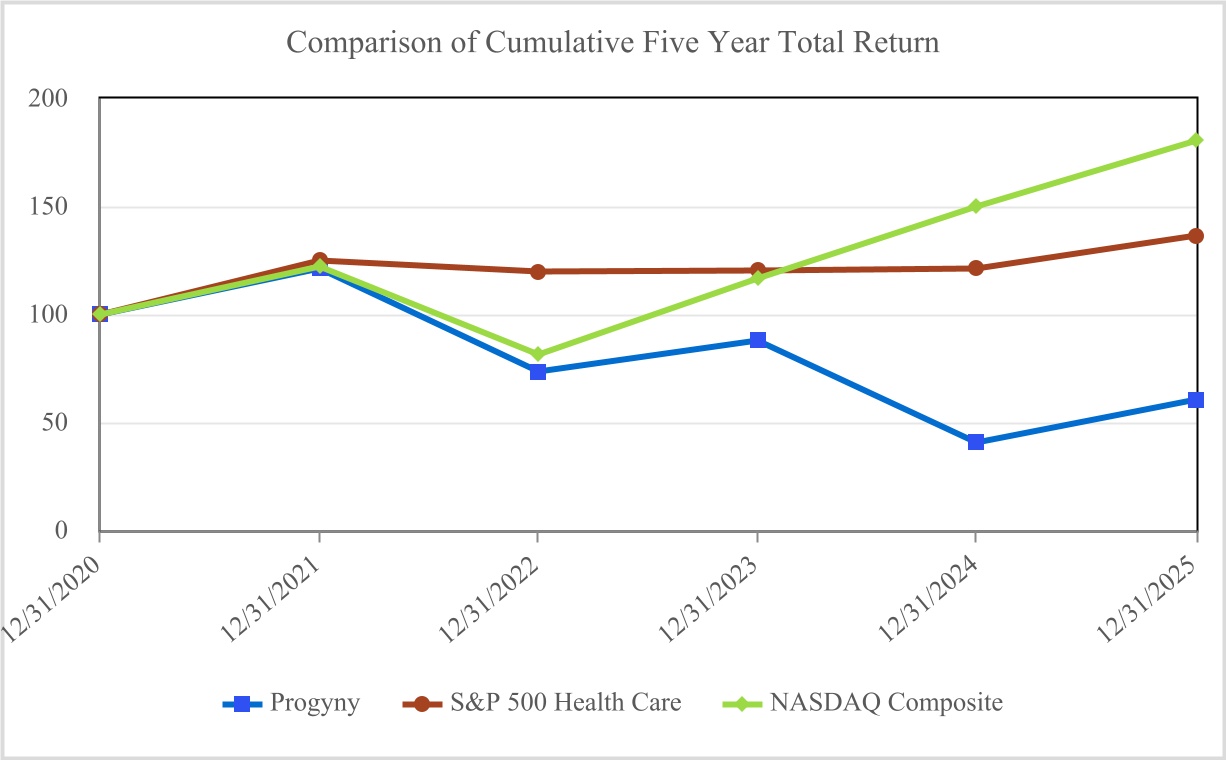
| Cumulative Total Returns | |||||||||||||||||||||||||||||||||||
| Company/Index | 12/31/2020 | 12/31/2021 | 12/31/2022 | 12/31/2023 | 12/31/2024 | 12/31/2025 | |||||||||||||||||||||||||||||
| Progyny, Inc. | $100.00 | $121.00 | $73.48 | $87.71 | $40.69 | $60.58 | |||||||||||||||||||||||||||||
| S&P 500 Health Care | $100.00 | $124.65 | $119.75 | $120.12 | $121.20 | $136.40 | |||||||||||||||||||||||||||||
| NASDAQ Composite | $100.00 | $122.14 | $81.21 | $116.47 | $149.83 | $180.33 | |||||||||||||||||||||||||||||
46
ITEM 6. [RESERVED]
ITEM 7. MANAGEMENT’S DISCUSSION AND ANALYSIS OF FINANCIAL CONDITION AND RESULTS OF OPERATIONS
The following discussion and analysis of our financial condition and results of operations should be read in conjunction with our consolidated financial statements and the related notes and other financial information included elsewhere in this Annual Report on Form 10-K. In addition to historical consolidated financial information, the following discussion contains forward-looking statements that reflect our plans, estimates, and beliefs. Our actual results could differ materially from those expressed or implied by such forward-looking statements. Important factors that could cause or contribute to these differences include, but are not limited to, those identified below and those discussed in Part I, Item 1A. “Risk Factors” of this Annual Report on Form 10-K. A discussion of the year ended December 31, 2024 as compared to the year ended December 31, 2023 has been reported previously in our Annual Report on Form 10-K for the year ended December 31, 2024, which was filed with the SEC on March 3, 2025 (File No. 001-39100) under the heading “Management's Discussion and Analysis of Financial Condition and Results of Operations - Comparison of Years Ended December 31, 2024 and 2023.”
Executive Overview
We are a benefits management company specializing in fertility, family building, and women's health benefits solutions primarily in the United States. For further information on our business and strategy, see Part I, Item 1. "Business" of this Annual Report on Form 10-K.
Revenue Model
Fertility Benefits Solution. Our fertility benefits solution includes providing members with access to effective and cost-efficient fertility treatments through our Smart Cycle plan design. Smart Cycles are proprietary treatment bundles designed by us to include those medical services available to our members through our selective network of high-quality fertility specialists. Medical services under our Smart Cycles include everything needed for a comprehensive fertility treatment cycle, including all necessary diagnostic testing and access to the latest technology (such as preimplantation genetic testing, in the case of in vitro fertilization, or IVF). We currently offer 20 different Smart Cycle treatment bundles, which may be used in various combinations depending on the member’s need. Each Smart Cycle treatment bundle has a separate unit value (i.e., some have fractional values and some have whole values). Our clients contract to purchase a cumulative Smart Cycle unit value per eligible member. These can range from one to an unlimited unit value. Members, in consultation with their Progyny Care Advocates, or PCAs, can choose their preferred provider clinics within our network and utilize the specific Smart Cycle treatment bundles necessary for the treatment pathway they determine throughout their fertility journey.
In addition, we provide care management services as part of our fertility benefits solution, which include active management of our selective network of high-quality fertility specialists, real-time member eligibility and treatment authorization, member-facing digital solutions, detailed quarterly reporting for our clients supported by our dedicated client success teams and end-to-end comprehensive concierge member support provided by our in-house staff of PCAs. Clients can also add adoption and surrogacy reimbursement programs as part of this solution.
Pharmacy Benefits Solution. Progyny Rx can only be purchased by clients that purchase our fertility benefits solution. Progyny Rx provides our members with access to the medications needed during their fertility treatment. As part of this solution, we provide care management services, which include our formulary plan design, simplified authorization, assistance with prescription fulfillment and timely delivery of the medications by our network of specialty pharmacies, as well as medication administration training, pharmacy support services and continuing PCA support.
Our clients primarily contract with us to provide our fertility benefits solution and, where added on by our clients, our Progyny Rx solution. Our revenue has both a utilization-based component and a population-based component, as follows:
47
•Utilization Component. Clients pay us for the fertility benefits and Progyny Rx solutions utilized by their employees. With respect to the fertility benefits solution, we bill clients for Smart Cycles in accordance with our bundled case rates, which vary by the type of fertility service rendered and clinic location. Case rates include all third-party fertility specialists, anesthesiology and laboratory services, as well as all of our care management services. With respect to Progyny Rx, we bill the client for the fertility medication dispensed to their employees in connection with the authorized fertility treatments. Medication fees also include our formulary management, drug utilization review and cost containment services and other care management services.
•Population-Based Component. Clients who purchase our fertility benefits solution also typically pay us a per employee per month fee, or PEPM fee, which is population-based. This allows us to provide members with access to our PCAs for fertility and family building education and guidance and other digital tools to all of our members, regardless of whether they ultimately pursue fertility treatment. PEPM fees represented 1% of our total revenue for the years ended December 31, 2025 and 2024, respectively.
Our revenue in a given year is determined by the utilization, including rate of consumption and mix, of our fertility benefits and Progyny Rx solutions by our members as well as the number of members enrolled in our clients’ benefits plans. Each year, we contract with new clients for our fertility benefits and Progyny Rx solutions. Given that the majority of our clients contract with us for a January 1st benefits plan start date, our sales cycle follows the conventional healthcare benefits cycle, which largely concludes by the end of October of the prior year to allow for benefits education and annual open enrollment to occur in November. For some clients that are considering a start date later in the year, the sales cycle can extend through the next year. Similarly, for existing clients, any changes in plan designs are typically elected by the end of October so that clients can inform their employees of the benefits during the open enrollment period ahead of a January 1st plan year start.
We continue to expand our women's health and family building solutions to include pregnancy and postpartum, menopause and midlife, benefit and leave navigation, and parent and child wellbeing solutions. While these offerings represent strategic areas of investment, they were not a significant portion of our revenue for the years ended December 31, 2025 and 2024.
Key Operational and Business Metrics
In addition to the measures presented in our consolidated financial statements, we use the following key operational and business metrics to evaluate our business, measure our performance, develop financial forecasts, and make strategic decisions.
Member and Client Base. Our addressable market is primarily large self-insured employers, as well as labor populations under the Labor Management Relations Act of 1947 (also known as the Taft-Hartley Act) and federal government populations. There are approximately 9,000 employers in the United States who have a minimum of 1,000 employees, who together with Taft-Hartley labor populations and federal government populations, represents approximately 106 million potential covered lives in total. Our current member base of approximately 7.2 million covered lives under contract represents a mid-single digit percent of our total market opportunity. We intend to continue to drive new client acquisition by investing significantly in sales and marketing to engage, educate and drive awareness of the unmet need around fertility solutions among benefits executives. We also increase brand awareness and adoption with employers by leveraging our strong relationships with benefits consultants. In particular, we are focused on expanding the number of clients with more than 2,500 covered lives. As of December 31, 2025 and 2024, we served 555 and 473 clients, representing 6,689,000 and 6,472,000 members, respectively.
48
Importantly, as we have continued to grow, we have meaningfully diversified our client base across more than 40 different industries currently from just two industries when we launched our fertility benefits solution in 2016. We are expanding our client base within each industry and have an industry-specific strategy that enables us to most effectively target our addressable market. Because our clients within an industry compete with each other for employees, we believe our solutions are increasingly viewed as an important way for them to differentiate from, or remain competitive with, one another. Additionally, we believe that our expanding presence has resulted in a heightened awareness of the need to offer fertility benefits and has informed the market of the value we provide to our clients and our members, which we believe also helps facilitate growth. In addition, we are continuously utilizing our established client relationships to evaluate other potential fertility solutions that could benefit our members and simultaneously drive growth. Our ability to attract new clients will depend on a number of factors, including the effectiveness and pricing of our solutions, offerings of our competitors, the effectiveness of our marketing efforts to drive awareness and the demand for fertility benefits solutions overall. We define a client as an organization for which we have an active contract in the period indicated. We count each organization we contract with as a single client, including divisions, segments or subsidiaries of larger organizations to the extent we contract separately with them.
| As of December 31, | ||||||||||||||||||||||||||
| 2025 | 2024 | |||||||||||||||||||||||||
| Client Tier (Members) | Clients | Members | Clients | Members | ||||||||||||||||||||||
| Up to 2,500 | 153 | 310,000 | 130 | 261,000 | ||||||||||||||||||||||
| 2,501 - 10,000 | 264 | 1,379,000 | 222 | 1,151,000 | ||||||||||||||||||||||
| 10,001 - 50,000 | 111 | 2,139,000 | 98 | 1,935,000 | ||||||||||||||||||||||
| Greater than 50,000 | 27 | 2,861,000 | 23 | 3,125,000 | ||||||||||||||||||||||
| Total | 555 | 6,689,000 | 473 | 6,472,000 | ||||||||||||||||||||||
Benefits Utilization. A key driver of our revenue is the number of members we serve and the rate at which they utilize their fertility benefits. As our client base has grown, our membership has grown from approximately 110,000 members in 2016 when we launched our fertility benefits solution to 6.7 million members as of December 31, 2025.
The following table highlights the number of ART cycles performed for Progyny members and the member utilization rates for each of the periods presented.
| Three Months Ended December 31, | Year Ended December 31, | ||||||||||||||||||||||
| 2025 | 2024 | 2025 | 2024 | ||||||||||||||||||||
Assisted Reproductive Treatment (ART) Cycles(1) | 15,927 | 15,839 | 65,006 | 61,114 | |||||||||||||||||||
Utilization - All Members(2) | 0.54% | 0.55% | 1.32% | 1.31% | |||||||||||||||||||
Utilization - Female Only(2) | 0.48% | 0.48% | 1.04% | 1.07% | |||||||||||||||||||
Average Members(3) | 6,707,000 | 6,471,000 | 6,719,000 | 6,404,000 | |||||||||||||||||||
(1)Represents the number of ART cycles performed, including IVF with a fresh embryo transfer, IVF freeze all cycles/embryo banking, frozen embryo transfers and egg freezing. Includes ART cycles performed in the first half of 2025 under the extended transition of care agreement with the large client who did not renew its service agreement.
(2)Represents the member utilization rate for all fertility and family building services, including but not limited to, ART cycles, initial consultations, IUIs and genetic testing. The utilization rate for all members includes all unique members (female and male) who utilize the benefit during that period while the utilization rate for female only includes only unique females who utilize the benefit during that period. For the purposes of calculating utilization rates in any given period, the results reflect the number of unique members utilizing the benefit for that period. Individual periods cannot be combined as member treatments may span multiple periods. Utilization for 2025 excludes activity under the extended transition of care agreement that ended June 30, 2025 with the large client who did not renew its service agreement, as only members meeting certain criteria were eligible to use the benefit.
(3)Includes approximately 300,000 members from a single client who are not reflected in utilization as a result of the client's chosen benefit design. 2025 excludes the limited number of members who were eligible to use the benefit under the extended transition of care agreement that ended June 30, 2025 with the large client who did not renew its service agreement.
49
Components of Results of Operations
Revenue
Revenue includes fertility benefits solution revenue, pharmacy benefits solution revenue and PEPM fees.
Fertility Benefits Solution Revenue
Fertility benefits solution revenue primarily represents utilization of our fertility benefits solution. Our client contracts are typically for a three-year term and pricing for this solution is established for each Smart Cycle treatment bundle, based in part on when the client first became a client and the number of members covered under the solution. Fertility benefits solution revenue includes amounts we receive directly from members, including deductibles, co-insurance and co-payments associated with the treatments under the fertility benefits solution. Revenue is recognized based on the negotiated price with our clients and includes the portion to be paid directly by the member. Revenue is recognized when Smart Cycle services are completed for a member. Revenue is also accrued for authorized Smart Cycle services rendered based on member appointments scheduled with a fertility specialist in our network but for which no claim has yet been reported, net of expected changes and cancellations of services.
Pharmacy Benefits Solution Revenue
Pharmacy benefits solution revenue primarily represents utilization of Progyny Rx. For clients who contract for the fertility benefits solution, we offer an add-on, separate, fully integrated pharmacy benefits solution designed by us. Progyny Rx provides our members with access to our formulary plan design, simplified authorization, prescription fulfillment and timely delivery of the medications used during treatment through our network of specialty pharmacies, as well as provides our members with medication administration training and other pharmacy support services. Prescription drugs are dispensed by our contracted mail order specialty pharmacies. Revenue related to the dispensing of prescription drugs by the specialty pharmacies in our network includes the prescription fees negotiated with our clients, including the portion that we collect directly from members (deductibles, co-insurance and co-payments). The contractual fees agreed to with our clients are inclusive of the cost of the prescription drug from our specialty providers, less any applicable discounts (or rebates), as well as the related clinical and care management services. Revenue from these arrangements is recognized when the drugs are dispensed. This solution was introduced in the marketplace in the third quarter of 2017 and went live with a select number of clients on January 1, 2018.
Per Employee Per Month (PEPM) Fee
Clients who purchase our fertility benefits solution also pay us a population based PEPM fee which provides access to our PCAs for fertility and family building education and guidance and other digital tools for all of our covered members, regardless of whether or not they ultimately pursue fertility treatment. We earn a PEPM fee for the majority of our clients. Revenue from the PEPM fee is billed and recognized monthly based upon the contractual fee and the number of employees at that specific client for that month.
Cost of Services
Our cost of services has three primary components: (1) fertility benefits services; (2) pharmacy benefits services; and (3) vendor rebates.
Fertility Benefits Services
Fertility benefits services costs include: (1) fees paid to provider clinics within our network, labs and anesthesiologists; (2) costs incurred (including salaries, bonuses, benefits, stock-based compensation expense, other related costs, and an allocation of our general overhead, depreciation and amortization) for those employees associated with our care management service functions: Provider Account Management, PCA, Provider Relations and Claims Processing teams; and (3) related information technology support costs. Our contracts with provider clinics are typically for a term of one to two years.
50
Pharmacy Benefits Services
Pharmacy benefits services costs include: (1) the fees for prescription drugs dispensed and clinical services provided during the reporting period by our specialty pharmacy partners; (2) costs incurred (including salaries, bonuses, benefits, stock-based compensation expense, other related costs, and an allocation of our general overhead, depreciation and amortization) for those employees associated with our care management service functions: PCA, Provider Relations and Claims Processing teams; and (3) related information technology support costs. Contracts with the specialty pharmacies are typically for a term of one year.
Vendor Rebates
We receive a rebate on certain medications purchased by our specialty pharmacies. Our contractual arrangements with pharmacy program partners provide for us to receive a rebate from established list prices, which is paid subsequent to dispensing. These rebates are recorded as a reduction to cost of services when prescriptions are dispensed.
Gross Profit and Gross Margin
Gross profit is total revenue less total cost of services. Gross margin is gross profit expressed as a percentage of total revenue. We expect that gross profit and gross margin will continue to be affected by various factors including the geographic location where treatments are performed, as well as pricing with each of our clients, provider clinics, labs, specialty pharmacies and pharmaceutical companies, all of which are negotiated separately, have different contracting start and end dates and durations which are not coterminous with each other. Additionally, staffing levels and the related personnel costs, including stock-based compensation expense, and other costs necessary to deliver our care management services will continue to grow as we continue to add clients and their associated members.
Operating Expenses
Our operating expenses consist of sales and marketing and general and administrative expenses.
Sales and Marketing Expense
Sales and marketing expense consists primarily of employee related costs, including salaries, bonuses, commissions, benefits, stock-based compensation expense, other related costs, and an allocation of our general overhead, depreciation and amortization for those employees associated with sales and marketing. These expenses also include third-party consulting services, advertising, marketing, promotional events, and brand awareness activities. We expect sales and marketing expense to continue to increase in absolute dollars as we continue to invest and grow our business.
General and Administrative Expense
General and administrative expense consists primarily of employee related costs, including salaries, bonuses, benefits, stock-based compensation expense, other related costs, and an allocation of our general overhead, depreciation and amortization for those employees associated with general and administrative services such as executive, legal, human resources, information technology, accounting, and finance as well as research and development activities. These expenses also include third-party consulting services, facilities costs, and bad debt expense. We anticipate that we will incur additional general and administrative expenses on an ongoing basis to support the growth of our business.
Interest and Other Income, Net
Interest and other income, net includes interest income and expense as well as investment income and losses.
Provision for Income Taxes
We are subject to income taxes in the United States and in certain foreign jurisdictions. Income tax expense consists of taxes currently payable and changes in deferred tax assets and liabilities calculated according to local tax rules. Deferred income taxes are recorded for the expected tax consequences of temporary differences between the tax basis of assets and liabilities for financial reporting purposes and amounts recognized for income tax purposes. As of each reporting date, management considers new evidence, both positive and negative, that could affect its view of the future realization of deferred tax assets. We believe there is sufficient positive evidence to conclude that it is more likely than not that substantially all the net deferred tax assets are realizable.
51
Results of Operations
The following tables set forth our results of operations for the periods presented and as a percentage of revenue for those periods:
| Year Ended December 31, | |||||||||||
| 2025 | 2024 | ||||||||||
| (in thousands) | |||||||||||
| Consolidated Statements of Operations Data: | |||||||||||
| Revenue | $ | 1,288,661 | $ | 1,167,221 | |||||||
Cost of services(1) | 984,177 | 913,858 | |||||||||
| Gross profit | 304,484 | 253,363 | |||||||||
| Operating expenses: | |||||||||||
Sales and marketing(1) | 72,113 | 63,948 | |||||||||
General and administrative(1) | 147,094 | 121,960 | |||||||||
| Total operating expenses | 219,207 | 185,908 | |||||||||
| Income from operations | 85,277 | 67,455 | |||||||||
| Interest and other income, net | 10,155 | 15,747 | |||||||||
| Income before income taxes | 95,432 | 83,202 | |||||||||
| Provision for income taxes | 36,912 | 28,866 | |||||||||
| Net income | $ | 58,520 | $ | 54,336 | |||||||
Adjusted EBITDA(2) | $ | 222,092 | $ | 198,760 | |||||||
(1)Includes stock-based compensation expense as follows:
| Year Ended December 31, | |||||||||||
| 2025 | 2024 | ||||||||||
| Cost of services | $ | 35,332 | $ | 36,799 | |||||||
| Sales and marketing | 30,702 | 30,490 | |||||||||
| General and administrative | 65,833 | 60,841 | |||||||||
| Total stock‑based compensation expense | $ | 131,867 | $ | 128,130 | |||||||
(2)Adjusted EBITDA is a non-GAAP financial measure that we define as net income, adjusted to exclude depreciation and amortization, stock-based compensation expense, interest and other income, net, and provision for income taxes. See “Management’s Discussion and Analysis of Financial Condition and Result of Operations – Non-GAAP Financial Measure – Adjusted EBITDA" below for a reconciliation of Adjusted EBITDA to net income, the most directly comparable measure calculated in accordance with U.S. GAAP.
52
| Year Ended December 31, | |||||||||||
| 2025 | 2024 | ||||||||||
| Consolidated Statements of Operations Data, as a percentage of revenue: | |||||||||||
| Revenue | 100.0 | % | 100.0 | % | |||||||
| Cost of services | 76.4 | % | 78.3 | % | |||||||
| Gross profit | 23.6 | % | 21.7 | % | |||||||
| Operating expenses: | |||||||||||
| Sales and marketing | 5.6 | % | 5.5 | % | |||||||
| General and administrative | 11.4 | % | 10.4 | % | |||||||
| Total operating expenses | 17.0 | % | 15.9 | % | |||||||
| Income from operations | 6.6 | % | 5.8 | % | |||||||
| Interest and other income, net | 0.8 | % | 1.3 | % | |||||||
| Income before income taxes | 7.4 | % | 7.1 | % | |||||||
| Provision for income taxes | 2.9 | % | 2.5 | % | |||||||
| Net income | 4.5 | % | 4.6 | % | |||||||
| Adjusted EBITDA | 17.2 | % | 17.0 | % | |||||||
| Note: percentages shown in the table may not foot due to rounding. | |||||||||||
Non-GAAP Financial Measure – Adjusted EBITDA
Adjusted EBITDA is a supplemental financial measure that is not required by, or presented in accordance with U.S. GAAP. We believe that Adjusted EBITDA, when taken together with our U.S. GAAP financial results, provides meaningful supplemental information regarding our operating performance and facilitates internal comparisons of our historical operating performance on a more consistent basis by excluding certain items that may not be indicative of our business, results of operations, or outlook. In particular, we believe that the use of Adjusted EBITDA is helpful to our investors as it is a measure used by management in assessing the health of our business, determining incentive compensation, evaluating our operating performance, and for internal planning and forecasting purposes.
Adjusted EBITDA is presented for supplemental informational purposes only, has limitations as an analytical tool and should not be considered in isolation or as a substitute for financial information presented in accordance with U.S. GAAP. Some of the limitations of Adjusted EBITDA include: (1) it does not properly reflect capital commitments to be paid in the future; (2) although depreciation and amortization are non-cash charges, the underlying assets may need to be replaced and Adjusted EBITDA does not reflect these capital expenditures; (3) it does not consider the impact of stock-based compensation expense; (4) it does not reflect other non-operating income and expenses, including interest and other income, net; and (5) it does not reflect tax payments that may represent a reduction in cash available to us. In addition, our Adjusted EBITDA may not be comparable to similarly titled measures of other companies because they may not calculate Adjusted EBITDA in the same manner as we calculate the measure, limiting its usefulness as a comparative measure. Because of these limitations, when evaluating our performance, you should consider Adjusted EBITDA alongside other financial performance measures, including our net income, gross margin, and other U.S. GAAP results.
We calculate Adjusted EBITDA as net income, adjusted to exclude depreciation and amortization, stock-based compensation expense, interest and other income, net, and provision for income taxes. The following table presents a reconciliation of Adjusted EBITDA to net income, the most directly comparable financial measure stated in accordance with U.S. GAAP, for each of the periods indicated:
53
| Year Ended December 31, | |||||||||||
| 2025 | 2024 | ||||||||||
| (in thousands) | |||||||||||
| Net income | $ | 58,520 | $ | 54,336 | |||||||
| Add: | |||||||||||
| Depreciation and amortization | 4,948 | 3,175 | |||||||||
| Stock‑based compensation expense | 131,867 | 128,130 | |||||||||
| Interest and other income, net | (10,155) | (15,747) | |||||||||
| Provision for income taxes | 36,912 | 28,866 | |||||||||
| Adjusted EBITDA | $ | 222,092 | $ | 198,760 | |||||||
Comparison of Years Ended December 31, 2025 and 2024
Revenue
| Year Ended December 31, | |||||||||||||||||
| 2025 | 2024 | % Change | |||||||||||||||
| (dollars in thousands) | |||||||||||||||||
| Revenue | $1,288,661 | $1,167,221 | 10 | % | |||||||||||||
Revenue increased by $121.4 million, or 10%, for the year ended December 31, 2025 compared to the year ended December 31, 2024. This increase is primarily due to a $101.3 million, or 14% increase, in revenue from our fertility benefits solution and a $20.1 million or 5% increase in revenue from our Progyny Rx solution. The increase in revenue from our fertility benefits solution and Progyny Rx solution were primarily due to the increase in the number of clients and covered lives.
Cost of Services
| Year Ended December 31, | |||||||||||||||||
| 2025 | 2024 | % Change | |||||||||||||||
| (dollars in thousands) | |||||||||||||||||
| Cost of services | $984,177 | $913,858 | 8 | % | |||||||||||||
Cost of services increased by $70.3 million, or 8%, for the year ended December 31, 2025 compared to the year ended December 31, 2024 primarily due to an increase in medical treatment and pharmacy prescription costs associated with fertility treatments delivered. This increase in cost of services was also attributable to an increase in personnel-related costs as higher costs attributable to incremental head count were partially offset by a decrease in stock-based compensation expense of $1.5 million.
Gross Profit and Gross Margin
| Year Ended December 31, | |||||||||||||||||
| 2025 | 2024 | % Change | |||||||||||||||
| (dollars in thousands) | |||||||||||||||||
| Gross profit | $304,484 | $253,363 | 20 | % | |||||||||||||
| Gross margin | 23.6 | % | 21.7 | % | |||||||||||||
Gross profit increased by $51.1 million, or 20%, for the year ended December 31, 2025 compared to the year ended December 31, 2024.
54
Gross margin increased 190 basis points for the year ended December 31, 2025 compared to the year ended December 31, 2024, primarily due to ongoing efficiencies realized in the delivery of our care management services.
Operating Expenses
Sales and Marketing Expense
| Year Ended December 31, | |||||||||||||||||
| 2025 | 2024 | % Change | |||||||||||||||
| (dollars in thousands) | |||||||||||||||||
| Sales and marketing | $72,113 | $63,948 | 13 | % | |||||||||||||
Sales and marketing expense increased by $8.2 million, or 13%, for the year ended December 31, 2025 compared to the year ended December 31, 2024. This increase was due to a $5.8 million increase in personnel-related costs attributable to incremental head count which included an increase in stock-based compensation expense of $0.2 million, and a $2.4 million increase in other related sales and marketing expenses.
General and Administrative Expense
| Year Ended December 31, | |||||||||||||||||
| 2025 | 2024 | % Change | |||||||||||||||
| (dollars in thousands) | |||||||||||||||||
| General and administrative | $147,094 | $121,960 | 21 | % | |||||||||||||
General and administrative expense increased by $25.1 million, or 21%, for the year ended December 31, 2025 compared to the year ended December 31, 2024. This increase was due to a $16.5 million increase in personnel-related costs, which included an increase of $5.0 million in stock-based compensation expense, attributable to incremental head count and executive severance costs, a $4.1 million increase in bad debt expense driven by our revenue growth, and a $4.5 million net increase in other related general and administrative expenses. Stock-based compensation expense included $7.7 million of executive severance costs in the year ended December 31, 2025 mainly attributable to the accelerated vesting of awards upon the termination of an executive in December 2025. Other related general and administrative expense also included a benefit of $2.1 million in the year ended December 31, 2025 related to employee retention credit refunds.
Interest and Other Income, Net
| Year Ended December 31, | |||||||||||||||||
| 2025 | 2024 | % Change | |||||||||||||||
| (dollars in thousands) | |||||||||||||||||
| Interest and other income, net | $10,155 | $15,747 | (36 | %) | |||||||||||||
Interest and other income, net decreased by $5.6 million or 36%, for the year ended December 31, 2025 compared to the year ended December 31, 2024, as higher interest income was more than offset by a decrease in investment income and an increase in interest expense.
55
Provision for Income Taxes
| Year Ended December 31, | |||||||||||||||||
| 2025 | 2024 | % Change | |||||||||||||||
| (dollars in thousands) | |||||||||||||||||
| Provision for income taxes | $ | 36,912 | $ | 28,866 | 28 | % | |||||||||||
For the year ended December 31, 2025, we recorded a provision for income taxes of $36.9 million, as compared to $28.9 million for the year ended December 31, 2024, primarily due to a higher operating profit and a decrease in tax benefits for equity compensation in the current year period.
Liquidity and Capital Resources
As of December 31, 2025, we had $112.2 million of cash and cash equivalents and $197.9 million of marketable securities. We have financed our operations primarily through cash generated from the sales of our solutions. Our cash and cash equivalents and working capital are affected by the timing of payments to third party providers and collections from clients and have increased as our revenue has increased. In particular, during the ramp up and onboarding of new clients who typically begin their benefits plan year as of January 1st, our accounts receivable has historically increased more than our accounts payable, accrued expenses and other current liabilities in the early part of each calendar year. Historically, these timing impacts have reversed throughout the remainder of the fiscal year. Accordingly, our working capital, and its impact on cash flow from operations, can fluctuate materially from period to period.
On July 1, 2025, we entered into a revolving credit facility (the “Facility”) pursuant to a Credit Agreement (the “Credit Agreement”) with the lenders and issuing banks, party thereto and JPMorgan Chase Bank, N.A., as administrative agent, collateral agent, and swing line lender. The Credit Agreement makes available a maximum aggregate amount of $200 million, subject to customary borrowing conditions, until its maturity on July 1, 2030. We are in compliance with all financial covenants under the Credit Agreement as of December 31, 2025. As of the date of this filing, no amounts were drawn under the Facility. Refer to Note 9 to the Consolidated Financial Statements included in this Annual Report on Form 10-K for additional information.
We believe that our existing cash and cash equivalents, including the proceeds from our marketable securities, cash flow from operations, and the availability of funds under the Facility will be sufficient to support working capital and capital expenditure requirements for at least the next 12 months. We also expect these sources of existing cash and cash equivalents will be sufficient to fund our long-term contractual obligations and capital needs. However, this is subject, to a certain extent, to general economic, financial, competitive, regulatory, and other factors that are beyond our control. Moreover, our future capital requirements will depend on many factors, including sales of our solutions and client renewals, the timing and the amount of cash received from clients, the amount of capital investment necessary to support our benefits offerings and growth strategy, the expansion of our sales and marketing activities and the continuing market adoption of our solutions. In addition, we may enter into arrangements to acquire or invest in complementary businesses, products, and technologies.
We may, in the future, be required to seek additional equity or debt financing. In the event that we require additional financing, we may not be able to raise such financing on terms acceptable to us or at all. If we are unable to raise additional capital or generate cash flows necessary to expand our operations and invest in continued innovation, we may not be able to compete successfully, which would harm our business, operations and financial condition.
56
The following table summarizes our cash flows from operations for the periods presented:
| Year Ended December 31, | |||||||||||
| 2025 | 2024 | ||||||||||
| (in thousands) | |||||||||||
| Net cash provided by operating activities | $ | 210,192 | $ | 179,105 | |||||||
| Net cash (used in) provided by investing activities | (159,013) | 195,792 | |||||||||
| Net cash used in financing activities | (99,362) | (309,880) | |||||||||
| Effect of exchange rate changes on cash, cash equivalents, and restricted cash | 62 | 1 | |||||||||
| Net (decrease) increase in cash, cash equivalents, and restricted cash | $ | (48,121) | $ | 65,018 | |||||||
Operating Activities
Net cash provided by operating activities was $210.2 million for the year ended December 31, 2025, primarily consisting of net income of $58.5 million adjusted for certain items, which includes $131.9 million of stock-based compensation expense, $20.5 million of bad debt expense, $8.1 million of deferred tax benefit, $4.9 million of depreciation and amortization expense, $0.9 million of net accretion of discounts on marketable securities, $0.4 million of non-cash interest expense, and $0.1 million of loss on disposal of property and equipment. Changes in operating assets and liabilities resulted in cash provided by operating activities from an increase in accounts payable of $28.8 million and accrued expenses and other current liabilities of $0.4 million, that was partially offset by cash used in operating activities from an increase in prepaid expenses and other current assets of $11.9 million, other noncurrent assets and liabilities of $9.3 million, and accounts receivable of $5.1 million. These changes were a result of the impact of revenue growth and our operating results as well as the timing of cash collections and payments to third parties, including $55.5 million of cash paid for income taxes, net of refunds for the year ended December 31, 2025.
Net cash provided by operating activities was $179.1 million for the year ended December 31, 2024, primarily consisting of net income of $54.3 million adjusted for certain non-cash items, which included $128.1 million of stock-based compensation expense, $16.4 million of bad debt expense, $10.5 million of deferred tax benefit, $3.2 million of depreciation and amortization, $2.1 million of net accretion of discounts on marketable securities, and $1.4 million loss on disposal of property and equipment. Changes in operating assets and liabilities resulted in cash used in operating activities from a decrease in accounts payable of $30.3 million, and an increase in accounts receivable of $9.9 million, partially offset by cash provided by operating activities from increases in accrued expenses and other current liabilities of $9.9 million and other noncurrent assets and liabilities of $0.4 million, and a decrease in prepaid expenses and other current assets of $18.0 million. These changes are a result of the impact of revenue growth and our operating results as well as the timing of cash collections and payments to third parties, including $40.4 million of cash paid for income taxes, net of refunds for the year ended December 31, 2024.
Investing Activities
Net cash used in investing activities was $159.0 million for the year ended December 31, 2025, which primarily consisted of net investment in marketable securities of $131.3 million, and $9.3 million used in a business acquisition, net of cash acquired. For the year ended December 31, 2024, net cash provided by investing activities was $195.8 million, which primarily consisted of net sales in marketable securities of $206.5 million, partially offset by $5.3 million used in a business acquisition, net of cash acquired. The remainder of the activity for the years ended December 31, 2025 and 2024, respectively, consisted of purchases of computers, software, including capitalized software development costs, and furniture and fixtures. Our capital investments, including investments in technology and the development of software, are expected to increase over the next 12 months as we continue to invest in our benefits offerings and growth strategy.
Financing Activities
Net cash used in financing activities was $99.4 million for the year ended December 31, 2025, consisting of $81.7 million of repurchases of common stock under the November 2025 share repurchase program, inclusive of $0.1 million in trading fees, payments of $15.8 million for employee taxes related to the net settlement of equity awards, and $3.1 million of issuance costs related to the Facility, partially offset by $1.1 million in proceeds from contributions to our employee stock purchase plan and $0.1 million in proceeds from stock option exercises.
57
Net cash used in financing activities was $309.9 million for the year ended December 31, 2024, consisting of $300.3 million of repurchases of common stock under the 2024 share repurchase program, inclusive of $0.4 million in trading fees and payments of $12.0 million for employee taxes related to the net settlement of equity awards, partially offset by $1.1 million in proceeds from stock option exercises and $1.3 million in proceeds from contributions to our employee stock purchase plan.
Share Repurchase Programs
In February 2024, our Board of Directors authorized a share repurchase program of up to $100 million in shares of common stock. In May 2024, our Board of Directors authorized an additional share repurchase program of up to $100 million in shares of common stock. In August 2024, our Board of Directors authorized an additional share repurchase program of up to $100 million in shares of common stock. As of the year ended December 31, 2024, the share repurchase programs were completed, and no amounts remained available for repurchase under the program.
In November 2025, our Board of Directors authorized a share repurchase program of up to $200 million in shares of common stock (the “November 2025 share repurchase program”). Repurchases under the November 2025 share repurchase program may be made in the form of open market repurchases, including through plans complying with Rule 10b5-1 under the Exchange Act, depending on stock price, market conditions, and other factors, as determined by the Company. There can be no assurance as to the total number of shares that will be repurchased by the Company under the November 2025 share repurchase program.
During the year ended December 31, 2025, we repurchased a total of 3,301,596 shares of common stock under the November 2025 share repurchase program at an average price per share of $25.31 and a total cost of $83.6 million, inclusive of $0.1 million in trading fees. In addition, we recognized $0.5 million of excise taxes related to the share repurchases. As of the date of this filing, we have repurchased a total of 6,530,363 shares of common stock under the November 2025 share repurchase program for a total cost of $159.4 million.
Operating Lease Commitments
In September 2019, we commenced a sublease agreement for our corporate offices in New York, New York. The sublease is for a 25,212 square foot office and will expire in May 2029. Pursuant to the sublease, we will pay the base rent of approximately $1.3 million per year through the end of the fifth lease year and approximately $1.4 million per year thereafter through the expiration date.
In February 2022, we entered into a lease agreement for leases commencing in February 2023 and March 2025 for additional space in our corporate offices in New York, New York, consisting of a 24,099 square foot office and a 21,262 square foot office, respectively. The lease agreement also provides for continued occupancy of the 25,212 square foot office after the expiration of the current sublease. For the 24,099 square foot office, we pay the base rent of approximately $1.4 million per year through the end of the fifth year and approximately $1.5 million per year thereafter through the April 2036, the expiration date. For the 21,262 square foot office, we will pay the base rent of approximately $1.3 million per year starting in April 2026 through the end of the fifth year and approximately $1.4 million per year thereafter through April 2036, the expiration date. For our current 25,212 square foot office, we will pay the base rent of approximately $1.6 million per year beginning in June 2029, which is the lease commencement date, through April 2036, the expiration date.
Critical Accounting Estimates
Our consolidated financial statements and accompanying notes have been prepared in accordance with U.S. GAAP. The preparation of these consolidated financial statements requires us to make estimates and assumptions that affect the reported amounts of assets, liabilities, revenue and expenses, and related disclosures. We base our estimates on historical experience and on various other assumptions that we believe are reasonable under the circumstances. We evaluate our estimates and assumptions on an ongoing basis. Actual results may differ from these estimates. To the extent that there are material differences between these estimates and our actual results, our future financial statements will be affected.
We believe that the assumptions and estimates associated with our accrued receivables related to revenue recognition, accrued claims payable, stock-based compensation expense, and accounting for income taxes have the greatest potential impact on our financial statements. Therefore, we consider these to be our critical accounting estimates.
For additional information about our significant accounting policies and estimates, see Note 1 – Business and Basis of Presentation and Note 2 - Summary of Significant Accounting Policies in the notes to the consolidated financial statements included in Part II, Item 8 of this Annual Report on Form 10-K.
58
Accrued Receivable and Accrued Claims Payable
Fertility benefits solution revenue is recognized based on the negotiated price with our clients and includes the portion to be paid directly by the member. Revenue is recognized when Smart Cycle services are completed for a member, which includes estimates of accrued receivables. We estimate accrued receivables based on historical experience for those fertility benefit services provided but for which a claim has not been received from the provider clinic, which includes assumptions regarding the lag between the authorization date and service date as well as estimates for changes and cancellations of services. We include accrued receivables within accounts receivable on our consolidated balance sheet. As of December 31, 2025 and 2024, accrued receivables were $54.9 million and $45.6 million, respectively.
At the same time, we estimate cost of services and accrued claims payables based on the amount to be paid to the provider clinic and expected gross margin on fertility benefit services. Accrued claims payable of $30.0 million and $32.1 million as of December 31, 2025 and 2024, respectively, are included within accrued expenses and other current liabilities in the consolidated balance sheets.
Our estimates are adjusted to actual at the time of billing and these adjustments have historically not been material.
Stock-Based Compensation
We recognize stock-based compensation expense based on the fair value of stock-based awards granted to employees and directors on the date of grant. We estimate the fair value of each stock-based award on the measurement date using either the Black-Scholes option-pricing model for stock options and stock purchased under the employee stock purchase plan on the closing market price of our common stock for restricted stock units, including those with performance-based vesting conditions.
The Black-Scholes option-pricing model requires the input of subjective assumptions, including (1) the expected stock price volatility, (2) the expected term of the award, (3) the risk-free interest rate and (4) expected dividends. Due to the lack of historical and implied volatility data of our common stock, the expected stock price volatility is estimated based on the historical volatilities of the daily closing prices of a specified group of companies in our industry for a period equal to the expected term of the option. We selected companies with comparable characteristics to our Company, including enterprise value, risk profiles and position within the industry, that have historical stock price information sufficient to meet the expected term of the stock option. The expected term of the award represents the period of time that options granted are expected to be outstanding and is calculated utilizing the simplified method, which is the mid-point between the vesting date and end of the contractual term for each option. The risk-free interest rate is based on the yield of zero-coupon U.S. Treasury securities for the period that is consistent with the expected term of the stock option. The dividend yield is assumed to be none as we have not paid dividends, nor do we anticipate paying dividends. The weighted-average estimated fair value of stock option awards granted in the year ended December 31, 2025 was $11.72. Changes in these inputs could result in a significant change in the fair value of stock options.
The following assumptions were used to calculate the fair value of stock options granted to employees:
| Year Ended December 31, | |||||||||||
| 2025 | 2024 | ||||||||||
| Expected volatility | 53.7% - 54.7% | 53.0% - 55.0% | |||||||||
| Expected term (in years) | 5.50 - 6.25 | 5.25 - 6.11 | |||||||||
| Risk‑free interest rate | 3.6% - 4.5% | 3.5% - 4.6% | |||||||||
| Expected dividend yield | — | — | |||||||||
59
Our outstanding stock-based awards as of December 31, 2025 are subject to service-based or performance-based vesting. We recognize compensation expense for service-based awards over the vesting period of the award on a straight-line basis. Compensation expense related to awards with performance-based vesting conditions is recognized over the requisite service period when achievement of the performance condition is considered probable. Forfeitures and cancellations of awards are recognized as they occur. For the years ended December 31, 2025 and 2024, stock-based compensation expense was $131.9 million and $128.1 million, respectively. As of December 31, 2025, we had $52.3 million and $77.8 million of unrecognized compensation costs related to unvested options and restricted stock units, respectively, which are expected to be expensed and vest over a weighted-average remaining period of approximately 1.9 years and 2.5 years, respectively.
Income Taxes
We account for income taxes in accordance with FASB ASC Topic 740, Income Taxes, or “ASC 740”. Deferred income taxes are recorded for the expected tax consequences of temporary differences between the tax basis of assets and liabilities for financial reporting purposes and amounts recognized for income tax purposes. We periodically review the recoverability of deferred tax assets recorded on the consolidated balance sheet and provide valuation allowances as deemed necessary to reduce such deferred tax assets to the amount that will, more likely than not, be realized. Income tax expense consists of taxes currently payable and changes in deferred tax assets and liabilities calculated according to local tax rules.
As of each reporting date, management considers new evidence, both positive and negative, that could affect its view of the future realization of deferred tax assets. Significant judgment is required in determining any valuation allowance recorded against deferred tax assets. In assessing the need for a valuation allowance, we consider all available evidence for each jurisdiction including past operating results, estimates of future taxable income and the feasibility of ongoing tax planning strategies. In the event we change our determination as to the amount of deferred tax assets that can be realized, we will adjust our valuation allowance with a corresponding impact to income tax expense in the period in which such determination is made. We believe there is sufficient positive evidence to conclude that it is more likely than not, that substantially all the net deferred tax assets were realizable as of December 31, 2025.
The amount of deferred tax provided is calculated using tax rates enacted at the balance sheet date. The impact of tax law changes is recognized in periods when the change is enacted.
As of December 31, 2025 and 2024, we had $93.0 million and $84.9 million of net deferred tax assets, respectively. There was a valuation allowance of $3.1 million and $1.8 million as of December 31, 2025 and 2024, respectively.
60
ITEM 7A. QUANTITATIVE AND QUALITATIVE DISCLOSURES ABOUT MARKET RISK
Quantitative and Qualitative Disclosures about Market Risk
We are exposed to market risks in the ordinary course of our business. Market risk represents the risk of loss that may impact our financial position due to adverse changes in financial market prices and rates. Our market risk exposure is primarily the result of fluctuations in interest rates.
Interest Rate Risk
Interest rate risk is highly sensitive due to many factors, including U.S. monetary and tax policies, U.S. and international economic factors and other factors beyond our control.
At December 31, 2025, we had cash and cash equivalents of $112.2 million and marketable securities of $197.9 million. Interest-earning instruments carry a degree of interest rate risk. We do not enter into investments for trading or speculative purposes and have not used any derivative financial instruments to manage our interest rate risk exposure. Our investments are exposed to market risk due to a fluctuation in interest rates, which may affect our interest income and the fair market value of our investments. A hypothetical 1% change in interest rates would not result in a material impact on our consolidated financial statements.
Inflation Rate Risk
While it is difficult to accurately measure the impact of inflation on our results of operations and financial condition, we do not believe that inflation has had a material effect on our business, financial condition or results of operations. Nonetheless, if our costs were to become subject to significant inflationary pressures, we may not be able to fully offset such higher costs through price increases. Our inability or failure to do so could harm our business, financial condition, and results of operations.
ITEM 8. FINANCIAL STATEMENTS AND SUPPLEMENTARY DATA
Index to Consolidated Financial Statements
| Page | |||||
Report of Independent Registered Public Accounting Firm (PCAOB ID | |||||
| Financial Statements: | |||||
61
Report of Independent Registered Public Accounting Firm
To the Stockholders and the Board of Directors of Progyny, Inc.
Opinion on the Financial Statements
We have audited the accompanying consolidated balance sheets of Progyny, Inc. (the Company) as of December 31, 2025 and 2024, the related consolidated statements of operations, comprehensive income, changes in stockholders' equity, and cash flows for each of the three years in the period ended December 31, 2025, and the related notes (collectively referred to as the "consolidated financial statements"). In our opinion, the consolidated financial statements present fairly, in all material respects, the financial position of the Company at December 31, 2025 and 2024, and the results of its operations and its cash flows for each of the three years in the period ended December 31, 2025, in conformity with U.S. generally accepted accounting principles.
We also have audited, in accordance with the standards of the Public Company Accounting Oversight Board (United States) (PCAOB), the Company's internal control over financial reporting as of December 31, 2025, based on criteria established in Internal Control—Integrated Framework issued by the Committee of Sponsoring Organizations of the Treadway Commission (2013 framework), and our report dated February 27, 2026 expressed an unqualified opinion thereon.
Basis for Opinion
These financial statements are the responsibility of the Company's management. Our responsibility is to express an opinion on the Company's financial statements based on our audits. We are a public accounting firm registered with the PCAOB and are required to be independent with respect to the Company in accordance with the U.S. federal securities laws and the applicable rules and regulations of the Securities and Exchange Commission and the PCAOB.
We conducted our audits in accordance with the standards of the PCAOB. Those standards require that we plan and perform the audit to obtain reasonable assurance about whether the financial statements are free of material misstatement, whether due to error or fraud. Our audits included performing procedures to assess the risks of material misstatement of the financial statements, whether due to error or fraud, and performing procedures that respond to those risks. Such procedures included examining, on a test basis, evidence regarding the amounts and disclosures in the financial statements. Our audits also included evaluating the accounting principles used and significant estimates made by management, as well as evaluating the overall presentation of the financial statements. We believe that our audits provide a reasonable basis for our opinion.
Critical Audit Matter
The critical audit matter communicated below is a matter arising from the current period audit of the financial statements that was communicated or required to be communicated to the audit committee and that: (1) relates to accounts or disclosures that are material to the financial statements and (2) involved our especially challenging, subjective or complex judgments. The communication of the critical audit matter does not alter in any way our opinion on the consolidated financial statements, taken as a whole, and we are not, by communicating the critical audit matter below, providing a separate opinion on the critical audit matter or on the accounts or disclosures to which it relates.
62
| Accrued Receivables and Accrued Claims Payable | |||||
| Description of the Matter | |||||
As of December 31, 2025, accrued receivables and accrued claims payable were $ | |||||
| Auditing the Company’s estimates of accrued receivables and the related accrued claims payable was complex and required significant judgment as the estimates were sensitive to changes in the significant assumptions, including management’s assumptions regarding the lag between authorization date and service date, service changes and cancellations. | |||||
| How We Addressed the Matter in Our Audit | We obtained an understanding, evaluated the design, and tested the operating effectiveness of the controls over the Company’s process to estimate accrued receivables and the associated claims payable. For example, we tested controls over management’s review of the methodology, significant assumptions and the underlying data used to determine these estimates. | ||||
| To test the accrued receivables and the related claims payable, our audit procedures included, among others, assessing the methodology, evaluating the significant assumptions described above and testing the completeness and accuracy of the underlying data used in the Company’s analysis. For example, we tested the Company’s assumptions of the lag between the authorization date and service date, service changes and cancellations based on historical claims data, historical gross margin per service and tested the clerical accuracy of management’s analysis. Additionally, we evaluated the historical accuracy of management’s estimate by testing management’s retrospective review analysis that compared the prior period’s estimated accrued receivables and accrued claims payable to actual billing and claims data. | |||||
/s/Ernst & Young LLP
We have served as the Company’s auditor since 2012.
February 27, 2026
63
PROGYNY, INC.
Consolidated Balance Sheets
(in thousands, except share and per share amounts)
| December 31, | |||||||||||
| 2025 | 2024 | ||||||||||
| ASSETS | |||||||||||
| Current assets: | |||||||||||
| Cash and cash equivalents | $ | $ | |||||||||
| Marketable securities | |||||||||||
Accounts receivable, net of $ | |||||||||||
| Prepaid expenses and other current assets | |||||||||||
| Total current assets | |||||||||||
| Property and equipment, net | |||||||||||
| Operating lease right-of-use assets | |||||||||||
| Goodwill | |||||||||||
| Intangible assets, net | |||||||||||
| Deferred tax assets, net | |||||||||||
| Other noncurrent assets | |||||||||||
| Total assets | $ | $ | |||||||||
| LIABILITIES AND STOCKHOLDERS’ EQUITY | |||||||||||
| Current liabilities: | |||||||||||
| Accounts payable | $ | $ | |||||||||
| Accrued expenses and other current liabilities | |||||||||||
| Total current liabilities | |||||||||||
| Operating lease noncurrent liabilities | |||||||||||
| Total liabilities | |||||||||||
Commitments and Contingencies (Note 15) | |||||||||||
| STOCKHOLDERS' EQUITY | |||||||||||
Common stock, $ | |||||||||||
| Additional paid-in capital | |||||||||||
Treasury stock, at cost, $ | ( | ( | |||||||||
| Accumulated earnings | |||||||||||
| Accumulated other comprehensive income | |||||||||||
| Total stockholders’ equity | |||||||||||
| Total liabilities and stockholders’ equity | $ | $ | |||||||||
The accompanying notes are an integral part of these consolidated financial statements.
64
PROGYNY, INC.
Consolidated Statements of Operations
(in thousands, except share and per share amounts)
| Year Ended December 31, | |||||||||||||||||
| 2025 | 2024 | 2023 | |||||||||||||||
| Revenue | $ | $ | $ | ||||||||||||||
| Cost of services | |||||||||||||||||
| Gross profit | |||||||||||||||||
| Operating expenses: | |||||||||||||||||
| Sales and marketing | |||||||||||||||||
| General and administrative | |||||||||||||||||
| Total operating expenses | |||||||||||||||||
| Income from operations | |||||||||||||||||
| Interest and other income, net | |||||||||||||||||
| Income before income taxes | |||||||||||||||||
| Provision for income taxes | |||||||||||||||||
| Net income | $ | $ | $ | ||||||||||||||
| Net income per share: | |||||||||||||||||
| Basic | $ | $ | $ | ||||||||||||||
| Diluted | $ | $ | $ | ||||||||||||||
| Weighted-average shares used in computing net income per share: | |||||||||||||||||
| Basic | |||||||||||||||||
| Diluted | |||||||||||||||||
The accompanying notes are an integral part of these consolidated financial statements.
65
PROGYNY, INC.
Consolidated Statements of Comprehensive Income
(in thousands)
| Year Ended December 31, | |||||||||||||||||
| 2025 | 2024 | 2023 | |||||||||||||||
| Net income | $ | $ | $ | ||||||||||||||
| Other comprehensive income (loss), net of tax: | |||||||||||||||||
| Unrealized gain on marketable securities before reclassifications | |||||||||||||||||
| Reclassification of gains on the sale of marketable securities into net income | ( | ( | |||||||||||||||
| Net change on unrealized gains on marketable securities | ( | ||||||||||||||||
| Foreign currency translation gain (loss) | ( | ||||||||||||||||
| Total other comprehensive income (loss), net of tax | ( | ||||||||||||||||
| Total comprehensive income | $ | $ | $ | ||||||||||||||
The accompanying notes are an integral part of these consolidated financial statements.
66
PROGYNY, INC.
Consolidated Statements of Changes in Stockholders’ Equity
(in thousands, except share and per share amounts)
| Common Stock | Treasury Stock | Additional Paid in Capital | Accumulated Earnings | Accumulated Other Comprehensive Income (Loss) | Total | ||||||||||||||||||||||||||||||||||||
| Shares | Amount | ||||||||||||||||||||||||||||||||||||||||
Balance at December 31, 2022 | $ | $ | ( | $ | $ | $ | $ | ||||||||||||||||||||||||||||||||||
| Issuance of employee equity awards, net of shares withheld | 0 | — | ( | — | — | ( | |||||||||||||||||||||||||||||||||||
| Stock-based compensation | — | — | — | — | — | ||||||||||||||||||||||||||||||||||||
| Warrant exercise | — | — | 0 | — | — | 0 | |||||||||||||||||||||||||||||||||||
| Other comprehensive income, net of tax | — | — | — | — | — | ||||||||||||||||||||||||||||||||||||
| Net income | — | — | — | — | — | ||||||||||||||||||||||||||||||||||||
Balance at December 31, 2023 | $ | $ | ( | $ | $ | $ | $ | ||||||||||||||||||||||||||||||||||
| Issuance of employee equity awards, net of shares withheld | 0 | — | ( | — | — | ( | |||||||||||||||||||||||||||||||||||
| Stock-based compensation | — | — | — | — | — | ||||||||||||||||||||||||||||||||||||
| Repurchase of common stock | ( | — | ( | — | — | — | ( | ||||||||||||||||||||||||||||||||||
| Warrant exercise | 0 | — | 0 | — | — | 0 | |||||||||||||||||||||||||||||||||||
| Other comprehensive loss, net of tax | — | — | — | — | — | ( | ( | ||||||||||||||||||||||||||||||||||
| Net income | — | — | — | — | — | ||||||||||||||||||||||||||||||||||||
Balance at December 31, 2024 | $ | $ | ( | $ | $ | $ | $ | ||||||||||||||||||||||||||||||||||
| Issuance of employee equity awards, net of shares withheld | 0 | — | ( | — | — | ( | |||||||||||||||||||||||||||||||||||
| Stock-based compensation | — | — | — | — | — | ||||||||||||||||||||||||||||||||||||
| Repurchase of common stock | ( | — | ( | — | — | — | ( | ||||||||||||||||||||||||||||||||||
Other comprehensive income, net of tax | — | — | — | — | — | ||||||||||||||||||||||||||||||||||||
| Net income | — | — | — | — | — | ||||||||||||||||||||||||||||||||||||
Balance at December 31, 2025 | $ | $ | ( | $ | $ | $ | $ | ||||||||||||||||||||||||||||||||||
The accompanying notes are an integral part of these consolidated financial statements.
67
PROGYNY, INC.
Consolidated Statements of Cash Flows
(in thousands)
| Year Ended December 31, | |||||||||||||||||
| 2025 | 2024 | 2023 | |||||||||||||||
| OPERATING ACTIVITIES | |||||||||||||||||
| Net income | $ | $ | $ | ||||||||||||||
| Adjustments to reconcile net income to net cash provided by operating activities: | |||||||||||||||||
| Deferred tax (benefit) expense | ( | ( | |||||||||||||||
| Non-cash interest expense (income) | ( | ||||||||||||||||
| Depreciation and amortization | |||||||||||||||||
| Loss on disposal of property and equipment | |||||||||||||||||
| Stock-based compensation expense | |||||||||||||||||
| Bad debt expense | |||||||||||||||||
| Net accretion of discounts on marketable securities | ( | ( | ( | ||||||||||||||
| Foreign currency exchange rate loss | ( | ||||||||||||||||
| Changes in operating assets and liabilities: | |||||||||||||||||
| Accounts receivable | ( | ( | ( | ||||||||||||||
| Prepaid expenses and other current assets | ( | ( | |||||||||||||||
| Accounts payable | ( | ||||||||||||||||
| Accrued expenses and other current liabilities | |||||||||||||||||
| Other noncurrent assets and liabilities | ( | ||||||||||||||||
| Net cash provided by operating activities | |||||||||||||||||
| INVESTING ACTIVITIES | |||||||||||||||||
| Purchase of property and equipment, net | ( | ( | ( | ||||||||||||||
| Purchase of marketable securities | ( | ( | ( | ||||||||||||||
| Sale of marketable securities | |||||||||||||||||
| Acquisition of business, net of cash acquired | ( | ( | |||||||||||||||
| Net cash (used in) provided by investing activities | ( | ( | |||||||||||||||
| FINANCING ACTIVITIES | |||||||||||||||||
| Repurchase of common stock | ( | ( | |||||||||||||||
| Proceeds from exercise of stock options | |||||||||||||||||
Issuance costs on credit facility | ( | ||||||||||||||||
| Payment of employee taxes related to equity awards | ( | ( | ( | ||||||||||||||
| Proceeds from contributions to employee stock purchase plan | |||||||||||||||||
| Net cash used in financing activities | ( | ( | ( | ||||||||||||||
Effect of exchange rate changes on cash, cash equivalents, and restricted cash | |||||||||||||||||
| Net (decrease) increase in cash, cash equivalents, and restricted cash | ( | ( | |||||||||||||||
| Cash, cash equivalents, and restricted cash, beginning of year | |||||||||||||||||
| Cash, cash equivalents, and restricted cash, end of year | $ | $ | $ | ||||||||||||||
Cash and cash equivalents | $ | $ | $ | ||||||||||||||
Restricted cash included within other noncurrent assets | |||||||||||||||||
Total cash, cash equivalents, and restricted cash | $ | $ | $ | ||||||||||||||
| SUPPLEMENTAL DISCLOSURE OF CASH FLOW INFORMATION | |||||||||||||||||
| Cash paid for income taxes, net of refunds received | $ | $ | $ | ||||||||||||||
| SUPPLEMENTAL DISCLOSURE OF NON-CASH INVESTING AND FINANCING ACTIVITIES | |||||||||||||||||
| Additions of property and equipment, net included in accounts payable and accrued expenses | $ | $ | $ | ||||||||||||||
The accompanying notes are an integral part of these consolidated financial statements.
68
PROGYNY, INC.
Notes to Consolidated Financial Statements
1. Business and Basis of Presentation
Description of Business
Progyny, Inc. (together with its subsidiaries referred to as “Progyny” or the “Company”) was incorporated in the state of Delaware on April 3, 2008, and maintains its corporate headquarters in New York, NY.
Progyny is a benefits management company specializing in fertility, family building and women's health benefits solutions and operates and manages in one operating segment. The fertility benefits solution consists of a significant service that integrates: (1) the treatment services (“Smart Cycles”) that the Company has designed, (2) access to the Progyny network of high-quality fertility specialists that perform the Smart Cycle treatments and (3) active management of the selective network of high-quality provider clinics, real-time member eligibility and treatment authorization, member-facing digital tools and detailed quarterly reporting supported by the Company’s dedicated client success teams, and end-to-end comprehensive concierge member support provided by Progyny’s in-house staff of Progyny Care Advocates (“PCAs”) (collectively, the “care management services”).
Progyny Rx is the integrated pharmacy benefits solution that is available as an add-on service by the Company's members to the fertility benefits solution. As part of this solution, the Company provides care management services, which include formulary plan design, simplified authorization, assistance with prescription fulfillment, and timely delivery of the medications by the Company’s network of specialty pharmacies, as well as medication administration training, pharmacy support services, and continuing PCA support. As a pharmacy benefits solution provider, Progyny manages the dispensing of pharmaceuticals through the Company’s specialty pharmacy contracts.
The Company has recently expanded its offerings to include pregnancy and postpartum, menopause and midlife, benefit and leave navigation, and parent and child wellbeing solutions (collectively referred to as the "Other solutions"). The Other solutions are not material to the consolidated financial statements.
Basis of Presentation
The accompanying consolidated financial statements include those of the Company and its wholly owned subsidiaries. All intercompany balances and transactions have been eliminated in consolidation. The consolidated financial statements and accompanying notes were prepared in accordance with accounting principles generally accepted in the United States (“U.S. GAAP”).
Use of Estimates
2. Summary of Significant Accounting Policies
Cash and Cash Equivalents and Marketable Securities
69
Revenue Recognition
Revenue is recognized when control of the promised goods or services is transferred to clients in an amount that reflects the consideration the Company expects to be entitled to in exchange for those goods or services.
The Company applies the following five-step model to recognize revenue from contracts with clients:
•Identification of the contract, or contracts, with a client;
•Identification of the performance obligations in the contract;
•Determination of the transaction price;
•Allocation of the transaction price to the performance obligations in the contract; and
•Recognition of revenue when, or as, a performance obligation is satisfied.
Progyny’s contracts typically have a stated term of three years and include contractual termination options after the first year, allowing the client to terminate the contract with 30 to 90 days’ notice.
Fertility Benefits Solution Revenue
Progyny primarily generates revenue through its fertility benefits solution, in which Progyny provides self-insured enterprise entities ("clients") and their employees and partners (together, "members") with fertility benefits. As part of the fertility benefits solution, Progyny provides access to effective and cost-efficient fertility treatments, referred to as Smart Cycles, as well as other related services. Smart Cycles are proprietary treatment bundles that include certain medical services available to members through Progyny’s proprietary, credentialed network of provider clinics. In addition to access to Progyny’s Smart Cycle treatment bundles and access to Progyny’s network of provider clinics, the fertility benefits solution includes other comprehensive services, which Progyny refers to as care management services, such as active management of the provider clinic network, real-time member eligibility and treatment authorization, member-facing digital tools throughout the Smart Cycle and detailed quarterly reporting all supported by client facing account management and end-to-end comprehensive member support provided by Progyny’s in house staff of PCAs.
The promises within Progyny’s fertility benefits contract with a client represent a single performance obligation because Progyny provides a significant service of integrating the Progyny designed Smart Cycles and access to the fertility treatment services provided by provider clinics with the other comprehensive services into the combined fertility benefits solution that the client contracted to receive. Progyny’s fertility benefits solution is a stand-ready obligation that is satisfied over the contract term.
Progyny’s contracts include the following sources of consideration, which are all variable: a per employee per month ("PEPM") administration fee (in most, but not all contracts) and a fixed rate per Smart Cycle. The PEPM administration fee is estimated using the expected value method and is allocated between the fertility benefits solution and the pharmacy benefits solution based on standalone selling price, estimated using an expected cost-plus margin method. The fixed rate per Smart Cycle meets the variable consideration allocation exception as the usage-based fees relate specifically to the Company's efforts to satisfy the performance obligation to provide services and is allocated to the distinct period during which the related services were performed and represents the consideration the Company is entitled to for the fertility benefits services provided. As a result, the fixed rate per Smart Cycle is included in the transaction price for the fertility benefits solution. Progyny’s contracts also include potential service level agreement refunds related to outcome-based service metrics. These service level refunds, which are determined based on results of a full plan year, if met, are based on a percentage of the PEPM fee paid by clients. In addition, certain client contracts include service level agreement refunds related to financial metrics for a full plan year. The Company estimates the variable consideration for service level agreement refunds using the expected value method and recognizes the amounts allocated to the fertility benefits solution ratably over the contract term. Progyny’s estimates of service level agreement refunds have not historically resulted in significant adjustments to the transaction price. There is no constraint on variable consideration within Progyny's fertility benefits contracts.
70
The Company recognizes revenue for its fertility benefit solution in the period in which the Smart Cycle services are provided to the member. The services provided in a reporting period are based on actual claims received from the provider clinic and an estimate of services provided but for which a claim has not been received at the end of the reporting period, which we refer to as accrued receivables, and is discussed in further detail below.
Clients are typically invoiced on a monthly basis for the PEPM administration fee. Progyny invoices its clients and members for their respective portions of the fixed rate per Smart Cycle bundle when all treatment services within a Smart Cycle are completed by the provider clinic. Once an invoice is issued, payment terms are typically between 30 to 60 days.
The Company assesses whether it is the principal or the agent for each arrangement with a client, since fertility treatment services are provided by a third party—the provider clinics. The Company is the principal in its arrangements with clients and therefore presents revenue gross of the amounts paid to the provider clinics because Progyny controls the specified service (the fertility benefits solution) before it is transferred to the client. Progyny integrates the fertility treatment services provided by the provider clinics into the overall fertility benefits solution that the client contracted to receive. In addition, Progyny defines the scope of the potential services to be performed by the provider clinics and monitors the performance of the provider clinics. Furthermore, Progyny is primarily responsible for fulfilling the promise to the client and has discretion in setting the pricing, as Progyny separately negotiates agreements with the provider clinics, which establish pricing for each treatment service. Pricing of services from provider clinics is independent from the fees charged to clients.
Pharmacy Benefits Solution Revenue
For clients that have the fertility benefits solution, Progyny offers, as an add-on, its pharmacy benefits solution, which is a separate, fully integrated pharmacy benefit. As part of the pharmacy benefits solution, Progyny provides care management services, which include Progyny’s formulary plan design, prescription fulfillment, simplified authorization and timely delivery of the medications used during treatment through Progyny’s network of specialty pharmacies, and clinical services consisting of member assessments, UnPack It calls, telephone support, online education, medication administration training, pharmacy support services and continuing PCA support.
The pharmacy-related promises represent a single performance obligation because Progyny provides a significant service of integrating the formulary plan design, prescription fulfillment, clinical services and PCA support into the combined pharmacy benefits solution that the client contracted to receive. The pharmacy benefits solution is a stand-ready obligation that is satisfied over the contract term.
Progyny’s contracts include the following sources of consideration, all of which are variable: a PEPM administration fee (in most, but not all contracts) and a fixed fee per fertility drug. As described above, the PEPM administration fee and estimated refunds related to service level agreements are allocated to the pharmacy benefits solution and recognized ratably over the contract term. The fixed fee per fertility drug meets the variable consideration allocation exception as the usage-based fees relate specifically to the Company’s efforts to satisfy the performance obligation to provide services and is allocated to the distinct period during which the related services were performed and represents the consideration the Company is entitled to for the pharmacy benefits services provided. As a result, the fixed fee per fertility drug is included in the transaction price and recognized in the period in which the Company is entitled to consideration from a client, which is when a prescription is filled and delivered to the members. There is no constraint on variable consideration within Progyny's pharmacy benefits contracts.
As stated above, clients are invoiced on a monthly basis for the PEPM administration fee. Progyny invoices the client and the member for their respective portions of the fixed fee per fertility drug, when the prescription services are completed by the specialty pharmacies. Once an invoice is issued, payment terms are typically between 30 to 60 days.
The Company assesses whether it is the principal or the agent for each arrangement with a client, as prescription fulfillment and clinical services are provided by a third party—the specialty pharmacies. The Company is the principal in its arrangements with clients, and therefore presents revenue gross of the amounts paid to the specialty pharmacies. Progyny controls the specified service (the pharmacy benefits solution) before it is transferred to the client. Progyny integrates the prescription fulfillment and clinical services provided by the pharmacies and PCAs into the overall pharmacy benefits solution that the client contracted to receive. In addition, Progyny defines the scope of the potential services to be performed by the specialty pharmacies and monitors the performance of the specialty pharmacies. Furthermore, Progyny is primarily responsible for fulfilling the promise to the client and has discretion in setting the pricing, as Progyny separately negotiates agreements with pharmacies, which establish pricing for each drug. Pricing of fertility drugs is independent from the fees charged to clients.
71
The Company does not disclose the transaction price allocated to remaining performance obligations because all of the transaction price is variable and is allocated to the distinct periods to which the services relate, as discussed above. The remaining contract term is typically less than one year , due to the client’s contractual termination options. There were no material contract asset or contract liability balances as of December 31, 2025 and 2024.
Accrued Receivables and Accrued Claims Payable
As of December 31, 2025 and 2024, accrued receivables were $54.9 million and $45.6 million, respectively. Accrued receivables are included within accounts receivable in the consolidated balance sheet.
Accrued claims payable of $30.0 million and $32.1 million as of December 31, 2025 and 2024, respectively, are included within accrued expenses and other current liabilities in the consolidated balance sheet. Claims payable are generally paid within 30 days based on contractual terms.
As of December 31, 2025 and December 31, 2024, unbilled receivables, which represent claims received and approved but unbilled at the end of the reporting period, were $33.9 million and $47.0 million, respectively. Unbilled receivables are typically billed to clients within 30 days of the approved claim based on the contractual billing schedule agreed upon with the client. Unbilled receivables are included in accounts receivable in the consolidated balance sheet.
Accounts Receivable and Allowance for Doubtful Accounts
Years Ended December 31, 2025, 2024 and 2023 | ||||||||||||||||||||||||||
| December 31, 2025 | Balance at Beginning of Period | Charged to Costs and Expenses | Write-offs | Balance at End of Period | ||||||||||||||||||||||
| Allowance for doubtful accounts | $ | $ | $ | ( | $ | |||||||||||||||||||||
| December 31, 2024 | ||||||||||||||||||||||||||
| Allowance for doubtful accounts | $ | $ | $ | ( | $ | |||||||||||||||||||||
| December 31, 2023 | ||||||||||||||||||||||||||
| Allowance for doubtful accounts | $ | $ | $ | ( | $ | |||||||||||||||||||||
72
Cost of Services
Fertility Benefits Services
Fertility benefits services costs include: (1) fees paid to provider clinics within the Company’s network, labs and anesthesiologists; (2) costs incurred (including salaries, bonuses, benefits, stock-based compensation expense, other related costs, and an allocation of the Company's general overhead, depreciation and amortization) for those employees associated with care management service functions: Provider Account Management, PCA, Provider Relations and Claims Processing teams; and (3) related information technology support costs. Contracts with provider clinics are typically for a term of to two years .
Pharmacy Benefits Services
Pharmacy benefits services costs include: (1) the fees for prescription drugs dispensed and clinical services provided during the reporting period by specialty pharmacy partners; (2) costs incurred (including salaries, bonuses, benefits, stock-based compensation expense, other related costs, and an allocation of the Company's general overhead, depreciation and amortization) for those employees associated with care management service functions: PCA, Provider Relations and Claims Processing teams; and (3) related information technology support costs. Contracts with the specialty pharmacies are typically for a term of one year .
In the specialty pharmacy contracts, the contractual fees of prescription drugs sold includes the cost of the prescription drugs purchased and shipped to members by the Company’s specialty mail service dispensing pharmacies, net of any volume-related or other discounts.
Vendor Rebates
The Company receives a rebate on formulations purchased and dispensed by the Company’s specialty pharmacies. The Company’s contractual arrangements with pharmacy program partners provide for the Company to receive a discount (or rebate) from established list prices paid subsequent to dispensing when products are purchased indirectly from a pharmacy program partner (such as through a specialty pharmacy). These rebates are recognized as a reduction of cost of services when prescriptions are dispensed and are generally estimated and billed to manufacturers within 20 days after the end of each month. Vendor rebates are included within accounts receivable in the consolidated balance sheet. The effect of adjustments resulting from the reconciliation of rebates recognized to the amounts billed and collected has not been material to the Company’s results of operations.
Research and Development Costs
Concentration of Credit Risk and Off-Balance-Sheet Risk
Financial instruments that potentially subject the Company to concentrations of credit risk consists primarily of cash and cash equivalents, marketable securities, and accounts receivable.
The Company invests its cash and cash equivalents and marketable securities with highly rated financial institutions and management believes that the financial risks associated with its cash equivalents are minimal.
Substantially all of the Company’s cash is maintained with two financial institutions with high credit standings. Such deposits may exceed federally insured limits.
73
Property and Equipment
Property and equipment consists of computer equipment, machinery and equipment, furniture and fixtures, leasehold improvements, and capitalized software development costs. The assets are stated at cost less accumulated depreciation. Depreciation is calculated using the straight-line method based on estimated useful lives and in the case of leasehold improvements, the shorter of the useful life or the remaining term of the lease (see Note 5) is used.
Goodwill and Intangible Assets
Goodwill represents the excess of the consideration transferred over the fair value of the assets acquired and liabilities assumed in a business combination. Other intangible assets consist of trademarks, physician network, and the websites acquired in the Fertility Authority acquisition. Goodwill is carried at the initial acquisition date fair value less any impairment. Other intangible assets are recorded at fair value at the date of acquisition, less accumulated amortization. Amortization is calculated using the straight-line method based on estimated useful lives.
Goodwill is reviewed for impairment annually as of October 1st of each year or when an interim triggering event has occurred indicating potential impairment. Events or changes in circumstances which could trigger an impairment review, which are assessed at the reporting unit level, include significant changes in the manner of the Company’s use of the acquired assets or the strategy for the Company’s overall business, significant negative industry or economic trends, significant underperformance relative to historical or projected future results of operations, a significant adverse change in the business climate, an adverse action or assessment by a regulator, unanticipated competition or a loss of key personnel. The Company has the option to first assess qualitative factors to determine whether the existence of events or circumstances leads to a determination that it is more likely than not that the fair value of the reporting unit is less than its carrying amount. If, after assessing the totality of events or circumstances, an entity determines it is not more likely than not that the fair value of the reporting unit is less than its carrying amount, then additional impairment testing is not required. However, if an entity concludes otherwise, then it is required to perform the first of a two-step impairment test.
The first step involves comparing the estimated fair value of the reporting unit with its respective book value, including goodwill. If the estimated fair value exceeds book value, goodwill is considered not to be impaired and no additional steps are necessary. If the carrying amount of goodwill exceeds the implied fair value of the goodwill, an impairment loss is recognized in an amount equal to the excess.
Impairment of Long-Lived Assets
74
Leases
The Company determines if an arrangement is a lease at inception. Operating leases are included in operating lease right-of-use assets, accrued expenses and other current liabilities, and operating lease noncurrent liabilities on the consolidated balance sheets. The Company elects to account for each separate lease and non-lease component as a single lease component. As of December 31, 2025 and 2024, the Company has no
In accordance with ASC 842, the Company records a right-of-use asset (“ROU”) and lease liability in connection with its operating leases. Operating lease ROU assets and operating lease liabilities are recognized based on the present value of the future minimum lease payments over the lease term at commencement date. To determine the present value of lease payments, the Company utilizes the rate implicit in the lease, if available. If the rate implicit in the lease is not readily determinable, the Company uses its secured incremental borrowing rate to determine the present value of the lease payments. The determination of the Company’s incremental borrowing rate requires judgment and is primarily based on publicly available information for companies within the same industry and with similar credit profiles. The rate is then adjusted for the lease term and other specific terms included in the Company’s lease arrangements. The incremental borrowing rate is subsequently reassessed upon a modification to the lease arrangement. The operating lease ROU asset also includes any lease payments made prior to the commencement date and excludes lease incentives and initial direct costs incurred. ROU assets are subsequently assessed for impairment in accordance with the Company’s accounting policy for long-lived assets.
Stock-Based Compensation
The Company accounts for stock-based compensation awards in accordance with FASB ASC Topic 718, Compensation—Stock Compensation (ASC 718). ASC 718 requires all stock-based payments, including restricted stock units and grants of stock options, to be recognized in the consolidated statements of operations based on their respective fair values. The fair value of the Company’s restricted stock units has been determined utilizing the closing market price of the Company’s common stock on the date of the grant, including those with performance-based vesting conditions.
The fair value of the Company’s stock options and stock purchased under the employee stock purchase plan has been determined using the Black-Scholes option-pricing model, which requires the input of subjective assumptions, including (i) the expected stock price volatility, (ii) the expected term of the award, (iii) the risk-free interest rate and (iv) expected dividends. Due to the lack of historical and implied volatility data of the Company’s common stock, the expected stock price volatility has been estimated based on the historical volatilities of the daily closing prices of a specified group of companies in Progyny’s industry for a period equal to the expected term of the option. Progyny selected companies with comparable characteristics to the Company, including enterprise value, risk profiles and position within the industry, that have historical stock price information sufficient to meet the expected term of the stock options. The expected term of the options granted represents the period of time that options granted are expected to be outstanding and is calculated using the simplified method, which is the mid-point between the vesting date and the end of the contractual term for each option. For non-employee service-based awards, the expected term is estimated based on the remaining contractual term of such awards. The risk-free interest rate is based on the yield of zero-coupon, U.S. Treasury securities for the period that is consistent with the expected term of the stock option. The Company has not paid, and does not anticipate paying, cash dividends on its shares of common stock; therefore, the expected dividend yield is zero .
The Company’s stock-based awards are subject to service-based or performance-based vesting conditions. The Company recognizes compensation expense for service-based awards over the vesting period of the award on a straight-line basis. Compensation expense related to awards with performance-based vesting conditions is recognized over the requisite service period when achievement of the performance condition is considered probable.
Income Taxes
The Company accounts for income taxes in accordance with FASB ASC Topic 740, Income Taxes (“ASC 740”). Deferred income taxes are recorded for the expected tax consequences of temporary differences between the tax basis of assets and liabilities for financial reporting purposes and amounts recognized for income tax purposes. The Company periodically reviews the recoverability of deferred tax assets recorded in the consolidated balance sheets and provides valuation allowances as deemed necessary to reduce such deferred tax assets to the amount that will, more likely than not, be realized. Income tax expense consists of taxes currently payable and changes in deferred tax assets and liabilities calculated according to local tax rules.
75
Significant judgment is required in determining any valuation allowance recorded against deferred tax assets. In assessing the need for a valuation allowance, the Company considers all available evidence for each jurisdiction including past operating results, estimates of future taxable income and the feasibility of ongoing tax planning strategies. In the event the Company changes its determination as to the amount of deferred tax assets that can be realized, the Company will adjust its valuation allowance with a corresponding impact to income tax expense in the period in which such determination is made.
The amount of deferred tax provided is calculated using tax rates enacted at the balance sheet date. The impact of tax law changes is recognized in periods when the change is enacted.
A two-step approach is applied pursuant to ASC 740 in the recognition and measurement of uncertain tax positions taken or expected to be taken in a tax return. The first step is to determine if the weight of available evidence indicates that it is more likely than not that the tax position will be sustained in an audit, including resolution of any related appeals or litigation processes. The second step is to measure the tax benefit as the largest amount that is more than 50% likely to be realized upon ultimate settlement.
Global Intangible Low-Taxed Income (“GILTI”) is described as the excess of a U.S. Shareholder's total net foreign income over a deemed return on tangible assets. The Company's policy is to recognize GILTI, if any, as a component of income tax expense in the consolidated statements of operations and comprehensive income during the period the tax arises.
Fair Value of Financial Instruments and Fair Value Measurements
The Company determines the fair value of financial assets and liabilities using the fair value hierarchy established in the accounting standards. The hierarchy describes three levels of inputs that may be used to measure fair value, as follows:
Level 1 — Quoted prices in active markets for identical assets and liabilities.
Level 2 — Inputs other than Level 1 that are observable, either directly or indirectly, such as quoted prices for similar assets or liabilities, quoted prices in markets that are not active, or other inputs that are observable or can be corroborated by observable market data for substantially the full term of the assets or liabilities.
Level 3 — Unobservable inputs that are supported by little or no market activity and that are significant to the fair value of the assets or liabilities.
Assets and liabilities measured at fair value are classified in their entirety based on the lowest level of input that is significant to the fair value measurements. The Company's assessment of the significance of a particular input to the fair value measurement in its entirety requires management to make judgments and consider factors specific to the asset or liability. The carrying amounts of certain of the Company's financial instruments, including cash equivalents, marketable securities, accounts receivable and accounts payable approximate fair value due to their short maturities.
Net Income per Share
Basic net income per share is calculated by dividing the net income by the weighted-average number of shares of common stock outstanding for the period.
76
Recently Adopted Accounting Pronouncements
In December 2023, the FASB issued ASU No. 2023-09, Income Taxes (Topic 740): Improvements to Income Tax Disclosures. The standard is intended to enhance the transparency and decision usefulness of income tax disclosures primarily through changes to the rate reconciliation and income taxes paid information. The Company adopted this standard prospectively in the annual period beginning January 1, 2025. The adoption of this standard did not have a material impact on the Company's consolidated financial statements. Refer to Note 14 – Income Taxes for the inclusion of the new disclosures required.
Accounting Pronouncements Issued but Not Yet Adopted
In November 2024, the FASB issued ASU 2024-03, Income Statement - Reporting Comprehensive Income - Expense Disaggregation Disclosures (Subtopic 220-40): Disaggregation of Income Statement Expenses. The standard is intended to provide enhanced transparency into the nature of expenses and requires more detailed information on specific expense categories (purchases of inventory, employee compensation, depreciation, and intangible asset amortization) included in certain expense captions presented on the face of the income statement. The new standard will be effective for the Company for the fiscal year beginning January 1, 2027, and for interim periods within the fiscal year beginning January 1, 2028. Early adoption is permitted. The amendments may be applied either 1) prospectively to financial statements issued for reporting periods after the effective date of this ASU or 2) retrospectively to all periods presented in the financial statements. The Company is currently evaluating the impact of the new standard including the impact on its disclosures.
In July 2025, the FASB issued ASU 2025-05, Financial Instruments - Credit Losses (Topic 326) - Measurement of Credit Losses for Accounts Receivable and Contract Assets. The amendment in ASU 2025-05 provides entities with a practical expedient to simplify the estimation of expected credit losses by assuming that the current conditions as of the balance sheet date will not change for the remaining life of the asset. The new standard will be effective for the Company for the fiscal year, including interim periods, beginning January 1, 2026. Early adoption is permitted and this amendment is applied prospectively. The Company is currently evaluating the impact of the new standard on its consolidated financial statements.
In September 2025, the FASB issued ASU 2025-06, Intangibles—Goodwill and Other—Internal-Use Software (Subtopic 350-40): Targeted Improvements to the Accounting for Internal-Use Software. The amendments in this update are intended to improve the operability of the guidance by removing all references to software development project stages so that the guidance is neutral to different software development methods, including methods that entities may use to develop software in the future. The amendments in this update will be effective for the Company for the fiscal year, including interim periods, beginning January 1, 2028. Early adoption is permitted. The Company is currently evaluating the impact of the new standard on its consolidated financial statements.
In December 2025, the FASB issued ASU 2025-11, Interim Reporting (Topic 270): Narrow-Scope Improvements, which provides clarity on the current interim reporting requirements by improving the navigability of the required interim disclosures, clarifying when that guidance is applicable, and applying Topic 270 to disclose events since the end of the last annual reporting period that have a material impact on the entity. The amendment will be effective for the Company for the fiscal year, including interim periods, beginning January 1, 2028. Early adoption is permitted. The Company is currently evaluating the impact of the new standard on its consolidated financial statements.
77
3. Revenue
Disaggregated revenue
The following table disaggregates revenue by service (in thousands):
| Year Ended December 31, | |||||||||||||||||
| 2025 | 2024 | 2023 | |||||||||||||||
| Revenue | |||||||||||||||||
Fertility benefit services revenue (1) | $ | $ | $ | ||||||||||||||
| Pharmacy benefit services revenue | |||||||||||||||||
| Total revenue | $ | $ | $ | ||||||||||||||
(1) Includes revenue from the Other solutions, which is not significant in any of the periods presented.
Concentration of Major Clients
4. Fair Value of Financial Instruments
As of December 31, 2025 and 2024, the Company had $112.5 million and $167.7 million, respectively, in financial assets held in money market accounts and $197.9 million and $65.6 million, respectively, held in marketable securities, including U.S. treasury bills. The Company measured these assets at fair value and all were classified as Level 1 in the fair value hierarchy. The Company classified these assets as Level 1 because the values of these assets are determined using unadjusted quoted prices in active markets for identical assets. For the years ended December 31, 2025, 2024, and 2023, interest income on cash, cash equivalents, restricted cash, and marketable securities, including the accretion of discounts on investments, was $10.4 million, $12.4 million, and $3.3 million, respectively.
During the year ended December 31, 2025, the Company had no gross realized gains related to marketable securities included within earnings. The gross realized gains included within earnings for the years ended December 31, 2024 and 2023 were $10.0 million and $5.2 million, respectively. There were no related gross realized losses included within earnings for these periods.
The Company reclassified no net unrealized holding gains out of other comprehensive income and into earnings for the year ended December 31, 2025. The reclassified net unrealized holdings gains out of other comprehensive income and into earnings for the years ended December 31, 2024, and 2023 were $7.3 million, and $3.8 million, respectively. These amounts were reclassified into interest and other income, net in the consolidated statement of operations.
The total net gains for marketable securities recorded into other comprehensive income, before reclassifications into earnings, for the years ended December 31, 2025, 2024, and 2023, was $0.1 million, $4.5 million, and $6.1 million, respectively. The amortized cost of these securities approximates fair value.
During the years ended December 31, 2025, 2024, and 2023, the Company did not
78
5. Property and Equipment, Net
Property and equipment consist of the following (in thousands):
| Estimated Useful Life (in years) | December 31, | ||||||||||||||||
| 2025 | 2024 | ||||||||||||||||
| Machinery and equipment | $ | $ | |||||||||||||||
| Computers and hardware | |||||||||||||||||
| Leasehold improvements | lease term | ||||||||||||||||
| Furniture and fixtures | |||||||||||||||||
| Capitalized software | |||||||||||||||||
| Property and equipment, gross | $ | $ | |||||||||||||||
| Less: accumulated depreciation | ( | ( | |||||||||||||||
| Total property and equipment, net | $ | $ | |||||||||||||||
Depreciation expense was approximately $4.1 million, $3.1 million and $2.2 million for the years ended December 31, 2025, 2024 and 2023, respectively.
6. Intangible Assets, Net
Intangible assets consist of the following (in thousands):
| Estimated Useful Life (in years) | December 31, | ||||||||||||||||
| 2025 | 2024 | ||||||||||||||||
| Trademarks | $ | $ | |||||||||||||||
| Physician Network | |||||||||||||||||
| Website | |||||||||||||||||
| Databases | |||||||||||||||||
| Technology | |||||||||||||||||
| Customers | |||||||||||||||||
| Intangible assets, gross | $ | $ | |||||||||||||||
| Less: accumulated amortization | ( | ( | |||||||||||||||
| Total intangible assets, net | $ | $ | |||||||||||||||
Amortization expense was $0.8 million, $0.1 million, and $0.1 million for the years ended December 31, 2025, 2024 and 2023, respectively.
As of December 31, 2025, the future amortization expense of other intangible assets is as follows (in thousands):
| Year ending December 31: | |||||
| 2026 | $ | ||||
| 2027 | |||||
| 2028 | |||||
| 2029 | |||||
| 2030 | |||||
| Thereafter | |||||
| Total | $ | ||||
79
7. Leases
In September 2019, the Company’s sublease agreement for a 25,212 square foot office in its corporate headquarters in New York, NY commenced and is scheduled to expire in May 2029. Pursuant to the sublease, the Company is obligated to pay the base rent of approximately $1.3 million per annum through the end of the fifth lease year and approximately $1.4 million per annum thereafter through the expiration date.
In February 2023, the Company's lease agreement for the additional 24,099 square foot office in its corporate offices (entered into in February 2022) commenced in New York, NY and expires in April 2036. Pursuant to the lease, the Company is obligated to pay the base rent of approximately $1.4 million per annum through the end of the fifth lease year and approximately $1.5 million per annum thereafter through the expiration date.
In March 2025, the Company's lease agreement for the additional 21,262 square foot office in its corporate offices (entered into in February 2022) commenced in New York, NY and expires in April 2036. In accordance with ASC 842, the Company recorded a right-of-use asset and a lease liability of $10.1 million and $10.0 million, respectively. Pursuant to the lease, the Company is obligated to pay the base rent of approximately $1.3 million per annum through the end of the fifth lease year and approximately $1.4 million per annum thereafter through the expiration date.
The Company recognizes lease expense on a straight-line basis over the lease term. Lease expense for the Company’s operating leases was $3.9 million for the year ended December 31, 2025. For the years ended December 31, 2024 and 2023, lease expense was $2.7 million and $2.4 million, respectively.
Cash outflows from operating activities attributable to the operating leases for the years ended December 31, 2025 was $3.1 million. For the years ended December 31, 2024 and 2023, cash outflows toward operating leases were $2.3 million and $1.3 million, respectively.
Information related to the Company’s leases is as follows (in thousands):
| Balance Sheet Location | December 31, 2025 | |||||||||||||
| Operating Leases | ||||||||||||||
| Right-of-use assets | Operating lease right-of-use assets | $ | ||||||||||||
| Short-term lease liabilities | $ | |||||||||||||
| Long-term lease liabilities | Operating lease noncurrent liabilities | $ | ||||||||||||
| Other information | ||||||||||||||
| Weighted average remaining lease term, operating lease | ||||||||||||||
| Weighted average discount rate, operating lease | ||||||||||||||
Future minimum facility lease payments as of December 31, 2025, are as follows (in thousands):
| Year Ending December 31: | Operating Lease Payments as of December 31, 2025 | |||||||
| 2026 | $ | |||||||
| 2027 | ||||||||
| 2028 | ||||||||
| 2029 | ||||||||
| 2030 | ||||||||
| Thereafter | ||||||||
| Total undiscounted lease payments | $ | |||||||
| Less: imputed interest | ||||||||
| Present value of lease liabilities | $ | |||||||
| Less: current portion of operating lease liabilities | ||||||||
| Operating lease noncurrent liabilities | $ | |||||||
80
February 2022 Lease Agreement
As noted above, the Company commenced its lease for the 24,099 square foot and 21,262 square foot offices in its corporate offices in New York, NY in February 2023 and March 2025, respectively, pursuant to a lease agreement entered into by the Company in February 2022. The lease agreement also provides for continued occupancy of the 25,212 square foot office after the expiration of the current sublease. For the current 25,212 square foot office, the Company is obligated to pay the base rent of approximately $1.6 million per year beginning in June 2029, which is the lease commencement, through April 2036, the expiration date.
8. Accrued Expenses and Other Current Liabilities
Accrued expenses and other current liabilities consist of the following (in thousands):
| December 31, | |||||||||||
| 2025 | 2024 | ||||||||||
| Accrued claims payable | $ | $ | |||||||||
| Accrued compensation | |||||||||||
| Accrued commission | |||||||||||
| Professional fees | |||||||||||
| Other accrued expenses | |||||||||||
| Other current liabilities | |||||||||||
| Total accrued expenses and other current liabilities | $ | $ | |||||||||
9. Debt
On July 1, 2025, the Company entered into a revolving credit facility (the “Facility”) pursuant to a Credit Agreement (the “Credit Agreement”) with the lenders and issuing banks, party thereto and JPMorgan Chase Bank, N.A., as administrative agent, collateral agent, and swingline lender. The Credit Agreement makes available to the Company a maximum aggregate amount of $200 million, subject to customary borrowing conditions, until maturity on July 1, 2030. Interest on the borrowings under the Credit Agreement accrues, at a variable rate, based on, at the Company’s option (i) adjusted Secured Overnight Financing Rate, or (ii) the alternate base rate, plus, in each case, an applicable margin. The applicable margin is determined by reference to the Company’s total leverage ratio, as specified in the Credit Agreement. Interest is payable on each Interest Payment Date, as specified in the Credit Agreement. Borrowings under the Credit Agreement may be repaid or reborrowed at any time.
The Credit Agreement contains customary events of default, representations and warranties and covenants, including, among other things, covenants that restrict or limit the ability of the Company to incur certain additional indebtedness; create liens; engage in mergers or consolidations; make certain payments or distributions in respect of junior and unsecured indebtedness, dividends or equity interest; make certain investments; dispose of certain assets; engage in sale and lease-back transactions; engage in certain affiliate transactions; make certain modifications to the terms of junior and unsecured indebtedness, as well as negative pledge provisions, subject to customary exceptions, and customary financial covenants, including a total leverage ratio covenant and an interest coverage ratio covenant. The Company was in compliance with all financial covenants under the Credit Agreement as of December 31, 2025.
81
10. Acquisitions
On January 8, 2025, the Company completed its acquisition of Benefit Bump LLC, a comprehensive parental leave benefits navigation program for new and growing families. The acquisition enhances the Company's existing offerings, extending its ability to further serve the needs of families on their journey from pregnancy to early childhood and beyond. The transaction was for a purchase price of $10.5 million, including $2.5 million held in escrow for standard indemnifications and the satisfaction of certain conditions. The transaction was accounted for using the acquisition method resulting in tangible and intangible assets acquired and liabilities assumed, recorded at their estimated fair values as of the acquisition date. Any excess consideration over the fair value of the assets and liabilities assumed was recognized as goodwill and is subject to revision as the purchase price allocation is completed during the measurement period (up to one year from acquisition date). This acquisition did not have a material impact on the Company’s consolidated financial statements.
On June 17, 2024, the Company completed its acquisition of Apryl GmbH, a Berlin-based fertility benefits platform, to expand its global offering. The transaction was for a purchase price of €5.1 million, or $5.5 million, net of cash acquired, based on the exchange rate on the acquisition closing date, and was accounted for using the acquisition method. As a result, tangible and intangible assets acquired and liabilities assumed were recorded at their estimated fair values as of the acquisition date. Any excess consideration over the fair value of the assets and liabilities assumed was recognized as goodwill and is subject to revision as the purchase price allocation is completed during the measurement period (up to one year from acquisition date). This acquisition did not have a material impact on the Company’s consolidated financial statements.
11. Stockholders’ Equity
Common Stock
The holders of common stock are entitled to one vote for each share held of record on all matters submitted to a vote of the stockholders. The common stock confers upon its holders the right to receive dividends out of any assets legally available, when and as declared by the Board of Directors.
The Company had 16,299,769 shares of treasury stock as of December 31, 2025. There were 12,998,173 and 615,980 shares of treasury stock shares for the years ended December 31, 2024 and 2023, respectively.
Share Repurchase Programs
In February 2024, the Company's Board of Directors authorized a share repurchase program of up to $100 million in shares of common stock (the “February Share Repurchase Program”). In May 2024, the Company's Board of Directors authorized an additional share repurchase program of up to $100 million in shares of common stock (the “May Share Repurchase Program”). In August 2024, the Company's Board of Directors authorized an additional share repurchase program of up to $100 million in shares of common stock (the “August Share Repurchase Program,” and together with the February Share Repurchase Program and the May Share Repurchase Program, the "2024 Share Repurchase Programs"). As of the year ended December 31, 2024, the 2024 Share Repurchase Programs were completed, and no amounts remained available for repurchase under the programs.
For the year ended December 31, 2024, the Company repurchased a total of 12,382,193 24.22 300.3 0.4 million in trading fees. In addition, the Company recognized $2.6 million of excise taxes related to the share repurchases.
In November 2025, the Company’s Board of Directors authorized a share repurchase program of up to $200 million in shares of common stock (the “November 2025 share repurchase program”). Repurchases under the November 2025 share repurchase program may be made in the form of open market repurchases, including through plans complying with Rule 10b5-1 under the Exchange Act, depending on stock price, market conditions, and other factors, as determined by the Company. There can be no assurance as to the number of shares to be repurchased by the Company under the November 2025 share repurchase program.
82
For the year ended December 31, 2025, the Company repurchased a total of 3,301,596 shares of common stock under the November 2025 share repurchase program at an average price per share of $25.31 and a total cost of $83.6 million, inclusive of $0.1 million in trading fees. In addition, the Company recognized $0.5 million of excise taxes related to the share repurchases. As of the year ended December 31, 2025, $116.4 million remained available for purchases under the November 2025 share repurchase program. As of the date of this filing, the Company repurchased a total of 6,530,363 shares of common stock under the November 2025 share repurchase program for a total cost of $159.4 million.
Common Stock Warrants
In connection with the IPO on October 25, 2019, all outstanding convertible preferred warrants were converted to common stock warrants. As of December 31, 2025 and 2024, the Company had no
For the year ended December 31, 2024, 305,595 common stock warrants were exercised for 279,867 shares of common stock at a weighted-average exercise price of $1.73 . The Company did not recognize compensation expense relating to the common stock warrants for the years ended December 31, 2025, 2024 and 2023 as they were all fully vested.
Stock Incentive Plan
In October 2019, the Company’s Board of Directors and stockholders adopted and approved the 2019 Equity Incentive Plan, as amended (the “2019 Plan”), as the successor to the Company’s 2017 Equity Incentive Plan, as amended (the “2017 Plan”). No further grants were made under the 2017 Plan from the date that the 2019 Plan became effective. Initially, the maximum number of shares issuable under the 2019 Plan will not exceed 19,198,875 shares of common stock, which is the sum of 1) 2,640,031 new shares and 2) an additional number of shares not to exceed 16,558,844 consisting of (a) shares that remained available for the issuance of awards under the 2017 Plan immediately prior to the effective date of the 2019 Plan and (b) shares of common stock subject to outstanding stock options or other stock awards granted under the 2017 Plan that, on or after the date the 2019 Plan became effective, terminate, expire or are cancelled prior to exercise or settlement; are forfeited or repurchased because of the failure to vest; or are reacquired or withheld (or not issued) to satisfy a tax withholding obligation or the purchase or exercise price, if any, as such shares become available from time to time.
Under the Company’s 2017 Plan and consistent with the Company's prior 2008 Equity Incentive Plan, options and other stock awards to purchase shares of common stock may be granted to employees, directors, and consultants. Incentive stock options are granted to employees and non-statutory stock options are granted to consultants and directors at an exercise price not less than 100 % of the fair value (as determined by the Board of Directors) of the Company’s common stock on the date of grant. The exercise price of options granted to stockholders who hold 10 % or more of the Company’s common stock on the option grant date shall not be less than 110 % of the fair value of the Company’s common stock on the date of grant for both incentive and non-qualified stock option grants. These options generally vest over four years and expire ten years from the date of grant. Stock option grants may be exercisable upon grant, and any unvested shares purchased are subject to repurchase. There were no
As of December 31, 2025 and 2024, 5,217,804 and 3,602,455 shares of common stock, respectively, remained available for future grants under the 2019 Plan. Under the 2019 Plan, subject to any adjustments necessary to implement any capitalization adjustments, an annual increase to the number of shares issuable is automatically added on January 1 of each year for a period of ten years commencing on January 1, 2020 and ending on (and including) January 1, 2029, in an amount equal to 4 % of the total number of shares of common stock outstanding on December 31 of the preceding year or such smaller amount as determined by the Company's Board of Directors.
83
Stock Options
Stock options are exercisable based on the terms and conditions outlined in the applicable award agreement. Stock options generally vest over four years and typically expire ten years from the date of grant. A summary of the Company’s stock option activity for the year ended December 31, 2025 is as follows:
| Number of Shares | Weighted-Average Exercise Price | Weighted-Average Remaining Contractual Life (Years) | Aggregate Intrinsic Value | ||||||||||||||||||||
| (In thousands) | |||||||||||||||||||||||
Outstanding at December 31, 2024 | $ | $ | |||||||||||||||||||||
| Granted | $ | ||||||||||||||||||||||
| Exercised | ( | $ | |||||||||||||||||||||
| Forfeited | ( | $ | |||||||||||||||||||||
| Cancelled | ( | $ | |||||||||||||||||||||
Outstanding at December 31, 2025 | $ | $ | |||||||||||||||||||||
Exercisable at December 31, 2024 | $ | $ | |||||||||||||||||||||
Exercisable at December 31, 2025 | $ | $ | |||||||||||||||||||||
The total intrinsic value of options exercised was $4.3 million, $13.7 million, and $79.7 million for the years ended December 31, 2025, 2024, and 2023, respectively.
The weighted-average grant date fair value of options granted was $11.72 , $16.60 , and $19.10 in the years ended December 31, 2025, 2024, and 2023, respectively.
The total grant date fair value of options vested was $335.2 million, $202.4 million, and $134.1 million as of December 31, 2025, 2024, and 2023, respectively.
The total unrecognized compensation cost related to unvested options was approximately $52.3 million at December 31, 2025. The weighted-average remaining recognition period is approximately 1.9 years.
Certain assumptions used in the option-pricing model for options granted to employees, directors, and non-employees are as follows:
| Year Ended December 31, | |||||||||||||||||
| 2025 | 2024 | 2023 | |||||||||||||||
| Expected term (in years) | |||||||||||||||||
| Risk-free interest rate | |||||||||||||||||
| Expected volatility | |||||||||||||||||
| Expected dividend rate | |||||||||||||||||
84
Restricted Stock Units
Restricted stock units are subject to service-based or performance-based vesting conditions. Restricted stock units vest based on the terms outlined in the applicable award agreement, which, for service-based awards, is generally over a period of 4 years. Performance-based awards vest upon attainment of the applicable performance targets, including various levels of revenue and adjusted EBITDA. If the performance or service-based vesting conditions are not met, the awards will be forfeited. Stock-based compensation expense for the performance-based awards is recognized only to the extent a performance target is probable to be achieved, which is reassessed by the Company each reporting period.
A summary of the Company’s restricted stock unit activity, including those with performance-based vesting conditions, is as follows:
Number of Shares | Weighted-Average Grant Date Fair Value | ||||||||||
Outstanding at December 31, 2024 | $ | ||||||||||
| Granted | $ | ||||||||||
| Vested | ( | $ | |||||||||
| Forfeited | ( | $ | |||||||||
Outstanding at December 31, 2025 | $ | ||||||||||
The total intrinsic value of restricted stock units vested was $42.5 million, $27.6 million, and $33.0 million for the years ended December 31, 2025, 2024, and 2023, respectively.
The weighted-average grant date fair value of restricted stock units granted was $21.83 , $25.05 , and $35.02 for the years ended December 31, 2025, 2024, and 2023, respectively.
The total grant date fair value of restricted stock units vested was $65.6 million, $43.4 million and $45.5 million for the years ended December 31, 2025, 2024, and 2023, respectively.
The total unrecognized compensation cost related to unvested restricted stock units was approximately $77.8 million at December 31, 2025. The weighted-average remaining recognition period is approximately 2.5 years.
Employee Stock Purchase Plan
In October 2019, the Board of Directors and stockholders also adopted and approved the 2019 Employee Stock Purchase Plan (the “ESPP”). Following the IPO, the ESPP authorized the issuance of 1,700,000 shares of common stock to purchase rights granted to the Company’s employees. Subject to the ESPP, the maximum number of shares of common stock that may be issued under the Plan will not exceed 1,700,000 shares, plus the number of shares that are automatically added on January 1st of each year, in an amount equal to the lesser of 1 % of the total number of shares of capital stock outstanding on December 31st of the preceding calendar year, and 2,500,000 shares of common stock, or such smaller amount as determined by the Company's Board of Directors. As of December 31, 2025 and December 31, 2024, 5,902,603 and 5,111,514 shares of common stock remained available to be issued under the ESPP, respectively.
85
The following table summarizes the purchases that were made for each purchase period of the ESPP in the years ending December 31, 2025, 2024, and 2023 (in thousands, except for share amounts):
| Purchase Period | Proceeds used for purchase | Shares purchased | ||||||||||||
| August 1, 2022 to January 31, 2023 | $ | |||||||||||||
| February 1, 2023 to July 31, 2023 | $ | |||||||||||||
| August 1, 2023 to January 31, 2024 | $ | |||||||||||||
| February 1, 2024 to July 31, 2024 | $ | |||||||||||||
August 1, 2024 to January 31, 2025 | $ | |||||||||||||
February 1, 2025 to July 31, 2025 | $ | |||||||||||||
The next purchase period commenced on August 1, 2025 and ended on January 31, 2026.
86
Stock-Based Compensation Expense
| Year Ended December 31, | |||||||||||||||||
| 2025 | 2024 | 2023 | |||||||||||||||
| Cost of services | $ | $ | $ | ||||||||||||||
| Sales and marketing | |||||||||||||||||
| General and administrative | |||||||||||||||||
| Total stock-based compensation expense | $ | $ | $ | ||||||||||||||
Accumulated other comprehensive income consisted of the following (in thousands):
| Year Ended December 31, 2025 | Year Ended December 31, 2024 | Year Ended December 31, 2023 | |||||||||||||||||||||||||||||||||||||||||||||||||||
| Unrealized gains on marketable securities | Foreign currency translation adjustments | Total | Unrealized gains on marketable securities | Foreign currency translation adjustments | Total | Unrealized gains on marketable securities | Foreign currency translation adjustments | Total | |||||||||||||||||||||||||||||||||||||||||||||
| Balance at beginning of period | $ | $ | $ | $ | $ | ( | $ | $ | $ | $ | |||||||||||||||||||||||||||||||||||||||||||
Other comprehensive income before reclassifications, net of tax(1) | ( | ||||||||||||||||||||||||||||||||||||||||||||||||||||
Amounts reclassified from accumulated other comprehensive income, net of tax(2) | ( | ( | ( | ( | |||||||||||||||||||||||||||||||||||||||||||||||||
| Net current period other comprehensive (loss) income | ( | ( | ( | ||||||||||||||||||||||||||||||||||||||||||||||||||
| Balance at end of period | $ | $ | $ | $ | $ | $ | $ | $ | ( | $ | |||||||||||||||||||||||||||||||||||||||||||
(1) Represents unrealized gains of $0.2 million, net of tax of $0.1 million for the year ended December 31, 2025, unrealized gains of $6.2 million, net of tax of $1.7 million for the year ended December 31, 2024, and unrealized gains of $8.6 million, net of tax of $2.5 million for the year ended December 31, 2023.
(2) The effects on net income of amounts reclassified from accumulated other comprehensive income were as follows (in thousands):
| Details about Accumulated Other Comprehensive Income Component | Year Ended December 31, | Affected Line Item in Statement of Operations | ||||||||||||||||||||||||
| 2025 | 2024 | 2023 | ||||||||||||||||||||||||
| Gains on marketable securities | $ | $ | $ | Interest and other income, net | ||||||||||||||||||||||
| Income before income taxes | ||||||||||||||||||||||||||
| Provision for income taxes | ||||||||||||||||||||||||||
| $ | $ | $ | Net income | |||||||||||||||||||||||
87
12. Net Income Per Share
A reconciliation of net income and the number of shares in the calculation of basic and diluted net income per share is as follows (in thousands, except share and per share amounts):
| Year Ended December 31, | |||||||||||||||||
| 2025 | 2024 | 2023 | |||||||||||||||
| Basic net income per common share: | |||||||||||||||||
| Numerator: | |||||||||||||||||
| Net income | $ | $ | $ | ||||||||||||||
| Denominator: | |||||||||||||||||
| Weighted-average shares used in computing basic net income per share | |||||||||||||||||
| Basic net income per share | $ | $ | $ | ||||||||||||||
| Diluted net income per common share: | |||||||||||||||||
| Numerator: | |||||||||||||||||
| Net income | $ | $ | $ | ||||||||||||||
| Denominator: | |||||||||||||||||
| Weighted-average shares used in computing basic net income per share | |||||||||||||||||
| Effect of dilutive securities: | |||||||||||||||||
| Options to purchase common stock | |||||||||||||||||
| Shares issuable under ESPP | |||||||||||||||||
| Warrants to purchase common stock | |||||||||||||||||
| Restricted stock units | |||||||||||||||||
| Total effect of dilutive securities | |||||||||||||||||
| Weighted-average shares used in computing diluted net income per share | |||||||||||||||||
| Diluted net income per share | $ | $ | $ | ||||||||||||||
The following weighted-average outstanding shares of potentially dilutive securities were excluded from the computation of diluted net income per share for the periods presented because including them would have been antidilutive:
| Year Ended December 31, | |||||||||||||||||
| 2025 | 2024 | 2023 | |||||||||||||||
| Options to purchase common stock | |||||||||||||||||
| Shares issuable under ESPP | |||||||||||||||||
| Restricted stock units | |||||||||||||||||
| Total potential dilutive shares | |||||||||||||||||
13. 401(k) Plan
The Company sponsors a 401(k) defined contribution plan covering all employees and began employer contributions in 2018. The Company incurred expenses related to employer contributions of $2.3 million, $1.8 million, and $1.4 million for the years ended December 31, 2025, 2024, and 2023, respectively.
88
14. Income Taxes
The components of income before income taxes were as follows (in thousands):
| Year Ended | ||||||||
| December 31, 2025 | ||||||||
Domestic | $ | |||||||
Foreign | ( | |||||||
Income before income taxes | $ | |||||||
The provision for income taxes is composed of the following (in thousands):
| Year Ended December 31, | |||||||||||||||||
| 2025 | 2024 | 2023 | |||||||||||||||
| Current: | |||||||||||||||||
| Federal | $ | $ | $ | ||||||||||||||
| State and local | |||||||||||||||||
| Total current provision for income taxes | |||||||||||||||||
| Deferred: | |||||||||||||||||
| Federal | ( | ( | |||||||||||||||
| State and local | ( | ( | ( | ||||||||||||||
| Total deferred (benefit) provision for income taxes | ( | ( | |||||||||||||||
| Total provision for income taxes | $ | $ | $ | ||||||||||||||
A reconciliation of the U.S. federal statutory income tax rate to the Company’s effective tax rate after the adoption of ASU No. 2023-09 is as follows (in thousands, except for percentages):
Year Ended | ||||||||||||||
| December 31, 2025 | ||||||||||||||
| Amount | Percent | |||||||||||||
| U.S. federal statutory income tax rate | $ | % | ||||||||||||
State and local income tax, net of federal income tax effect(1) | ||||||||||||||
| Foreign tax effects | ||||||||||||||
| Germany | ||||||||||||||
| Change in valuation allowance | ||||||||||||||
| Other | ( | ( | ||||||||||||
| Other foreign jurisdictions | ( | ( | ||||||||||||
| Tax credits | ||||||||||||||
| Research and development tax credits | ( | ( | ||||||||||||
| Nontaxable or nondeductible items | ||||||||||||||
| Share-based payment awards | ||||||||||||||
| Executive compensation | ||||||||||||||
| Changes in unrecognized tax benefits | ||||||||||||||
| Other adjustments | ( | ( | ||||||||||||
| Effective tax rate | $ | % | ||||||||||||
(1) State taxes in New York and California made up the majority (greater than 50 percent) of the tax effect in this category.
89
On July 4, 2025, the One Big Beautiful Bill Act (the “OBBBA”) was signed into law. The OBBBA includes various changes to U.S. federal income tax law, including extensions of several expiring provisions from the Tax Cuts and Jobs Act of 2017. The OBBBA has multiple effective dates, with certain provisions effective in 2025. The OBBBA did not have a material impact on the Company’s effective tax rate for the year ended December 31, 2025. The Company will continue to evaluate the impact of the new legislation on its consolidated financial statements as additional guidance is issued.
As previously disclosed for the years ended December 31, 2024 and 2023, a reconciliation of the U.S. federal statutory income tax rate to the Company’s effective tax rate prior to the adoption of ASU No. 2023-09 is as follows (in percentages):
| Year Ended December 31, | ||||||||||||||
| 2024 | 2023 | |||||||||||||
| Income tax provision at statutory rate | % | % | ||||||||||||
| State income taxes, net of federal benefit | ||||||||||||||
| Stock-based compensation | ( | |||||||||||||
| Section 162(m) compensation limitation | ||||||||||||||
| Other | ||||||||||||||
| Effective tax rate | % | % | ||||||||||||
The components of the Company’s deferred tax assets and liabilities are as follows (in thousands):
Year Ended December 31, | |||||||||||
| 2025 | 2024 | ||||||||||
| Deferred tax assets: | |||||||||||
| Net operating loss carryforwards | $ | $ | |||||||||
| Research and development capitalization | |||||||||||
| Stock-based compensation | |||||||||||
| Accruals and reserves | |||||||||||
| Operating lease liabilities | |||||||||||
| Depreciation and amortization | |||||||||||
| Total deferred tax assets | |||||||||||
| Valuation allowance | ( | ( | |||||||||
| Deferred tax assets after valuation allowance | $ | $ | |||||||||
| Deferred tax liabilities: | |||||||||||
| Goodwill | $ | ( | $ | ( | |||||||
| Operating lease right-of-use assets | ( | ( | |||||||||
| Unrealized gain on marketable securities | ( | ( | |||||||||
Depreciation and amortization | ( | ||||||||||
| Total deferred tax liabilities | ( | ( | |||||||||
| Net deferred tax assets | $ | $ | |||||||||
Assessing the realizability of deferred tax assets requires determination of whether it is more-likely-than-not that some portion or all the deferred tax assets will not be realized. In assessing the need for a valuation allowance, the Company considers all available positive and negative evidence, including future reversals of existing taxable temporary differences, projected future taxable income, loss carry back and tax-planning strategies. The valuation allowance increased by $1.3 million during the year ended December 31, 2025. As of December 31, 2025, management believes there is sufficient positive evidence to conclude that it is more likely than not that substantially all the net deferred tax assets were realizable.
90
As of December 31, 2025, the Company has U.S. federal net operating loss carryforwards of $1.1 million which expire in the year 2030 and U.S. state net operating loss carryforwards of $51.3 million, which will begin to expire in the year 2038. In addition, the Company has foreign net operating loss carryforwards of $10.9 million, which will begin to expire in the year 2041. Utilization of the U.S. federal net operating loss carryforwards may be subject to an annual limitation due to ownership changes, as provided by Section 382 of the Internal Revenue Code. Such annual limitation could result in the expiration of net operating losses before their utilization.
A reconciliation of the beginning and ending amount of unrecognized tax benefits is as follows (in thousands):
| Year Ended December 31, | |||||||||||||||||
| 2025 | 2024 | 2023 | |||||||||||||||
| Balance at the beginning of the year | $ | $ | $ | ||||||||||||||
| Additions based upon tax positions related to the current year | |||||||||||||||||
Reductions based upon tax positions related to the prior year | ( | ||||||||||||||||
| Balance at the end of the year | $ | $ | $ | ||||||||||||||
For the years ended December 31, 2025, 2024, and 2023, the total amount of unrecognized tax benefits that, if recognized, would affect the effective tax rate is $0.8 million, $0.6 million, and $0.4 million, in the aggregate, respectively. The Company classifies interest and penalties related to unrecognized tax benefits as components of the provision for income taxes. As of December 31, 2025, 2024, and 2023, the Company had no significant accrued interest or penalties related to unrecognized tax benefits and no amounts have been recognized in the Company’s consolidated statements of operations. The Company does not anticipate any material change in its unrecognized tax benefits over the next twelve months.
The Company files income tax returns in the U.S. for federal and state and local jurisdictions, as well as in certain foreign jurisdictions, with varying statutes of limitations. The Company is no longer subject to U.S. federal, state and local, or non-U.S. income tax examinations by tax authorities for years prior to 2020. However, to the extent the Company generated net operating losses or tax credits in closed tax years, future use of the net operating losses or tax credit carryforward balances would be subject to examination within the relevant statute of limitations for the year in which utilized.
Cash paid for income taxes, net of refunds received, were as follows (in thousands):
Year Ended | ||||||||
| December 31, 2025 | ||||||||
| Federal | $ | |||||||
| State | ||||||||
| California | ||||||||
| New York | ||||||||
| Other states | ||||||||
| Total cash paid for income taxes, net of refunds received | $ | |||||||
15. Commitments and Contingencies
Arbitration/Litigation
The Company records accruals for loss contingencies when it is probable that a liability will be incurred and the amount of the loss can be reasonably estimated. If the Company determines that a loss is reasonably possible, the Company discloses the matter, and the amount or range of the possible loss, if estimable, in the notes to the consolidated financial statements.
From time to time, the Company is involved in certain claims and litigation arising in the normal course of business. The Company is not aware of any legal proceedings or claims, that the Company believes will have, individually or in the aggregate, a material adverse effect on the Company’s financial position or results of operations.
91
Indemnifications
The Company indemnifies each of its officers and directors for certain events or occurrences, subject to certain limits, while the officer or director is or was serving at the Company’s request in such capacity, as permitted under Delaware law and in accordance with its certificate of incorporation and bylaws. The term of the indemnification period lasts as long as an officer or a director may be subject to any proceeding arising out of acts or omissions of such officer or director in such capacity. The maximum amount of potential future indemnification is unlimited; however, the Company currently holds director and officer liability insurance. This insurance allows the transfer of risk associated with the Company’s exposure and may enable it to recover a portion of any future amounts paid. The Company believes that the fair value of these indemnification obligations is minimal. Accordingly, it has not recognized any liabilities relating to these obligations for any period presented.
16. Segment Reporting
Progyny is a benefits management company specializing in fertility, family building and women's health benefits solutions. Substantially, all of the Company's revenues and assets are attributable to the United States.
The chief operating decision maker (“CODM”) is the Chief Executive Officer. The Company determined it has one operating segment and one reportable segment, as the CODM manages the business and evaluates performance at the consolidated level.
The CODM uses net income to allocate resources (including personnel, technology, and capital resources) for the single segment to make decisions regarding the annual budget, ongoing operations, and strategic investments to drive the Company's strategy and mission.
| Year Ended December 31, | |||||||||||||||||
| 2025 | 2024 | 2023 | |||||||||||||||
Revenue(1) | $ | $ | $ | ||||||||||||||
| Less: | |||||||||||||||||
| Cost of services | |||||||||||||||||
| Sales and marketing | |||||||||||||||||
| General and administrative | |||||||||||||||||
| Interest and other income, net | ( | ( | ( | ||||||||||||||
| Provision for income taxes | |||||||||||||||||
| Net income | $ | $ | $ | ||||||||||||||
(1) Refer to footnote 3, for disaggregated revenue by service.
| As of December 31, | |||||||||||
| 2025 | 2024 | ||||||||||
| Total Assets | $ | $ | |||||||||
92
17. Unaudited Quarterly Results of Operations Data
The following table sets forth the unaudited quarterly consolidated results of operations for each of the quarterly periods in the years ended December 31, 2025 and 2024. The unaudited quarterly results of operations have been prepared on the same basis as the audited consolidated financial statements, and we believe they reflect all normal recurring adjustments necessary for the fair statement of the Company’s results of operations for these periods. This information should be read in conjunction with the consolidated financial statements and related notes included elsewhere in this Annual Report. The Company’s historical operating data may not be indicative of the Company’s future performance.
| Three Months Ended | |||||||||||||||||||||||||||||||||||||||||||||||
| Mar. 31, 2024 | Jun. 30, 2024 | Sep. 30, 2024 | Dec. 31, 2024 | Mar. 31, 2025 | Jun. 30, 2025 | Sep. 30, 2025 | Dec. 31, 2025 | ||||||||||||||||||||||||||||||||||||||||
| (in thousands) | |||||||||||||||||||||||||||||||||||||||||||||||
| Revenue | $ | $ | $ | $ | $ | $ | $ | $ | |||||||||||||||||||||||||||||||||||||||
| Cost of services | |||||||||||||||||||||||||||||||||||||||||||||||
| Gross profit | |||||||||||||||||||||||||||||||||||||||||||||||
| Operating expenses: | |||||||||||||||||||||||||||||||||||||||||||||||
| Sales and marketing | |||||||||||||||||||||||||||||||||||||||||||||||
| General and administrative | |||||||||||||||||||||||||||||||||||||||||||||||
| Total operating expenses | |||||||||||||||||||||||||||||||||||||||||||||||
| Income from operations | |||||||||||||||||||||||||||||||||||||||||||||||
| Interest and other income, net | |||||||||||||||||||||||||||||||||||||||||||||||
| Income before income taxes | |||||||||||||||||||||||||||||||||||||||||||||||
| Provision for income taxes | |||||||||||||||||||||||||||||||||||||||||||||||
| Net income | $ | $ | $ | $ | $ | $ | $ | $ | |||||||||||||||||||||||||||||||||||||||
| Net income per share: | |||||||||||||||||||||||||||||||||||||||||||||||
| Basic | $ | $ | $ | $ | $ | $ | $ | $ | |||||||||||||||||||||||||||||||||||||||
| Diluted | $ | $ | $ | $ | $ | $ | $ | $ | |||||||||||||||||||||||||||||||||||||||
| Weighted-average shares used in computing net income per share: | |||||||||||||||||||||||||||||||||||||||||||||||
| Basic | |||||||||||||||||||||||||||||||||||||||||||||||
| Diluted | |||||||||||||||||||||||||||||||||||||||||||||||
ITEM 9. CHANGES IN AND DISAGREEMENTS WITH ACCOUNTANTS ON ACCOUNTING AND FINANCIAL DISCLOSURE
None.
93
ITEM 9A. CONTROLS AND PROCEDURES
Evaluation of Disclosure Controls and Procedures
The Company maintains disclosure controls and procedures (as that term is defined in Rules 13a-15(e) and 15d-15(e) under the Exchange Act) that are designed to ensure that information required to be disclosed in the Company’s reports under the Exchange Act is recorded, processed, summarized and reported within the time periods specified in the SEC’s rules and forms, and that such information is accumulated and communicated to the Company’s management, including its Chief Executive Officer and Chief Financial Officer, as appropriate, to allow timely decisions regarding required disclosures. In designing and evaluating our disclosure controls and procedures, management recognizes that any controls and procedures, no matter how well designed and operated, can provide only reasonable assurance of achieving the desired control objectives. In addition, the design of disclosure controls and procedures must reflect the fact that there are resource constraints and that management is required to apply judgment in evaluating the benefits of possible controls and procedures relative to their costs.
Our management, with the participation of our principal executive officer and principal financial officer, has evaluated, as of the end of the period covered by this Annual Report on Form 10-K, the effectiveness of our disclosure controls and procedures (as that term is defined in Rules 13a-15(e) and 15d-15(e) under the Exchange Act). Based on this evaluation, our principal executive officer and principal financial officer concluded that our disclosure controls and procedures were effective at the reasonable assurance level as of December 31, 2025.
Management's Annual Report on Internal Control Over Financial Reporting
Our management is responsible for establishing and maintaining adequate internal control over financial reporting (as that term is defined in Rule 13a-15(f) and 15d-15(f) under the Exchange Act). Because of its inherent limitations, internal control over financial reporting may not prevent or detect material misstatements. Also, projections of any evaluation of effectiveness to future periods are subject to the risk that controls may become inadequate because of changes in conditions, or that the degree of compliance with the policies or procedures may deteriorate. Under the supervision and with the participation of the Company’s principal executive officer and principal financial officer, our management assessed the effectiveness of our internal control over financial reporting as of December 31, 2025 based on the criteria set forth in Internal Control—Integrated Framework issued by the Committee of Sponsoring Organizations of the Treadway Commission (2013 framework). Based on its assessment, our management concluded that our internal control over financial reporting was effective as of December 31, 2025.
In accordance with guidance issued by the SEC, companies are permitted to exclude acquisitions from their final assessment of internal control over financial reporting for the first fiscal year in which the acquisition occurred. Our management's evaluation of internal control over financial reporting excluded BenefitBump LLC, which we acquired on January 8, 2025. BenefitBump represented less than 1% of our total revenues and total assets for fiscal year ended December 31, 2025.
Attestation Report of the Independent Registered Public Accounting Firm
Ernst & Young LLP, an independent registered public accounting firm, has audited the consolidated financial statements included in this Annual Report on Form 10-K and has issued an attestation report on our internal control over financial reporting, which is included in this Item 9A below.
Changes in Internal Control Over Financial Reporting
There were no changes in our internal control over financial reporting (as that term is defined in Rules 13a-15(f) and 15d-15(f) under the Exchange Act) that occurred during the quarter ended December 31, 2025 that materially affected, or are reasonably likely to materially affect, our internal control over financial reporting.
94
Report of Independent Registered Public Accounting Firm
To the Stockholders and the Board of Directors of Progyny, Inc.
Opinion on Internal Control Over Financial Reporting
We have audited Progyny, Inc.’s internal control over financial reporting as of December 31, 2025, based on criteria established in Internal Control—Integrated Framework issued by the Committee of Sponsoring Organizations of the Treadway Commission (2013 framework) (the COSO criteria). In our opinion, Progyny, Inc. (the Company) maintained, in all material respects, effective internal control over financial reporting as of December 31, 2025, based on the COSO criteria.
As indicated in the accompanying Management’s Annual Report on Internal Control Over Financial Reporting, management’s assessment of and conclusion on the effectiveness of internal control over financial reporting did not include the internal controls of BenefitBump LLC, which is included in the 2025 consolidated financial statements of the Company and constituted less than 1% of total assets and revenue as of and for the year ended December 31, 2025, respectively. Our audit of internal control over financial reporting of the Company also did not include an evaluation of the internal control over financial reporting of BenefitBump LLC.
We also have audited, in accordance with the standards of the Public Company Accounting Oversight Board (United States) (PCAOB), the consolidated balance sheets of the Company as of December 31, 2025 and 2024, the related consolidated statements of operations, comprehensive income, changes in stockholders’ equity and cash flows for each of the three years in the period ended December 31, 2025 and the related notes, and our report dated February 27, 2026 expressed an unqualified opinion thereon.
Basis for Opinion
The Company’s management is responsible for maintaining effective internal control over financial reporting and for its assessment of the effectiveness of internal control over financial reporting included in the accompanying Management’s Annual Report on Internal Control Over Financial Reporting. Our responsibility is to express an opinion on the Company’s internal control over financial reporting based on our audit. We are a public accounting firm registered with the PCAOB and are required to be independent with respect to the Company in accordance with the U.S. federal securities laws and the applicable rules and regulations of the Securities and Exchange Commission and the PCAOB.
We conducted our audit in accordance with the standards of the PCAOB. Those standards require that we plan and perform the audit to obtain reasonable assurance about whether effective internal control over financial reporting was maintained in all material respects.
Our audit included obtaining an understanding of internal control over financial reporting, assessing the risk that a material weakness exists, testing and evaluating the design and operating effectiveness of internal control based on the assessed risk, and performing such other procedures as we considered necessary in the circumstances. We believe that our audit provides a reasonable basis for our opinion.
Definition and Limitations of Internal Control Over Financial Reporting
A company’s internal control over financial reporting is a process designed to provide reasonable assurance regarding the reliability of financial reporting and the preparation of financial statements for external purposes in accordance with generally accepted accounting principles. A company’s internal control over financial reporting includes those policies and procedures that (1) pertain to the maintenance of records that, in reasonable detail, accurately and fairly reflect the transactions and dispositions of the assets of the company; (2) provide reasonable assurance that transactions are recorded as necessary to permit preparation of financial statements in accordance with generally accepted accounting principles, and that receipts and expenditures of the company are being made only in accordance with authorizations of management and directors of the company; and (3) provide reasonable assurance regarding prevention or timely detection of unauthorized acquisition, use, or disposition of the company’s assets that could have a material effect on the financial statements.
95
Because of its inherent limitations, internal control over financial reporting may not prevent or detect misstatements. Also, projections of any evaluation of effectiveness to future periods are subject to the risk that controls may become inadequate because of changes in conditions, or that the degree of compliance with the policies or procedures may deteriorate.
/s/ Ernst & Young LLP
New York, New York
February 27, 2026
96
ITEM 9B. OTHER INFORMATION
a.None
b.On December 19, 2025 , Melissa Cummings , our Chief Operating Officer , adopted a trading plan that is intended to satisfy the conditions under Rule 10b5-1(c) of the Exchange Act. Ms. Cummings' trading plan is for the sale of up to 24,062 shares of the Company's common stock in amounts and prices determined in accordance with a formula set forth in the plan. The plan terminates on the earlier of the date all shares under the plan are sold or March 31, 2027 .
ITEM 9C. DISCLOSURE REGARDING FOREIGN JURISDICTIONS THAT PREVENT INSPECTIONS
Not Applicable.
PART III
ITEM 10. DIRECTORS, EXECUTIVE OFFICERS AND CORPORATE GOVERNANCE
The Company has an insider trading policy governing the purchase, sale and other dispositions of the Company's securities that applies to all of the Company's directors, officers, employees and other covered persons, as well as the Company itself. The Company believes that its insider trading policy is reasonably designed to promote compliance with insider trading laws, rules and regulations and applicable Nasdaq listing standards. A copy of the Company's insider trading policy is filed as Exhibit 19.1 to this Annual Report on Form 10-K.
The other information required by this item will be included under the headings “Proposal 1—Election of Directors,” “Information about Director Nominees and Current Directors,” “Information about the Board of Directors and Corporate Governance,” “Executive Officers,” and, if applicable, “Delinquent Section 16(a) Reports” in our definitive proxy statement relating to the 2026 Annual Meeting of Stockholders to be filed with the SEC within 120 days of the fiscal year ended December 31, 2025, which we refer to as our 2026 Proxy Statement, and such required information is hereby incorporated by reference into this Annual Report on Form 10-K.
ITEM 11. EXECUTIVE COMPENSATION
The information required by this item will be included under the headings “Executive Compensation,” “Director Compensation,” and “Information about the Board of Directors and Corporate Governance” in our 2026 Proxy Statement and is hereby incorporated by reference into this Annual Report on Form 10-K.
ITEM 12. SECURITY OWNERSHIP OF CERTAIN BENEFICIAL OWNERS AND MANAGEMENT AND RELATED STOCKHOLDER MATTERS
The information required by this item will be included under the headings “Equity Compensation Plan Information” and “Security Ownership of Certain Beneficial Owners and Management” in our 2026 Proxy Statement and is hereby incorporated by reference into this Annual Report on Form 10 K.
ITEM 13. CERTAIN RELATIONSHIPS AND RELATED TRANSACTIONS, AND DIRECTOR INDEPENDENCE
The information required by this item will be included under the headings “Transactions with Related Persons” and “Information about the Board of Directors and Corporate Governance” in our 2026 Proxy Statement and is hereby incorporated by reference into this Annual Report on Form 10-K.
97
ITEM 14. PRINCIPAL ACCOUNTANT FEES AND SERVICES
The information required by this item will be included under the headings “Principal Accountant Fees and Services” and “Pre-Approval Policies and Procedures” in our 2026 Proxy Statement and is hereby incorporated by reference into this Annual Report on Form 10-K.
PART IV
ITEM 15. EXHIBITS, AND FINANCIAL STATEMENT SCHEDULES.
(a)Documents filed as part of this report:
1. List of Financial Statements
The following financial statements are included in Item 8 “Financial Statements and Supplementary Data” herein.
| Page | |||||
| Financial Statements: | |||||
2. List of Financial Statement Schedules
All schedules are omitted because they are not applicable, not required or the required information is shown in the consolidated financial statements or notes thereto.
3. List of Exhibits
The exhibits to this report are listed below.
| Incorporated by Reference | |||||||||||||||||||||||||||||||||||
Exhibit Number | Description | Form | File No. | Exhibit | Filing Date | Filed/Furnished Herewith | |||||||||||||||||||||||||||||
| 3.1 | 8-K | 001-39100 | 3.2 | 10/31/2019 | |||||||||||||||||||||||||||||||
| 3.2 | 10-Q | 001-39100 | 3.1 | 11/12/2024 | |||||||||||||||||||||||||||||||
| 4.1 | S-1/A | 333-233965 | 4.1 | 10/15/2019 | |||||||||||||||||||||||||||||||
| 4.2 | S-1/A | 333-233965 | 4.2 | 10/15/2019 | |||||||||||||||||||||||||||||||
| 4.3 | S-1/A | 333-233965 | 4.3 | 10/15/2019 | |||||||||||||||||||||||||||||||
| 4.4 | S-1/A | 333-233965 | 4.4 | 10/15/2019 | |||||||||||||||||||||||||||||||
| 4.5 | S-1/A | 333-233965 | 4.5 | 10/15/2019 | |||||||||||||||||||||||||||||||
| 4.6 | * | ||||||||||||||||||||||||||||||||||
98
| 10.1† | S-1 | 333-233965 | 10.2 | 9/27/2019 | |||||||||||||||||||||||||||||||
| 10.2† | S-8 | 333-233965 | 99.2 | 10/25/2019 | |||||||||||||||||||||||||||||||
| 10.3† | 10-K | 001-39100 | 10.4 | 3/10/2020 | |||||||||||||||||||||||||||||||
| 10.4† | S-1/A | 333-233965 | 10.4 | 10/15/2019 | |||||||||||||||||||||||||||||||
| 10.5† | 10-K | 001-3910 | 10.6 | 3/10/2020 | |||||||||||||||||||||||||||||||
| 10.6† | S-1/A | 333-233965 | 10.5 | 10/15/2019 | |||||||||||||||||||||||||||||||
| 10.7† | S-1 | 333-233965 | 10.6 | 9/27/2019 | |||||||||||||||||||||||||||||||
| 10.8† | 10-Q | 001-39100 | 10.1 | 5/6/2022 | |||||||||||||||||||||||||||||||
| 10.9† | 10-Q | 001-39100 | 10.2 | 5/6/2022 | |||||||||||||||||||||||||||||||
| 10.10† | 10-Q | 001-39100 | 10.1 | 8/5/2022 | |||||||||||||||||||||||||||||||
| 10.11† | 10-K | 001-39100 | 10.11 | 3/1/2023 | |||||||||||||||||||||||||||||||
| 10.12† | 10-Q | 001-39100 | 10.3 | 5/6/2022 | |||||||||||||||||||||||||||||||
| 10.13 | S-1 | 333-233965 | 10.1 | 9/27/2019 | |||||||||||||||||||||||||||||||
| 10.14 | 10-K | 001-39100 | 10.14 | 3/1/2023 | |||||||||||||||||||||||||||||||
| 10.15 | S-1 | 333-233965 | 10.10 | 9/27/2019 | |||||||||||||||||||||||||||||||
99
| 10.15 | 10-Q | 001-39100 | 10.1 | 8/7/2020 | |||||||||||||||||||||||||||||||
10.16† | 10-Q | 001-39100 | 10.1 | 5/9/2025 | |||||||||||||||||||||||||||||||
10.17† | Form of PSU Award Agreement (2025). | 10-Q | 001-39100 | 10.2 | 5/9/2025 | ||||||||||||||||||||||||||||||
| 10.18 | 8-K | 001-39100 | 10.1 | 7/8/2025 | |||||||||||||||||||||||||||||||
10.19† | 10-Q | 001-39100 | 10.1 | 8/8/2025 | |||||||||||||||||||||||||||||||
10.20† | 10-Q | 001-39100 | 10.2 | 8/8/2025 | |||||||||||||||||||||||||||||||
10.21† | 10-Q | 001-39100 | 10.3 | 8/8/2025 | |||||||||||||||||||||||||||||||
| 10.22 | * | ||||||||||||||||||||||||||||||||||
| 19.1 | 10-K | 001-39100 | 19.1 | 3/3/2025 | |||||||||||||||||||||||||||||||
| 21.1 | 10-K | 001-39100 | 21.1 | 3/1/2022 | |||||||||||||||||||||||||||||||
| 23.1 | * | ||||||||||||||||||||||||||||||||||
| 24.1 | Power of Attorney (incorporated by reference to the signature pages of this Annual Report on Form 10-K). | * | |||||||||||||||||||||||||||||||||
| 31.1 | * | ||||||||||||||||||||||||||||||||||
| 31.2 | * | ||||||||||||||||||||||||||||||||||
| 32.1 | ** | ||||||||||||||||||||||||||||||||||
| 32.2 | ** | ||||||||||||||||||||||||||||||||||
| 97 | 10-K | 001-39100 | 97 | 2/29/2024 | |||||||||||||||||||||||||||||||
| 101.INS | Inline XBRL Instance Document. | ||||||||||||||||||||||||||||||||||
| 101.SCH | Inline XBRL Taxonomy Extension Schema Document. | * | |||||||||||||||||||||||||||||||||
100
| 101.CAL | Inline XBRL Taxonomy Extension Calculation Linkbase Document. | * | |||||||||||||||||||||||||||||||||
| 101.DEF | Inline XBRL Taxonomy Extension Definition Linkbase Document. | * | |||||||||||||||||||||||||||||||||
| 101.LAB | Inline XBRL Taxonomy Extension Label Linkbase Document. | * | |||||||||||||||||||||||||||||||||
| 101.PRE | Inline XBRL Taxonomy Extension Presentation Linkbase Document. | * | |||||||||||||||||||||||||||||||||
| 104 | Cover Page Interactive Data File (embedded within the Inline XBRL document). | * | |||||||||||||||||||||||||||||||||
* Filed herewith.
** Furnished herewith.
† Indicates management contract or compensatory plan or arrangement in which any director or executive officer participates.
101
ITEM 16. FORM 10-K SUMMARY
None.
102
SIGNATURES
Pursuant to the requirements of Section 13 or Section 15(d) of the Securities Exchange Act of 1934, the Registrant has duly caused this report to be signed on its behalf by the undersigned thereunto duly authorized.
| PROGYNY, INC. | ||||||||
Date: February 27, 2026 | By: | /s/ PETER ANEVSKI | ||||||
| Peter Anevski | ||||||||
| Chief Executive Officer | ||||||||
| (Principal Executive Officer) | ||||||||
103
POWER OF ATTORNEY
KNOW ALL PERSONS BY THESE PRESENTS, that each person whose signature appears below constitutes and appoints Peter Anevski and Mark Livingston, and each one of them, as his or her true and lawful attorneys-in-fact and agents, with full power of substitution and resubstitution, for him or her and in their name, place and stead, in any and all capacities, to sign any and all amendments to this Annual Report on Form 10-K, and to file the same, with all exhibits thereto and other documents in connection therewith, with the Securities and Exchange Commission, granting unto said attorneys-in-fact and agents, and each of them, full power and authority to do and perform each and every act and thing requisite and necessary to be done in connection therewith, as fully to all intents and purposes as he or she might or could do in person, hereby ratifying and confirming all that said attorneys-in-fact and agents or any of them, or his or her substitute or substitutes, may lawfully do or cause to be done by virtue hereof.
Pursuant to the requirements of the Securities Exchange Act of 1934, this report has been signed below by the following persons on behalf of the Registrant and in the capacities indicated as of February 27, 2026.
| Signature | Title | ||||
/s/ PETER ANEVSKI | Chief Executive Officer and Director | ||||
| Peter Anevski | (principal executive officer) | ||||
/s/ MARK LIVINGSTON | Chief Financial Officer | ||||
| Mark Livingston | (principal financial and accounting officer) | ||||
/s/ DAVID SCHLANGER | Executive Chairman | ||||
| David Schlanger | |||||
/s/ ELIZABETH BIERBOWER | Director | ||||
Elizabeth Bierbower | |||||
/s/ LLOYD DEAN | Director | ||||
| Lloyd Dean | |||||
/s/ KEVIN GORDON | Director | ||||
| Kevin Gordon | |||||
/s/ ROGER HOLSTEIN | Director | ||||
| Roger Holstein | |||||
/s/ DEBRA MORRIS | Director | ||||
| Debra Morris | |||||
/s/ JEFFREY PARK | Lead Independent Director | ||||
| Jeffrey Park | |||||
/s/ NORMAN PAYSON | Director | ||||
| Norman Payson, M.D. | |||||
/s/ CHERYL SCOTT | Director | ||||
| Cheryl Scott | |||||
104
Exhibit 4.6
DESCRIPTION OF PROGYNY, INC. SECURITIES
As of December 31, 2025, Progyny, Inc. had one class of securities registered under Section 12 of the Securities Exchange Act of 1934, as amended, or the Exchange Act: our common stock, par value $0.0001 per share. When we use the words “we,” “us,” “our” or the “Company,” we are referring to Progyny, Inc.
The following description of our capital stock is a summary and does not purport to be complete. It is subject to, and qualified in its entirety by reference to, the applicable provisions of our amended and restated certificate of incorporation, which we refer to as our “certificate of incorporation” and our second amended and restated bylaws, which we refer to as our “bylaws.” The certificate of incorporation and bylaws are incorporated by reference as Exhibits 3.1 and 3.2, respectively, to our Annual Report on Form 10-K for the year ended December 31, 2025, of which this Exhibit 4.6 is a part. We encourage you to read our certificate of incorporation, our bylaws and the applicable provisions of the Delaware General Corporation Law for more information.
General
Our authorized capital stock consists of 1,100,000,000 shares, all with a par value of $0.0001 per share, consisting of 1,000,000,000 shares of common stock and 100,000,000 shares of preferred stock. Our common stock is listed on the Nasdaq Global Select Market under the symbol “PGNY.”
Description of Common Stock
Voting rights. The common stock is entitled to one vote per share on any matter that is submitted to a vote of our stockholders, including the election of directors. Our certificate of incorporation does not provide for cumulative voting for the election of directors. Accordingly, the holders of a majority of the outstanding shares of common stock entitled to vote in any election of directors can elect all of the directors standing for election, if they so choose, other than any directors that holders of any redeemable convertible preferred stock we may issue may be entitled to elect.
Dividend rights. Subject to preferences that may be applicable to any then outstanding redeemable convertible preferred stock, holders of common stock are entitled to receive ratably those dividends, if any, as may be declared by the board of directors out of legally available funds.
Rights upon liquidation. In the event of our liquidation, dissolution, or winding up, the holders of common stock will be entitled to share ratably in the assets legally available for distribution to stockholders after the payment of or provision for all of our debts and other liabilities, subject to the prior rights of any redeemable convertible preferred stock then outstanding.
Other rights. Holders of common stock have no preemptive or conversion rights or other subscription rights, and there are no redemption or sinking funds provisions applicable to the common stock. All outstanding shares of common stock are duly authorized, validly issued, fully paid, and nonassessable. The rights, preferences and privileges of holders of common stock are subject to and may be adversely affected by the rights of the holders of shares of any series of redeemable convertible preferred stock that we may designate and issue in the future.
Anti-Takeover Provisions
Certificate of Incorporation and Bylaws
Because our stockholders do not have cumulative voting rights, stockholders holding a majority of the voting power of our shares of common stock will be able to elect all of our directors. Our certificate of incorporation and bylaws provide for stockholder actions at a duly called meeting of stockholders, and not by consent in writing. A special meeting of stockholders may be called only by a majority of our board of directors, the chair of our board of directors, our chief executive officer or our lead independent director. Our bylaws establish an advance notice procedure for stockholder proposals to be brought before an annual meeting of our stockholders, including proposed nominations of persons for election to our board of directors. In accordance with our certificate of incorporation, our board of directors is divided into three classes with staggered three-year terms. Our certificate of incorporation further provides that our directors may be removed for cause only upon the vote of at least two-thirds of our outstanding shares of voting stock. Further, our certificate of incorporation requires the approval of our board of directors or the holders of at least two-thirds of our outstanding shares of voting stock to amend our bylaws and certain provisions of our certificate of incorporation.
The foregoing provisions will make it more difficult for another party to obtain control of us by replacing our board of directors. Since our board of directors has the power to retain and discharge our officers, these provisions could also make it more difficult for existing stockholders or another party to effect a change in management. In addition, the authorization of undesignated preferred stock makes it possible for our board of directors to issue preferred stock with voting or other rights or preferences that could impede the success of any attempt to change our control.
These provisions are intended to preserve our existing control structure, facilitate our continued innovation and the risk-taking that it requires, permit us to continue to prioritize our long-term goals rather than short-term results, enhance the likelihood of continued stability in the composition of our board of directors and its policies and to discourage certain types of transactions that may involve an actual or threatened acquisition of us. These provisions are also designed to reduce our vulnerability to an unsolicited acquisition proposal and to discourage certain tactics that may be used in proxy fights. However, such provisions could have the effect of discouraging others from making tender offers for our shares and may have the effect of deterring hostile takeovers or delaying changes in our control or management. As a consequence, these provisions may also inhibit fluctuations in the market price of our stock that could result from actual or rumored takeover attempts.
Section 203 of the Delaware General Corporation Law
We are subject to Section 203 of the Delaware General Corporation Law, or DGCL, which prohibits a Delaware corporation from engaging in any business combination with any interested stockholder for a period of three years after the date that such stockholder became an interested stockholder, subject to certain exceptions. The existence of this provision would be expected to have an anti-takeover effect with respect to transactions not approved in advance by our board of directors, including discouraging takeover attempts that might result in a premium over the market price for the shares of our common stock.
Choice of Forum
Our certificate of incorporation provides that the Court of Chancery of the State of Delaware (or, if and only if the Court of Chancery of the State of Delaware lacks subject matter jurisdiction, any state court located within the State of Delaware or, if and only if all such state courts lack subject matter jurisdiction, the federal district court for the District of Delaware) will be the exclusive forum for actions or proceedings brought under Delaware statutory or common law, including: (1) any derivative action or proceeding brought on our behalf; (2) any action asserting a breach of fiduciary duty; (3) any action asserting a claim against us arising under the DGCL; (4) any action regarding our certificate of incorporation or our bylaws; (5) any action as to which the DGCL confers jurisdiction to the Court of Chancery of the State of Delaware; or (6) any action asserting a claim against us that is governed by the internal affairs doctrine. This provision would not apply to claims brought to enforce a duty or liability created by the Exchange Act or any other claim for which the federal courts have exclusive jurisdiction.
Transfer Agent and Registrar
The transfer agent and registrar for our common stock is Computershare Trust Company, N.A.
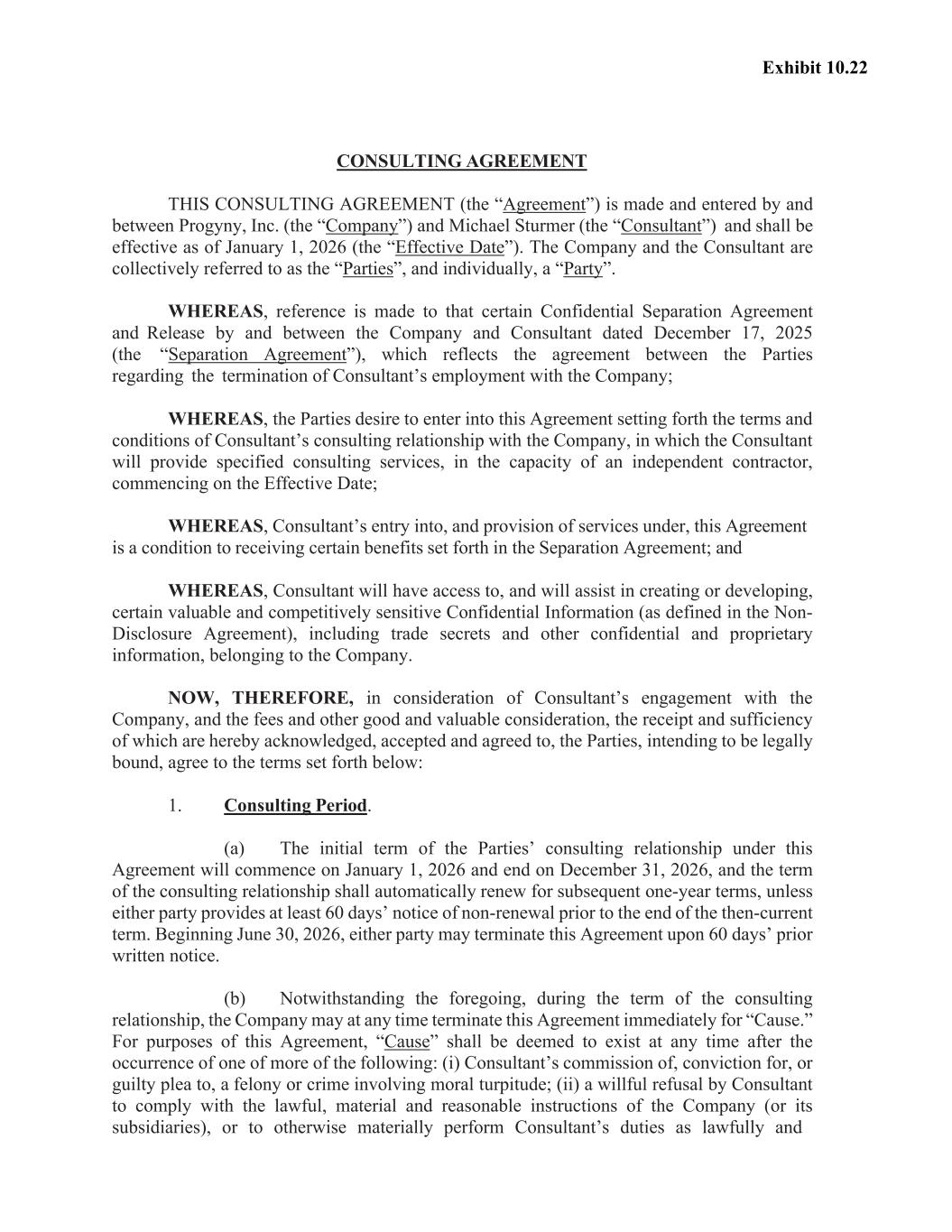
Exhibit 10.22 CONSULTING AGREEMENT THIS CONSULTING AGREEMENT (the “Agreement”) is made and entered by and between Progyny, Inc. (the “Company”) and Michael Sturmer (the “Consultant”) and shall be effective as of January 1, 2026 (the “Effective Date”). The Company and the Consultant are collectively referred to as the “Parties”, and individually, a “Party”. WHEREAS, reference is made to that certain Confidential Separation Agreement and Release by and between the Company and Consultant dated December 17, 2025 (the “Separation Agreement”), which reflects the agreement between the Parties regarding the termination of Consultant’s employment with the Company; WHEREAS, the Parties desire to enter into this Agreement setting forth the terms and conditions of Consultant’s consulting relationship with the Company, in which the Consultant will provide specified consulting services, in the capacity of an independent contractor, commencing on the Effective Date; WHEREAS, Consultant’s entry into, and provision of services under, this Agreement is a condition to receiving certain benefits set forth in the Separation Agreement; and WHEREAS, Consultant will have access to, and will assist in creating or developing, certain valuable and competitively sensitive Confidential Information (as defined in the Non- Disclosure Agreement), including trade secrets and other confidential and proprietary information, belonging to the Company. NOW, THEREFORE, in consideration of Consultant’s engagement with the Company, and the fees and other good and valuable consideration, the receipt and sufficiency of which are hereby acknowledged, accepted and agreed to, the Parties, intending to be legally bound, agree to the terms set forth below: 1. Consulting Period. (a) The initial term of the Parties’ consulting relationship under this Agreement will commence on January 1, 2026 and end on December 31, 2026, and the term of the consulting relationship shall automatically renew for subsequent one-year terms, unless either party provides at least 60 days’ notice of non-renewal prior to the end of the then-current term. Beginning June 30, 2026, either party may terminate this Agreement upon 60 days’ prior written notice. (b) Notwithstanding the foregoing, during the term of the consulting relationship, the Company may at any time terminate this Agreement immediately for “Cause.” For purposes of this Agreement, “Cause” shall be deemed to exist at any time after the occurrence of one of more of the following: (i) Consultant’s commission of, conviction for, or guilty plea to, a felony or crime involving moral turpitude; (ii) a willful refusal by Consultant to comply with the lawful, material and reasonable instructions of the Company (or its subsidiaries), or to otherwise materially perform Consultant’s duties as lawfully and

2 reasonably determined by the Company (or its subsidiaries), in each case that is not cured by Consultant (if such refusal is of a type that is capable of being cured) within 15 days of written notice being given to Consultant of such refusal; (iii) any willful act or acts of dishonesty undertaken by Consultant and intended to result in Consultant’s (or any other person’s) material gain or personal enrichment at the expense of the Company, its subsidiaries or any of its or their customers, partners, affiliates, or employees; (iv) any willful act of gross misconduct by Consultant which is injurious to the Company or its subsidiaries; (v) any material breach by Consultant of Consultant’s obligations under any agreement between Consultant and the Company or its subsidiaries, including, without limitation, this Agreement, that is not cured by Consultant (if such breach is of a type that is capable of being cured) within 15 days of written notice being given to Consultant of such breach; or (vi) or any material non-fulfillment of Consultant’s primary role duties, as set forth in Section 2 of this Agreement, including failure to work approximately 20 hours per week. (c) If this Agreement is terminated for any reason, Consultant will be entitled to receive only those Monthly Fees for Services rendered, if any, prior to the effective date of termination, pursuant to the terms and conditions set forth in Section 3 below, and no further amounts will be payable by the Company. 2. Consulting Services. During the term of this Agreement, the Company hereby engages Consultant, and Consultant hereby accepts, the Company’s engagement to provide the following services to the Company in the capacity of an independent contractor (the “Services”): (i) Consultant shall assist the Company with identification and development of new strategic partnerships; (ii) Consultant shall advise the Company on the execution of its growth strategy, including, but not limited to, M&A, expansion of the Company’s client base, and new product development; (iii) Consultant shall provide continued support to the Company on strategic initiatives; and (iv) Consultant shall perform such other services as may be mutually agreed upon by Consultant and the Company from time to time. Consultant is expected to work approximately twenty (20) hours weekly in connection with the provision of the Services. The Consultant shall have the discretion to determine the time of performance of the Services, provided that the Consultant agrees: (i) to maintain contact with the designated employees of the Company, and to make himself reasonably available to the Company to discuss the Services as may be requested by the Company from time to time; and (ii) to provide the Services in a timely manner in accordance with any deadlines set by the Company. 3. Compensation. (a) Monthly Fee. During the term of this Agreement, in consideration of the Services provided to the Company under this Agreement, the Company shall pay Consultant a monthly consulting fee, pro-rated for any partial months (the “Monthly Fee”), in the amount of $20,833.33 per month. (b) Stock Option Exercise Period. In the event Consultant performs the Services on a continuous basis between January 1, 2026 through December 31, 2026, then, as set forth in, and in accordance with, Section 3(a)(xii) of the Separation Agreement, for each two months of Services provided by Consultant pursuant to this Agreement between January
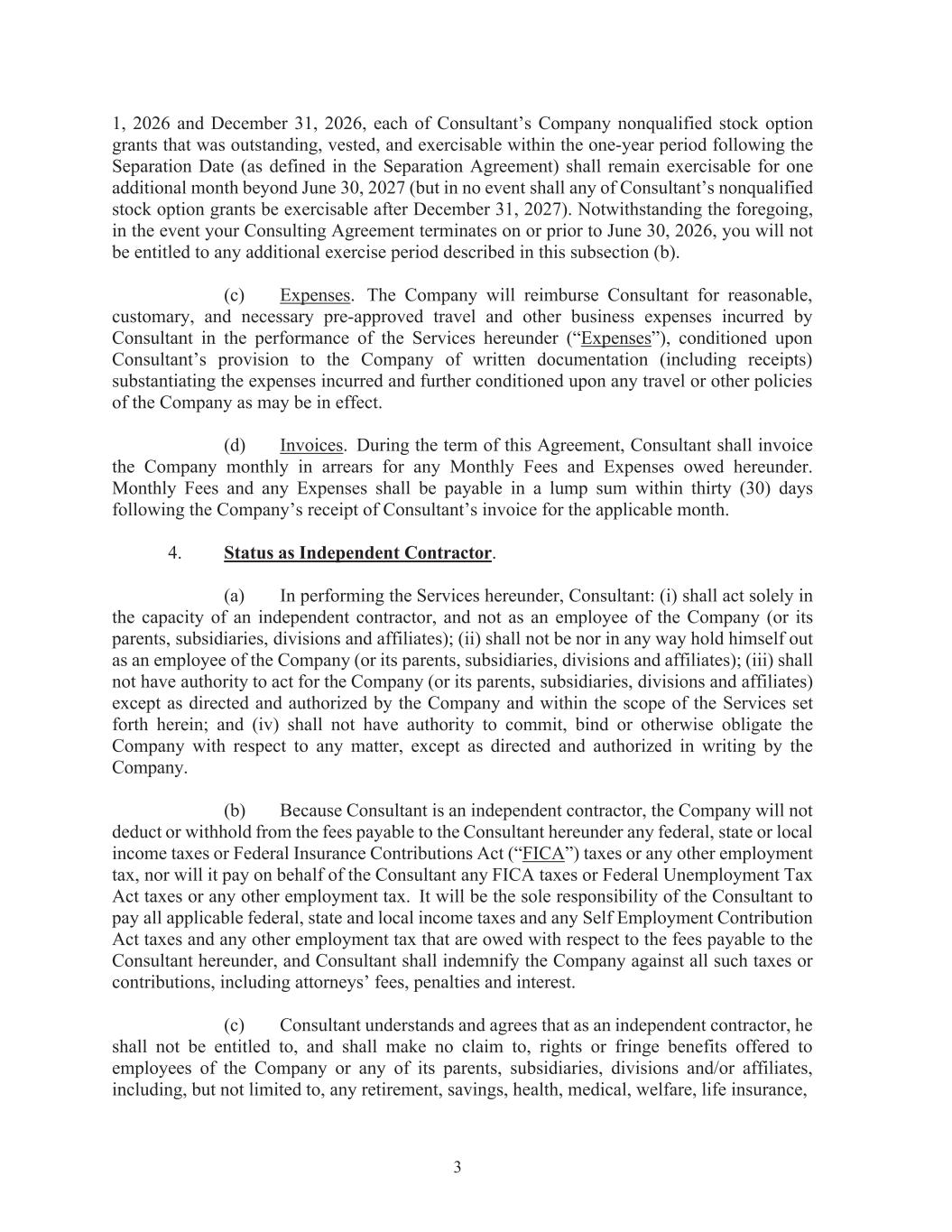
3 1, 2026 and December 31, 2026, each of Consultant’s Company nonqualified stock option grants that was outstanding, vested, and exercisable within the one-year period following the Separation Date (as defined in the Separation Agreement) shall remain exercisable for one additional month beyond June 30, 2027 (but in no event shall any of Consultant’s nonqualified stock option grants be exercisable after December 31, 2027). Notwithstanding the foregoing, in the event your Consulting Agreement terminates on or prior to June 30, 2026, you will not be entitled to any additional exercise period described in this subsection (b). (c) Expenses. The Company will reimburse Consultant for reasonable, customary, and necessary pre-approved travel and other business expenses incurred by Consultant in the performance of the Services hereunder (“Expenses”), conditioned upon Consultant’s provision to the Company of written documentation (including receipts) substantiating the expenses incurred and further conditioned upon any travel or other policies of the Company as may be in effect. (d) Invoices. During the term of this Agreement, Consultant shall invoice the Company monthly in arrears for any Monthly Fees and Expenses owed hereunder. Monthly Fees and any Expenses shall be payable in a lump sum within thirty (30) days following the Company’s receipt of Consultant’s invoice for the applicable month. 4. Status as Independent Contractor. (a) In performing the Services hereunder, Consultant: (i) shall act solely in the capacity of an independent contractor, and not as an employee of the Company (or its parents, subsidiaries, divisions and affiliates); (ii) shall not be nor in any way hold himself out as an employee of the Company (or its parents, subsidiaries, divisions and affiliates); (iii) shall not have authority to act for the Company (or its parents, subsidiaries, divisions and affiliates) except as directed and authorized by the Company and within the scope of the Services set forth herein; and (iv) shall not have authority to commit, bind or otherwise obligate the Company with respect to any matter, except as directed and authorized in writing by the Company. (b) Because Consultant is an independent contractor, the Company will not deduct or withhold from the fees payable to the Consultant hereunder any federal, state or local income taxes or Federal Insurance Contributions Act (“FICA”) taxes or any other employment tax, nor will it pay on behalf of the Consultant any FICA taxes or Federal Unemployment Tax Act taxes or any other employment tax. It will be the sole responsibility of the Consultant to pay all applicable federal, state and local income taxes and any Self Employment Contribution Act taxes and any other employment tax that are owed with respect to the fees payable to the Consultant hereunder, and Consultant shall indemnify the Company against all such taxes or contributions, including attorneys’ fees, penalties and interest. (c) Consultant understands and agrees that as an independent contractor, he shall not be entitled to, and shall make no claim to, rights or fringe benefits offered to employees of the Company or any of its parents, subsidiaries, divisions and/or affiliates, including, but not limited to, any retirement, savings, health, medical, welfare, life insurance,
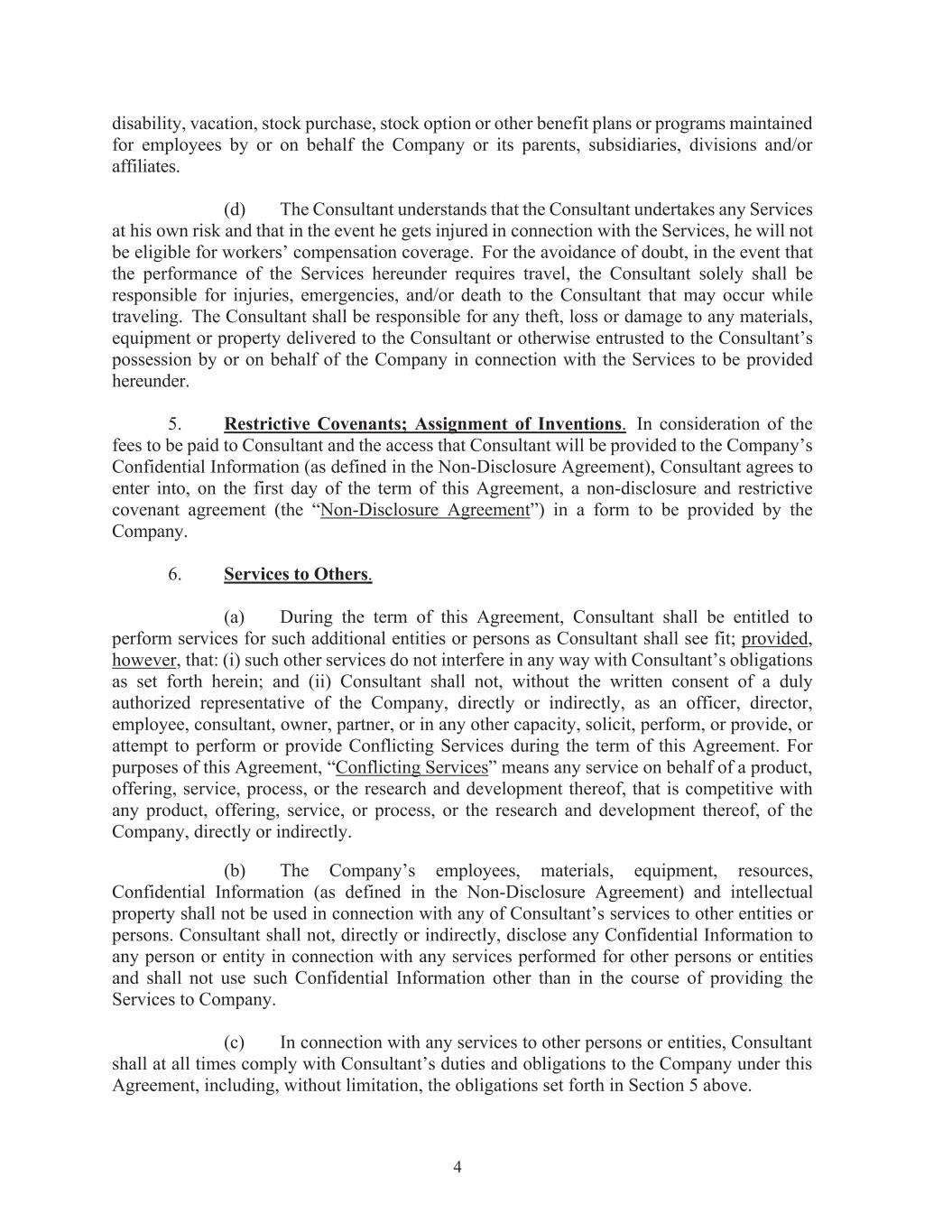
4 disability, vacation, stock purchase, stock option or other benefit plans or programs maintained for employees by or on behalf the Company or its parents, subsidiaries, divisions and/or affiliates. (d) The Consultant understands that the Consultant undertakes any Services at his own risk and that in the event he gets injured in connection with the Services, he will not be eligible for workers’ compensation coverage. For the avoidance of doubt, in the event that the performance of the Services hereunder requires travel, the Consultant solely shall be responsible for injuries, emergencies, and/or death to the Consultant that may occur while traveling. The Consultant shall be responsible for any theft, loss or damage to any materials, equipment or property delivered to the Consultant or otherwise entrusted to the Consultant’s possession by or on behalf of the Company in connection with the Services to be provided hereunder. 5. Restrictive Covenants; Assignment of Inventions. In consideration of the fees to be paid to Consultant and the access that Consultant will be provided to the Company’s Confidential Information (as defined in the Non-Disclosure Agreement), Consultant agrees to enter into, on the first day of the term of this Agreement, a non-disclosure and restrictive covenant agreement (the “Non-Disclosure Agreement”) in a form to be provided by the Company. 6. Services to Others. (a) During the term of this Agreement, Consultant shall be entitled to perform services for such additional entities or persons as Consultant shall see fit; provided, however, that: (i) such other services do not interfere in any way with Consultant’s obligations as set forth herein; and (ii) Consultant shall not, without the written consent of a duly authorized representative of the Company, directly or indirectly, as an officer, director, employee, consultant, owner, partner, or in any other capacity, solicit, perform, or provide, or attempt to perform or provide Conflicting Services during the term of this Agreement. For purposes of this Agreement, “Conflicting Services” means any service on behalf of a product, offering, service, process, or the research and development thereof, that is competitive with any product, offering, service, or process, or the research and development thereof, of the Company, directly or indirectly. (b) The Company’s employees, materials, equipment, resources, Confidential Information (as defined in the Non-Disclosure Agreement) and intellectual property shall not be used in connection with any of Consultant’s services to other entities or persons. Consultant shall not, directly or indirectly, disclose any Confidential Information to any person or entity in connection with any services performed for other persons or entities and shall not use such Confidential Information other than in the course of providing the Services to Company. (c) In connection with any services to other persons or entities, Consultant shall at all times comply with Consultant’s duties and obligations to the Company under this Agreement, including, without limitation, the obligations set forth in Section 5 above.
5 (d) Consultant represents and warrants to the Company that Consultant is not, and Consultant agrees that, during the term of this Agreement, Consultant shall not be, subject to any agreement, instrument, order or decree of any kind, or any other restrictive agreement of any character that would prevent Consultant from entering into this Agreement or which would be breached upon Consultant’s performance of the Services hereunder. 7. Insider Trading Policy. Consultant acknowledges and agrees that, at all times during the term of this Agreement, Consultant shall be subject to the Company’s Statement of Policy Concerning Trading in Company Securities, a copy of which is attached hereto as Exhibit A. 8. Return of Property. Consultant agrees that following the termination of the term of this Agreement: (i) Consultant shall deliver to the Company (and will not keep in Consultant’s possession or deliver to anyone else) documents and materials that relate in any way to the Services, including, but not limited to, devices, Confidential Information (as defined in the Non-Disclosure Agreement), records, data, notes, reports, proposals, lists, correspondence, specifications, drawings, blueprints, sketches, equipment, other documents or property, or reproductions of any of the aforementioned items developed by Consultant during the term of this Agreement or otherwise belonging to the Company; and/or (ii) if Consultant has used any non-Company computer, electronic device, server, storage drive, “cloud” account, or e-mail system to receive, store, review, prepare or transmit any Confidential Information, Consultant shall permanently delete and expunge such information, unless such deletion or expungement is prohibited by law. 9. Injunctive Relief; Tolling. Consultant expressly acknowledges and agrees that monetary damages shall not be a sufficient remedy for any breach or threatened breach by Consultant of Sections 5, 6, and/or 9 of this Agreement, and, in addition to any other remedies, the Company shall be entitled to seek specific performance and/or injunctive or other equitable relief without any requirement to post a bond or other security. As a remedy for any such breach or threatened breach, Consultant will reimburse the Company for all court costs and legal fees, including attorneys’ fees, incurred in enforcing Sections 5, 6, and/or 9 of this Agreement or obtaining any associated relief in connection with a breach or threatened breach of Sections 5, 6, and/or 9 herein. Consultant further acknowledges and agrees that the applicable period of each such restrictive covenant shall be tolled during any period of time in which Consultant is in breach or violation of the terms thereof, in order that the Company shall have all of the agreed-upon temporal protection thereunder. 10. Severability. It is the desire and intent of the Parties that the provisions of this Agreement shall be enforced to the fullest extent permissible under applicable law. If any one or more of the provisions contained in this Agreement is held to be excessively broad as to duration, scope, activity or subject, then the Parties agree that a court or arbitrator is expressly authorized to modify any such provision in lieu of severing the provision, whether by rewriting the offending provision, deleting any or all of the offending provision, adding additional language or by making such other modifications as it deems warranted to carry out the intent and agreement of the Parties as embodied herein to the maximum extent permitted by law. In the event that any one or more of the provisions of this Agreement shall be held to be invalid,
6 illegal or unenforceable and incapable of modification, the validity, legality and enforceability of the remainder of this Agreement shall not in any way be affected or impaired thereby. 11. Indemnification. (a) The Consultant shall indemnify and hold harmless the Company and its subsidiaries and affiliates, and their respective parents, subsidiaries, divisions and affiliates and each of their respective stockholders, directors, officers, employees and investors (collectively, the “Company Indemnified Parties”) from and against any and all losses, liabilities, claims, damages, costs and expenses (including attorneys’ fees), fines and penalties (“Losses”) suffered by the Company Indemnified Parties, directly or indirectly, arising from or relating to: (i) any breach by the Consultant of this Agreement; (ii) intentional or grossly negligent misconduct in the Consultant’s performance of the Services hereunder; and/or (iii) violation of any law, rule or regulation in connection with the Consultant’s performance of the Services. (b) Consultant represents and warrants that the Consultant: (i) shall perform the Services in a timely, good, professional and workmanlike manner and in accordance with high professional standards; (ii) shall perform the Services in compliance with all applicable laws, rules and regulations; and (iii) has the full legal right to enter into this Agreement. 12. Cooperation. Consultant and the Company agree that certain matters in which Consultant will be involved during Consultant’s engagement hereunder may necessitate Consultant’s assistance and cooperation with the Company in the future, both during and after the term of this Agreement. Accordingly, to the extent reasonably requested by the Company, Consultant agrees to assist the Company and cooperate fully in connection with matters arising out of Consultant’s engagement with the Company hereunder, both during and after the term of this Agreement. Such assistance and cooperation shall include, but not be limited to, requests for information and being available to speak with officers or employees of the Company and/or its counsel at reasonable times and locations, executing accurate and truthful documents and taking such other actions as may reasonably be requested by the Company and/or its counsel: (i) about the business of the Company or Consultant’s involvement and participation therein; (ii) in connection with the defense or prosecution of any claims or actions now in existence or which may be brought in the future against or on behalf of the Company which relate to events or occurrences that transpired during Consultant’s engagement with the Company hereunder or about which Consultant might have knowledge; and (iii) in connection with any investigation or review by any federal, state or local regulatory, quasi-regulatory or self-governing authority as any such investigation or review relates to events or occurrences that transpired during Consultant’s engagement with the Company or about which Consultant might have knowledge. The Company further agrees: (i) to reimburse Consultant for any reasonable, out-of-pocket travel, hotel and meal expenses (for the avoidance of doubt, such reimbursement does not include lost wages or earnings) incurred in connection with Consultant’s performance of obligations pursuant to this Section for which Consultant has obtained prior, written approval from the Company; and (ii) in the event Consultant’s obligations pursuant to this Section require a material time commitment outside the Services
7 contemplated under Section 2 above, the Company shall pay Consultant reasonable additional compensation to be negotiated in good faith and mutually agreed upon in advance. 13. Governing Law; Venue. This Agreement shall be governed by and construed and enforced in accordance with the laws of the State of New York, without giving effect to the conflict of law provisions thereof. Consultant and the Company agree to submit to the exclusive jurisdiction and forum of the state and/or federal courts located in the State of New York for any claim, dispute, action, or lawsuit in any way arising out of, relating to, or connected with this Agreement, and/or Consultant’s engagement by the Company or the cessation thereof. Consultant and the Company consent to such court(s) in New York as a convenient forum for any such claim, dispute, action, or lawsuit, and hereby waive any objection to the venue, forum, or jurisdiction for any such claim, dispute, action, or lawsuit proceeding in such court(s). Consultant and the Company agree that Consultant is subject to the jurisdiction of the courts located in the State of New York and may be served with legal process within the State of New York or in any other manner provided by law. CONSULTANT AND THE COMPANY EACH HEREBY WAIVE, AS AGAINST THE OTHER, TRIAL BY JURY IN ANY JUDICIAL PROCEEDING TO WHICH BOTH ARE PARTIES INVOLVING, DIRECTLY OR INDIRECTLY, ANY MATTER IN ANY WAY ARISING OUT OF, RELATED TO, OR CONNECTED WITH THIS AGREEMENT AND/OR CONSULTANT’S ENGAGEMENT BY THE COMPANY OR THE CESSATION THEREOF. 14. Successors; Binding Agreement. This Agreement may not be assigned by any Party without the prior written consent of the other Party, except that no consent is necessary for the Company to assign this Agreement to a member of the Company’s affiliated group or any corporation or other entity succeeding to all or substantially all of the assets or business of the Company, whether by merger, consolidation, stock purchase, exchange, asset purchase or otherwise, and, in each case of a permitted assignment by the Company, the “Company” under this Agreement shall be deemed to include such assignee or successor. Consultant may not subcontract or otherwise delegate or assign this Agreement or any of his respective obligations hereunder without the prior written consent of a duly authorized representative of the Company. This Agreement shall be binding upon and inure to the benefit of the heirs, successors and permitted assigns of the Parties. 15. Entire Agreement. This Agreement constitutes the entire agreement between the Parties pertaining specifically to the financial and other business-related terms concerning the consulting relationship between the Consultant and the Company, and fully supersedes any and all agreements, promises, covenants, arrangements, communications, representations or warranties, whether oral or written, by any officer, employee or representative of any Party hereto respecting this subject matter; provided, however, for the avoidance of doubt, nothing in this Agreement shall impair the Company’s or the Consultant’s obligations under any confidentiality, non-disparagement, non-competition, non-solicitation, intellectual property and other similar restrictions to which Consultant may be subject under a separate agreement between Consultant, on the one hand, and the Company and/or any other member of the Company’s affiliated group, on the other hand, which shall continue in full force and effect.
8 In addition, no amendment or modification to this Agreement shall be valid unless set forth in writing and signed by a duly authorized representative of each of the Parties. 16. No Waiver. Any waiver by the Company of a breach of any provision of this Agreement shall not operate or be construed as a waiver of any subsequent breach. 17. Survival. The provisions of Sections 4-12 of this Agreement shall survive the termination of the Consultant’s consulting relationship with the Company or any termination of this Agreement for any reason. 18. Headings. The headings used in this Agreement are intended for convenience or reference only and shall not in any manner amplify, limit, modify or otherwise be used in the construction or interpretation of any provision of this Agreement. 19. Third-Party Beneficiaries. Nothing in this Agreement, express or implied, is intended or shall be construed to create any third-party beneficiaries other than the members of the Company’s affiliated group. 20. Counterparts. This Agreement may be executed simultaneously in two or more counterparts, each of which shall be deemed an original, but all of which together shall constitute one and the same instrument. [remainder of page left intentionally blank; signature page to follow]
9 IN WITNESS WHEREOF, the Parties hereto have executed this Agreement as of the dates set forth below. PROGYNY, INC. By: /s/ Cassandra Pratt Date: 12/17/2025 Name: Cassandra Pratt Title: CHRO CONSULTANT /s/ Michael Sturmer Date: 12/17/2025 Michael Sturmer

10 Exhibit A Statement of Policy Concerning Trading in Company Securities [attached]
PROGYNY, INC. Statement of Policy Concerning Trading in Company Securities I. Summary of Policy Concerning Trading in Company Securities A. Restrictions on Trading in Company Securities It is the general policy of Progyny, Inc. and its subsidiaries (collectively, the “Company”) that it will, without exception, comply with all applicable laws and regulations in conducting its business; and that, when carrying out Company business, directors, officers, and employees must avoid any activity that violates applicable laws or regulations. To that end, when trading in Company securities, each director, officer, and employee of the Company and each other person listed below is expected to abide by this Statement of Policy Concerning Trading in Company Securities (such policy, the “Trading Policy”). In order to avoid even an appearance of impropriety, the Company’s directors, officers and certain other employees are subject to pre-approval requirements described below and other limitations on their ability to enter into transactions involving the Company’s securities. Although these limitations do not apply to transactions pursuant to written plans for trading securities that comply with Rule 10b5-1 under the Securities Exchange Act of 1934, as amended (the “Exchange Act”), the adoption, amendment, suspension or termination of any such written trading plan is subject to pre-approval requirements and other limitations detailed in Rule 10b5-1, including, but not limited to, applicable cooling-off periods and limitations on overlapping plans, as well as any requirements and guidelines adopted by the Company from time to time described in the Company’s Rule 10b5-1 Trading Plan Guidelines. B. Who is Subject to this Trading Policy Except where stated otherwise, this Trading Policy applies to the following individuals and entities, without regard to where they are located in the U.S. or internationally. We refer to these individuals and entities collectively as “Insiders”: • directors, officers, and employees of the Company and its subsidiaries; • contractors, consultants, and certain other persons who may have access to material non-public information of the Company; • spouses, domestic partners, parents, minor children, siblings, mothers and fathers-in-law, sons and daughters-in-law and brothers and sisters-in-law of such directors, officers or employees (collectively, “Family Members”); • persons who share a household with any director, officer or employee of the Company (regardless of whether or not such person is a Family Member); • anyone to whom directors, officers or employees provide significant financial support; and • unless otherwise determined by the Company, any entity or account over which the persons listed above, have or share the power, directly or indirectly, to make investment decisions (whether or not such persons have a financial interest in the entity or account) and those entities or accounts established or maintained by such persons with their consent or knowledge and in which such persons have a direct or indirect financial interest. Because of their access to confidential information on a regular basis, this Trading Policy subjects directors, officers and certain employees (the “Window Group”) to additional restrictions on trading in Company securities as discussed in Section II.C. below. In addition, directors, officers and certain employees with knowledge of material non-public information may be subject to ad hoc restrictions on trading from time to time. Updated as of: February 2025
2 Furthermore, the Company itself must comply with U.S. securities laws applicable to its own securities trading activities and will not effect transactions in respect of its securities, or adopt any securities repurchase plans, when it is in possession of material non-public information concerning the Company, other than in compliance with applicable law, subject to the policies and procedures adopted by the Company and attached as Exhibit A hereto, and the prior approval of the General Counsel. II. Prohibition on Trading in Securities While in Possession of Material Non-Public Information A. General Rule and What is Material U.S. federal securities laws prohibit Company’s Insiders from using information about the Company in the purchase and sale of securities, such as the Company’s shares of common stock, bonds, notes, debentures, limited partnership units or other equity or debt securities. For example, if an employee of a company learns material information through the course of their employment, they are prohibited from buying or selling securities (including the Company’s securities and the securities of other companies that could be impacted by such information) until such information has been adequately disclosed to the public. This is because such employee knows information that could cause the price of the security to change and has a duty to the company not to use the information for their personal gain. Trading on the basis of material non-public information is fraudulent and illegal. Civil and criminal penalties for this kind of activity are severe. Information is material if there is a substantial likelihood that a reasonable investor would consider it important in making an investment decision. Material information can be favorable or unfavorable. Courts and regulators often second-guess materiality determinations with the benefit of hindsight. If you have any uncertainty about whether non- public information is material, you should consult with the General Counsel and otherwise treat it as if it were material. Some examples of information that could be considered material include: • significant changes in the Company’s prospects or key performance indicators; • actual, anticipated or targeted revenue, earnings, dividends and other financial information; • operational developments that could affect the Company’s financial performance or forecasts, such as changes in the Company’s relationship (contractual or otherwise) with a key client or vendor; • financial, sales and other significant internal business forecasts or a change in previously released estimates; • pending or proposed mergers, business acquisitions, tender offers, joint ventures, restructurings, dispositions or the expansion or curtailment of operations; • significant cybersecurity or data protection events, including, but not limited to, any breach of information systems that compromises the functioning of the Company’s information or other systems or results in the exposure or loss of customer information; • proposed equity or debt offerings or significant borrowing; • changes in debt ratings or analyst upgrades or downgrades of the Company or one of its securities; • significant changes in accounting treatment, write-offs or effective tax rate or financial restatements; • pending or threatened significant litigation or governmental investigation or the resolution of such matters; • liquidity problems or impending bankruptcy;
3 • auditor notification that the Company may no longer rely on an audit report; • changes to the membership of board of directors or executive leadership; and • stock splits, repurchase plans or other corporate actions. In this Trading Policy, we use the term “non-public information” to refer to information that has not been publicly disclosed in a manner making it available to investors generally on a broad-based non-exclusionary basis (for example, the filing of a Form 8-K or issuance of a press release) and/or the investing public has not had time to fully absorb the information. If it is not clear whether material information has been sufficiently publicized, it should be treated as if it is non-public information. Furthermore, it is illegal for any Insider in possession of material non-public information to provide other people with such information or to recommend that they buy or sell the securities (this is called “tipping”). In that case, the tipper and the tippee may both be held liable. Information obtained in the course of employment or service as a director, contractor or consultant does not belong to individual Insiders who may handle it or otherwise become knowledgeable about it. The information is an asset of the Company. Any person who uses such information for personal benefit or discloses it to others outside the Company without authorization violates their confidentiality obligations to the Company and may be in breach of their fiduciary, loyalty or other duties to the Company. More particularly, trading on the basis of non-public information of the Company harms the Company and its investors. The Securities and Exchange Commission (the “SEC”), the Financial Industry Regulatory Authority (“FINRA”), prosecutors and plaintiffs’ lawyers devote considerable resources to identifying insider trading. A breach of the insider trading laws could expose an Insider or anyone who trades on information provided by an Insider to criminal fines and imprisonment, in addition to civil penalties and injunctive actions. Even if allegations of insider trading do not lead to a conviction, defending against such allegations is expensive. In addition, the mere perception that an Insider traded with the knowledge of material non-public information could harm the reputation of the Company and that Insider. Accordingly, this Trading Policy is in some cases more restrictive than what applicable insider trading laws might otherwise require. B. Guidelines The following guidelines should be followed to ensure compliance with applicable anti-fraud laws and with this Trading Policy and other applicable Company policies: 1. Nondisclosure. Material non-public information must not be disclosed to anyone, except to persons within the Company whose positions require them to know it or with prior approval of the General Counsel. No Insider should discuss material non-public information in public places or in common areas on Company property. 2. Trading in Company Securities. No Insider may place a purchase or sale order, or recommend that another person place a purchase or sale order, in the Company’s securities when such Insider has knowledge of material information concerning the Company that has not been disclosed to the public. This includes orders for purchases and sales of stock, convertible securities and other securities (e.g., bonds) and increasing or decreasing investment in Company securities through a retirement account. Except as provided in Section II.C.3. below, the exercise of employee stock options for cash and participating in the Company’s employee stock purchase plan are not subject to this Trading Policy. However, the purchase of stock upon the exercise of options and the sale of stock that was acquired upon exercise of a stock option will be treated like any other stock and may not be sold by an Insider who is in possession of material non-public information, including in a “cashless” exercise because this involves a market sale. Any Insider who possesses material non-public information should wait until after one full trading day after the information has been publicly released before trading, except as otherwise set forth in this Trading Policy or as otherwise directed by the General Counsel. There is no exception to this Trading Policy, even for hardship to the Insider or based on the use of proceeds (such as making a mortgage payment or for an emergency expenditure).
4 3. Trading in Another Company’s Securities. No Insider should place a purchase or sale order (including investment through a retirement account), or recommend that another person place a purchase or sale order, in the securities of another company, if the Insider learns in the course of their employment or service as a director, contractor or consultant material non-public information that is likely to affect the value of those securities. For example, it would be a violation of the securities laws if a Company employee learned through their role at the Company that the Company intended to amend or terminate a material client or vendor contract and then placed an order to buy or sell stock in that client or vendor company because of the likely increase or decrease in the value of its securities. 4. Avoid Speculation. Investing in the Company’s common stock or other securities provides an opportunity to share in the future growth of the Company. But investment in the Company and sharing in the growth of the Company does not mean short range speculation based on fluctuations in the market. Such activities put the personal gain of an Insider in conflict with the best interests of the Company and its stockholders. Although this Trading Policy does not mean that Insiders may never sell shares, the Company encourages Insiders to avoid frequent trading in Company stock. Speculating in Company stock is not part of the Company’s culture. C. Additional Restrictions on the Window Group 1. Window Group Defined. The Window Group consists of (i) directors and executive officers of the Company and their executive assistants and Family Members, (ii) certain employees who may have regular or specific access to material non-public information of the Company as a result of their positions with the Company and (iii) such other persons and entities as may be designated from time to time and informed of such status by the Company’s General Counsel. 2. Trading Window. Trading by the Window Group is permitted only after the completion of one full trading day following an earnings release with respect to the preceding fiscal period until the thirtieth calendar day prior to an earnings release for the then-current fiscal quarter, except for the fourth quarter of a fiscal year, in which case trading will be permitted until the last calendar day of the quarter (the “Window”). From time to time, the General Counsel may determine that no trades may occur even during the Window when clearance is requested. This may occur as a result of a material development that has not yet been publicly disclosed. No reasons may be provided, and the closing of the Window may itself constitute material non-public information that should not be communicated. 3. Pre-Clearance. All transactions by Window Group members, including the exercise of any options, are subject to prior review and clearance by the General Counsel. Notwithstanding pre-clearance, every person is individually responsible for their compliance with this Trading Policy and with applicable insider trading laws. The restrictions set forth in Sections II. B. and II.C. do not apply to transactions pursuant to written plans for trading securities that comply with Rule 10b5-1 under the Exchange Act (“10b5-1 Plans”). However, Window Group members may not enter into, amend or terminate a 10b5-1 Plan relating to Company securities without the prior approval of the General Counsel, which will only be given during a Window period and only if the Window Group member does not have knowledge of material non-public information. D. Hedging and Derivatives Insiders are prohibited from engaging in any derivative transactions (including transactions involving options, puts, calls, prepaid variable forward contracts, equity swaps, collars or other derivatives) that are designed to hedge or speculate on any change in the market value of the Company’s equity securities. As discussed below, Insiders are also prohibited from shorting the Company’s securities. Trading in options or other derivatives is generally highly speculative and very risky. Individuals who buy options are betting that the stock price will move rapidly. For that reason, when a person trades in options in their employer’s stock, it may arouse suspicion by the SEC that such person was trading on the basis of material non-public information,
5 particularly where the trading occurs before a company announcement or major event. It is difficult for a director, officer or employee to prove that they did not know about the announcement or event. If the SEC or FINRA were to notice active options trading by one or more directors, officers or employees of the Company prior to an announcement or event, they would likely investigate. Such an investigation could be embarrassing to the Company (as well as expensive) and could result in severe penalties and expense for the persons involved. For all of these reasons, the Company prohibits Insiders from engaging in derivative transactions as described above involving the Company’s stock. E. Pledging of Securities, Margin Accounts Pledged securities may be sold by the pledgee without the pledgor’s consent under certain conditions. For example, securities held in a margin account may be sold by a broker without the customer’s consent if the customer fails to meet a margin call. Because such a sale may occur at a time when an Insider has material non-public information or is otherwise not permitted to trade in Company securities, the Company prohibits Insiders from pledging Company securities under any circumstance, including by purchasing Company securities on margin or holding Company securities in a margin account. F. Applicability of U.S. Securities Laws to International Transactions All Insiders of the Company, which includes its domestic and international subsidiaries, are subject to this Trading Policy. In addition, U.S. securities laws may be applicable to trades in the Company’s securities executed outside the United States or by an employee is located outside the United States. Transactions involving securities of subsidiaries or affiliates should be carefully reviewed by outside legal counsel for compliance not only with applicable local law but also for possible application of U.S. securities laws. G. Gifts of Securities Unless otherwise approved by the General Counsel in limited circumstances, gifts of Company securities should only be made (i) when an Insider is not in possession of material non-public information and (ii) during a Window. Gifts of Company securities are otherwise subject to this Trading Policy, including the guidelines and restrictions set forth under sections II.B. and II.C. H. Affiliated Fund Sales and Distributions Sales and distributions of Company securities by a venture capital partnership, private equity fund or other similar entity with which a Company director is affiliated to its partners, members or other similar persons are generally subject to this Trading Policy, unless the entity provides evidence satisfactory to the General Counsel that such entity has adequate policies and procedures in place to ensure that individuals making investment decisions on its behalf would not violate insider trading laws. It is the responsibility of each affected director and the affiliated entity, in consultation with their own counsel, to determine the process and timing for any such sales or distributions based on all relevant facts and circumstances and applicable securities laws. I. Applicability Following Termination of Employment, Service or Affiliation The prohibition on trading in the Company’s securities or in the securities of another Company while in possession of material non-public information continues even after an Insider’s employment, service or affiliation with the Company terminates. Insiders whose employment, service or affiliation with the Company terminates will continue to be subject to the additional restrictions of this Trading Policy until the later of (i) completion of one full trading day following the first earnings release after an Insider’s last day of employment, service or affiliation or (ii) ninety days after an Insider’s last day of employment, service or affiliation.
Exhibit A Company Trading Policies and Procedures These policies and procedures govern repurchases of the Company’s equity securities (“Repurchases”) approved from time to time by the Board of Directors (the “Board”) of the Company to help ensure that such Repurchases are not made, or a share repurchase plan is not adopted, when the Company is in possession of material non-public information concerning the Company (“MNPI”). Capitalized terms used but not defined herein have the respective meanings given to them in the Company’s Trading Policy. 1. Policy. It is the Company’s policy that no Repurchases may take place outside a Window or when the Company is otherwise in possession of MNPI, other than Repurchases made pursuant to a Rule 10b5-1 Plan or otherwise in compliance with applicable law. 2. Trading Activity. Any Repurchases (other than Repurchases made pursuant to a Rule 10b5-1 Plan), or the adoption of a Rule 10b5-1 Plan to effect Repurchases, shall be subject to the following procedures: (a) The adoption of a Rule 10b5-1 Plan shall be subject to prior written approval by the General Counsel. The General Counsel shall take such steps as they deem reasonably necessary to ascertain that the Company is not in possession of MNPI at the time of plan adoption, including, but not limited to, consulting with other members of senior management (each, an “Authorized Officer”) and/or outside legal counsel. (b) With respect to Repurchases that have been approved by the Board, if at any time during the period such Repurchases are scheduled to take place, the General Counsel or any Authorized Officer become aware of any MNPI, they shall notify the relevant employee(s) at the Company responsible for effecting Repurchases as soon as practicable to suspend such Repurchases. (c) Once the General Counsel and such Authorized Officer are satisfied that, to their knowledge, the Company is no longer in possession of MNPI, they shall notify the relevant employee(s) that the Company may resume its Repurchases. 3. Recordkeeping. The General Counsel shall maintain a record of the communications referred to in these policies and procedures in compliance with the Company’s recordkeeping policies. 4. Training. Company directors, officers and employees who are involved in the Company’s securities trading activities shall be provided training on the Trading Policy and these policies and procedures consistent with the Company’s employee training policies. 5. Modification or Waiver. These policies and procedures may be modified, and specific requirements therein may be waived, subject to approval by the General Counsel if they deem such modifications or waivers are appropriate based on particular facts and circumstances and in compliance with applicable law. 6. Amendments. These policies and procedures may be reviewed periodically as determined by the General Counsel. Any material amendments to these policies and procedures shall require the approval of the General Counsel. A-1
Supplement to Trading Policy Other Limitations on Securities Transactions A. Public Resales – Rule 144 The Securities Act of 1933, as amended (the “Securities Act”) requires every person who offers or sells a security to register such transaction with the SEC unless an exemption from registration is available. Rule 144 under the Securities Act is the exemption typically relied on for (i) public resales by any person of “restricted securities” (i.e., unregistered securities acquired in a private offering or sale) and (ii) public resales by directors, officers and other control persons of a company (known as “affiliates”) of any of the Company’s securities, whether restricted or unrestricted. The exemption in Rule 144 may only be relied on if certain conditions are met. These conditions vary based on whether the Company has been subject to the SEC’s reporting requirements for 90 days (and is therefore a “reporting company” for purposes of the rule) and whether the person seeking to sell the securities is an affiliate or not. Application of the rule is complex and directors, officers and employees of the Company should not make a sale of Company securities in reliance on Rule 144 without obtaining the approval of the General Counsel, who may require the director, officer or employee to obtain an outside legal opinion satisfactory to the General Counsel concluding that the proposed sale qualifies for the Rule 144 exemption. 1. Holding Period. Restricted securities issued by a reporting company (i.e., a company that has been subject to the SEC’s reporting requirements for at least 90 days) must be held, and fully paid, for a period of six months prior to their sale. Restricted securities issued by a non-reporting company are subject to a one-year holding period. The holding period requirement does not apply to securities held by affiliates that were acquired either in the open market or in a public offering of securities registered under the Securities Act. Generally, if the seller acquired the securities from someone other than the Company or an affiliate of the Company, the holding period of the person from whom the seller acquired such securities can be “tacked” to the seller’s holding period in determining if the holding period has been satisfied. 2. Current Public Information. Current information about the Company must be publicly available before the sale can be made. The Company’s periodic reports filed with the SEC ordinarily satisfy this requirement. If the seller is not an affiliate of the Company (and has not been an affiliate for at least three months) and one year has passed since the securities were acquired from the Company or an affiliate of the Company (whichever is later), the seller can sell the securities without regard to the current public information requirement. Rule 144 also imposes the following additional conditions on sales by persons who are “affiliates.” A person or entity is considered an “affiliate,” and therefore subject to these additional conditions, if it is currently an affiliate or has been an affiliate within the previous three months: 1. Volume Limitations. The amount of debt securities that can be sold by an affiliate and by certain persons associated with the affiliate during any three-month period cannot exceed 10% of a tranche (or class when the securities are non-participatory preferred stock), together with all sales of securities of the same tranche sold for the account of the affiliate. The amount of equity securities that can be sold by an affiliate during any three-month period cannot exceed the greater of (i) one percent of the outstanding shares of the class of equity securities or (ii) the average weekly reported trading volume for shares of the class during the four calendar weeks preceding the time the order to sell is received by the broker or executed directly with a market maker. 2. Manner of Sale. Equity securities held by affiliates must be sold in unsolicited brokers’ transactions directly to a market-maker or in riskless principal transactions. 3. Notice of Sale. An affiliate seller must file a notice of the proposed sale with the SEC at the time the order to sell is placed with the broker, unless the amount to be sold neither exceeds 5,000 shares nor involves sale proceeds greater than $50,000. See “Filing Requirements” below.
Bona fide gifts are not deemed to involve sales of shares for purposes of Rule 144, so they can be made without limitation on the amount of the gift, subject to the terms of the Company’s Trading Policy and in compliance with applicable law. Donees who receive restricted securities from an affiliate generally will be subject to the same restrictions under Rule 144 that would have applied to the donor, depending on the circumstances. B. Private Resales Directors and officers also may sell securities in a private transaction without registration pursuant to Section 4(a)(7) of the Securities Act, which allows resales of shares of reporting companies to accredited investors, provided that the sale is not solicited by any form of general solicitation or advertising. There are a number of additional requirements, including that the seller and persons participating in the sale on a remunerated basis are not “bad actors” under Rule 506(d)(1) of Regulation D or otherwise subject to certain statutory disqualifications; the Company is engaged in a business and not in bankruptcy; and the securities offered have been outstanding for at least 90 days and are not part of an unsold underwriter’s allotment. Private resales must be reviewed in advance by the Company’s General Counsel and may require the participation of outside legal counsel. C. Restrictions on Purchases of Company Securities In order to prevent market manipulation, the SEC adopted Regulation M under the Securities Exchange Act of 1934, as amended (the “Exchange Act”). Regulation M generally restricts the Company or any of its affiliates from buying Company stock, including as part of a share repurchase program, in the open market during certain periods while a distribution, such as a public offering, is taking place. You should consult with the Company’s General Counsel if you desire to make purchases of Company stock during any period in which the Company is conducting an offering. Similar considerations may apply during periods when the Company is conducting or has announced a tender offer. D. Disgorgement of Profits on Short-Swing Transactions – Section 16(b) Section 16 of the Exchange Act applies to directors and executive officers of the Company and to any person owning more than ten percent (10%) of any registered class of the Company’s equity securities. Section 16 is intended to deter such persons (collectively referred to below as “Section 16 insiders”) from misusing confidential information about their companies for personal trading gain. Section 16(a) requires Section 16 insiders to publicly disclose any changes in their beneficial ownership of the Company’s equity securities (see “Filing Requirements” below). Section 16(b) requires Section 16 insiders to disgorge to the Company any “profit” resulting from “short-swing” transactions, as discussed more fully below. Section 16(c) effectively prohibits Section 16 insiders from engaging in short sales (see “Prohibition of Short Sales” below). Under Section 16(b), any profit realized by an insider on a “short-swing” transaction (i.e., a purchase and sale, or sale and purchase, of the Company’s equity securities within a period of less than six months) must be disgorged to the Company upon demand by the Company or a stockholder acting on its behalf. By law, the Company cannot waive or release any claim it may have under Section 16(b) or enter into an enforceable agreement to provide indemnification for amounts recovered under such section. Liability under Section 16(b) is imposed in a mechanical fashion without regard to whether the Section 16 insider intended to violate the section. Good faith, therefore, is generally not a defense. All that is necessary for a successful claim is to show that the insider realized “profits” on a short-swing transaction; however, profit, for this purpose, is calculated as the difference between the sale price and the purchase price in the matching transactions and may be unrelated to the actual gain on the shares sold. When computing recoverable profits on multiple purchases and sales within a six-month period, the courts maximize the recovery by matching the lowest purchase price with the highest sale price, the next lowest purchase price with the next highest sale price, and so on. The use of this method makes it possible for an insider to sustain a net loss on a series of transactions while having recoverable profits. The terms “purchase” and “sale” are interpreted under Section 16(b) to cover a broad range of transactions, including acquisitions and dispositions in tender offers, certain corporate reorganizations and transactions in convertible or derivative securities (such as stock options and stock appreciation rights). Moreover, purchases and sales by an insider
may be matched with transactions by any person (such as certain family members or a family trust) whose securities are deemed to be beneficially owned by the insider. The Section 16 rules are complicated and present ample opportunity for inadvertent error. To avoid unnecessary costs and potential embarrassment for Section 16 insiders and the Company, directors and executive officers are strongly urged to consult with the Company’s General Counsel prior to engaging in any transaction or other transfer of Company equity securities regarding the potential applicability of Section 16(b). E. Prohibition of Short Sales Under Section 16(c), Section 16 insiders are prohibited from effecting “short sales” of the Company’s equity securities. A “short sale” is one involving securities, which the seller does not own at the time of sale, or, if owned, are not delivered within 20 days after the sale or deposited in the mail or other usual channels of transportation within five days after the sale. Apart from Section 16(c), the Company prohibits directors, officers and employees from short selling the Company’s stock. This type of activity is inherently speculative in nature and is contrary to the best interests of the Company and its stockholders. F. Filing Requirements 1. Form 3, 4 and 5. Under Section 16(a) of the Exchange Act, Section 16 insiders must file with the SEC public reports disclosing their holdings of, and transactions involving, the Company’s equity securities. An initial report on Form 3 must be filed by every Section 16 insider within 10 days after election or appointment disclosing all equity securities of the Company beneficially owned by the reporting person on the date they became an insider. Even if no securities were owned on that date, the insider must file a Form 3. Any subsequent change in the nature or amount of beneficial ownership by the insider must be reported on Form 4 and filed by the end of the second business day following the date of the transaction. The Form 4 filing requirement and filing deadline also applies to any donation or gift of company equity securities by the insider, regardless of the recipient. Certain exempt transactions may be reported on Form 5 within 45 days after the end of the fiscal year. The fact that an insider’s transactions during the month resulted in no net change, or the fact that no securities were owned after the transactions were completed, does not provide a basis for failing to report. All changes in the amount or the form (i.e., direct or indirect) of beneficial ownership (not just purchases and sales) must be reported. Thus, transactions such as gifts ordinarily are reportable. Moreover, a director or officer who has ceased to be a director or officer must report any transactions after termination which occurred within six months of a transaction that occurred while the person was an insider. Form 4 also must reflect the insider’s holdings immediately after the reported transaction, so it is important to maintain an accurate account of the insider’s holdings over time. The reports under Section 16(a) are intended to cover all securities beneficially owned either directly by the insider or indirectly through others. An insider is considered the direct owner of all Company equity securities held in their own name or held jointly with others. An insider is considered the indirect owner of any securities from which they obtain benefits substantially equivalent to those of ownership. Thus, equity securities of the Company beneficially owned through partnerships, corporations, trusts, estates and by family members generally are subject to reporting. Absent countervailing facts, an insider is presumed to be the beneficial owner of securities held their spouse and other family members sharing the same household. But an insider is free to disclaim beneficial ownership of these or any other securities being reported if the insider believes there is a reasonable basis for doing so. It is important that reports under Section 16(a) be prepared properly and filed on a timely basis. The reports must be received at the SEC by the filing deadline. There is no provision for an extension of the filing deadlines, and the SEC can take enforcement action against Section 16 insiders who do not comply fully with the filing requirements. In addition, the Company is required to disclose in its annual proxy statement the names of Section 16 insiders who failed to file Section 16(a) reports properly during the fiscal year, along with the particulars of such instances of noncompliance. Accordingly, all directors and officers must notify the Company’s General Counsel, prior to any transactions or changes in their or their family members’

beneficial ownership involving Company stock and are strongly encouraged to avail themselves of the assistance available from the Company’s legal department in satisfying the reporting requirements. 2. Form 144. As described above under the discussion of Rule 144, an affiliate seller relying on Rule 144 must file a notice of proposed sale with the SEC at the time the order to sell is placed with the broker unless the amount to be sold during any three-month period neither exceeds 5,000 shares nor involves sale proceeds greater than $50,000.
Exhibit 23.1
Consent of Independent Registered Public Accounting Firm
We consent to the incorporation by reference in the following Registration Statements:
(1) Registration Statement on Form S-8 (No. 333-285523) pertaining to the following plans:
•2019 Equity Incentive Plan
•2019 Employee Stock Purchase Plan
(2) Registration Statement on Form S-8 (No. 333-277528) pertaining to the following plans:
•2019 Equity Incentive Plan
•2019 Employee Stock Purchase Plan
(3) Registration Statement on Form S-8 (No. 333-270198) pertaining to the following plans:
•2019 Equity Incentive Plan
•2019 Employee Stock Purchase Plan
(4) Registration Statement on Form S-8 (No. 333-263240) pertaining to the following plans:
•2019 Equity Incentive Plan
•2019 Employee Stock Purchase Plan
(5) Registration Statement on Form S-8 (No. 333-253787) pertaining to the following plans:
•2019 Equity Incentive Plan
•2019 Employee Stock Purchase Plan
(6) Registration Statement on Form S-8 (No. 333-237072) pertaining to the following plans:
•2019 Equity Incentive Plan
(7) Registration Statement on Form S-8 (No. 333-234342) pertaining to the following plans:
•2019 Equity Incentive Plan
•2019 Employee Stock Purchase Plan
•2017 Equity Incentive Plan
•2008 Stock Plan
of our reports dated February 27, 2026, with respect to the consolidated financial statements of Progyny, Inc. and the effectiveness of internal control over financial reporting of Progyny, Inc. included in this Annual Report (Form 10-K) of Progyny, Inc. for the year ended December 31, 2025.
/s/ Ernst & Young LLP
New York, New York
February 27, 2026
Exhibit 31.1
CERTIFICATION
I, Peter Anevski, certify that:
1.I have reviewed this Annual Report on Form 10-K of Progyny, Inc.;
2.Based on my knowledge, this report does not contain any untrue statement of a material fact or omit to state a material fact necessary to make the statements made, in light of the circumstances under which such statements were made, not misleading with respect to the period covered by this report;
3.Based on my knowledge, the financial statements, and other financial information included in this report, fairly present in all material respects the financial condition, results of operations and cash flows of the registrant as of, and for, the periods presented in this report;
4.The registrant's other certifying officer(s) and I are responsible for establishing and maintaining disclosure controls and procedures (as defined in Exchange Act Rules 13a-15(e) and 15d-15(e)) and internal control over financial reporting (as defined in Exchange Act Rules 13a-15(f) and 15d-15(f)) for the registrant and have:
a.Designed such disclosure controls and procedures, or caused such disclosure controls and procedures to be designed under our supervision, to ensure that material information relating to the registrant, including its consolidated subsidiaries, is made known to us by others within those entities, particularly during the period in which this report is being prepared;
b.Designed such internal control over financial reporting, or caused such internal control over financial reporting to be designed under our supervision, to provide reasonable assurance regarding the reliability of financial reporting and the preparation of financial statements for external purposes in accordance with generally accepted accounting principles;
c.Evaluated the effectiveness of the registrant's disclosure controls and procedures and presented in this report our conclusions about the effectiveness of the disclosure controls and procedures, as of the end of the period covered by this report based on such evaluation; and
d.Disclosed in this report any change in the registrant's internal control over financial reporting that occurred during the registrant's most recent fiscal quarter (the registrant’s fourth fiscal quarter in the case of an annual report) that has materially affected, or is reasonably likely to materially affect, the registrant's internal control over financial reporting; and
5.The registrant's other certifying officer(s) and I have disclosed, based on our most recent evaluation of internal control over financial reporting, to the registrant's auditors and the audit committee of the registrant's board of directors (or persons performing the equivalent functions):
a.All significant deficiencies and material weaknesses in the design or operation of internal control over financial reporting which are reasonably likely to adversely affect the registrant's ability to record, process, summarize and report financial information; and
b.Any fraud, whether or not material, that involves management or other employees who have a significant role in the registrant's internal control over financial reporting.
Date: February 27, 2026 | By: | /s/ Peter Anevski | |||||||||
| Peter Anevski | |||||||||||
Chief Executive Officer (principal executive officer) | |||||||||||
Exhibit 31.2
CERTIFICATION
I, Mark Livingston, certify that:
1.I have reviewed this Annual Report on Form 10-K of Progyny, Inc.;
2.Based on my knowledge, this report does not contain any untrue statement of a material fact or omit to state a material fact necessary to make the statements made, in light of the circumstances under which such statements were made, not misleading with respect to the period covered by this report;
3.Based on my knowledge, the financial statements, and other financial information included in this report, fairly present in all material respects the financial condition, results of operations and cash flows of the registrant as of, and for, the periods presented in this report;
4.The registrant's other certifying officer(s) and I are responsible for establishing and maintaining disclosure controls and procedures (as defined in Exchange Act Rules 13a-15(e) and 15d-15(e)) and internal control over financial reporting (as defined in Exchange Act Rules 13a-15(f) and 15d-15(f)) for the registrant and have:
a.Designed such disclosure controls and procedures, or caused such disclosure controls and procedures to be designed under our supervision, to ensure that material information relating to the registrant, including its consolidated subsidiaries, is made known to us by others within those entities, particularly during the period in which this report is being prepared;
b.Designed such internal control over financial reporting, or caused such internal control over financial reporting to be designed under our supervision, to provide reasonable assurance regarding the reliability of financial reporting and the preparation of financial statements for external purposes in accordance with generally accepted accounting principles;
c.Evaluated the effectiveness of the registrant's disclosure controls and procedures and presented in this report our conclusions about the effectiveness of the disclosure controls and procedures, as of the end of the period covered by this report based on such evaluation; and
d.Disclosed in this report any change in the registrant's internal control over financial reporting that occurred during the registrant's most recent fiscal quarter (the registrant’s fourth fiscal quarter in the case of an annual report) that has materially affected, or is reasonably likely to materially affect, the registrant's internal control over financial reporting; and
5.The registrant's other certifying officer(s) and I have disclosed, based on our most recent evaluation of internal control over financial reporting, to the registrant's auditors and the audit committee of the registrant's board of directors (or persons performing the equivalent functions):
a.All significant deficiencies and material weaknesses in the design or operation of internal control over financial reporting which are reasonably likely to adversely affect the registrant's ability to record, process, summarize and report financial information; and
b.Any fraud, whether or not material, that involves management or other employees who have a significant role in the registrant's internal control over financial reporting.
Date: February 27, 2026 | By: | /s/ Mark Livingston | |||||||||
| Mark Livingston | |||||||||||
Chief Financial Officer (principal financial officer) | |||||||||||
Exhibit 32.1
CERTIFICATION PURSUANT TO
18 U.S.C. SECTION 1350, AS ADOPTED PURSUANT TO
SECTION 906 OF THE SARBANES-OXLEY ACT OF 2002
In connection with the Annual Report on Form 10-K of Progyny, Inc. (the “Company”) for the period ended December 31, 2025, as filed with the Securities and Exchange Commission on the date hereof (the “Report”), I, hereby certify, pursuant to 18 U.S.C. Section 1350, as adopted pursuant to Section 906 of the Sarbanes-Oxley Act of 2002, as amended, that, to my knowledge:
(1)the Report fully complies with the requirements of Section 13(a) or 15(d) of the Securities Exchange Act of 1934, as amended; and
(2)the information contained in the Report fairly presents, in all material respects, the financial condition and results of operations of the Company.
Date: February 27, 2026 | By: | /s/ Peter Anevski | |||||||||
| Peter Anevski | |||||||||||
Chief Executive Officer (principal executive officer) | |||||||||||
Exhibit 32.2
CERTIFICATION PURSUANT TO
18 U.S.C. SECTION 1350, AS ADOPTED PURSUANT TO
SECTION 906 OF THE SARBANES-OXLEY ACT OF 2002
In connection with the Annual Report on Form 10-K of Progyny, Inc. (the “Company”) for the period ended December 31, 2025, as filed with the Securities and Exchange Commission on the date hereof (the “Report”), I, hereby certify, pursuant to 18 U.S.C. Section 1350, as adopted pursuant to Section 906 of the Sarbanes-Oxley Act of 2002, as amended, that to my knowledge:
(1)the Report fully complies with the requirements of Section 13(a) or 15(d) of the Securities Exchange Act of 1934, as amended; and
(2)the information contained in the Report fairly presents, in all material respects, the financial condition and results of operations of the Company.
Date: February 27, 2026 | By: | /s/ Mark Livingston | |||||||||
| Mark Livingston | |||||||||||
Chief Financial Officer (principal financial officer) | |||||||||||